




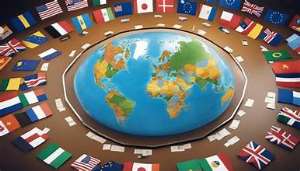
Historical Background: Ghana’s Diplomatic Engagement with the World
Since gaining independence in 1957, Ghana has pursued a foreign policy deeply rooted in sovereignty, Pan-African solidarity, and principled engagement with the international community. As the first sub-Saharan African country to break free from colonial rule in the modern era, Ghana entered the global stage with a strong vision of diplomacy shaped by its founding leader, Kwame Nkrumah. Nkrumah viewed diplomacy not merely as a tool for national interest but as an instrument for continental liberation and global justice.
At the height of the Cold War, when global politics was sharply divided between Western and Eastern blocs, Ghana deliberately avoided becoming entangled in ideological rivalries. Instead, it embraced the doctrine of Non-Aligned Movement, joining other newly independent states in advocating for strategic neutrality and peaceful coexistence. This approach allowed Ghana to maintain constructive relations with diverse global powers while safeguarding its independence in foreign policy decisions.
Ghana’s diplomatic posture during this period was also strongly linked to the ideals of Pan-Africanism. Under Nkrumah’s leadership, the country actively supported liberation movements across the African continent and played a central role in the establishment of the Organization of African Unity, now known as the African Union. Through these initiatives, Ghana positioned itself as a champion of collective African diplomacy and regional cooperation.
Over the decades, Ghana has maintained this tradition of balanced international engagement. Successive governments have cultivated strong bilateral and multilateral relationships with countries across Europe, Asia, the Middle East, and the Americas, while simultaneously deepening regional partnerships within Africa. The country has also distinguished itself as a reliable contributor to global peace and security through its participation in **United Nations peacekeeping operations, earning international recognition for its commitment to conflict resolution and humanitarian diplomacy.
Today, Ghana’s diplomatic identity reflects a careful blend of historical principles and contemporary pragmatism. Its foreign policy continues to emphasize non-alignment, respect for international law, and multilateral cooperation—principles that enable the country to engage constructively with the world while maintaining an independent voice in global affairs. In an era of renewed geopolitical tensions, this legacy remains a vital guide for Ghana’s engagement with complex international conflicts and diplomatic pressures.
In the turbulent theatre of international politics, moments arise when smaller states are confronted with choices that test not only their diplomacy but their national sovereignty. The escalating tensions between Israel and Iran present precisely such a moment for Ghana, a country whose foreign policy tradition has long been anchored in peace, non-alignment, and principled multilateralism.
As global powers mobilize alliances and shape narratives around the conflict, Ghana must tread cautiously. The stakes are not merely diplomatic. They involve the preservation of Ghana’s independent voice in international relations and the safeguarding of a foreign policy legacy rooted in sovereignty and balance.
The Weight of Diplomatic Pressure
Recent diplomatic exchanges illustrate the complexity of the moment. Israel’s ambassador to Ghana, Roey Gilad, has publicly encouraged Ghana to reconsider its long-standing policy of non-alignment in light of Israel’s confrontation with Iran. He has argued that global security concerns should prompt Ghana to reassess its traditional diplomatic posture and support international pressure against Tehran, according to a publication by MyJoyOnline.
While such appeals are part of the normal choreography of diplomacy, Ghana’s response must remain guided by its national interest rather than external persuasion. Others have already reaffirmed that the country’s foreign policy decisions will not be dictated by outside actors, emphasizing that neutrality and respect for international law remain central to its diplomatic philosophy, as published by MyNewsGh.
This exchange is a reminder that diplomacy often operates in a space where persuasion and pressure coexist. For Ghana, the challenge is to maintain equilibrium—engaging all parties constructively while resisting any attempt to draw it into geopolitical rivalries far beyond its immediate interests.
Ghana’s Legacy of Non-Alignment
Ghana’s cautious approach to global conflicts is not accidental; it is deeply rooted in its diplomatic history. Since its independence in 1957, the country has embraced a policy of non-alignment, positioning itself as a bridge rather than a battleground in international politics.
This tradition reflects the broader philosophy of many post-colonial states that sought to avoid becoming pawns in great-power competition. By maintaining strategic neutrality, Ghana has been able to cultivate relations across ideological divides—engaging Western powers, Middle Eastern states, and emerging economies without compromising its autonomy. Neutrality, in this sense, is not passivity. It is a strategic choice that allows Ghana to contribute to international peace while preserving diplomatic flexibility.
The Strategic Value of Neutrality
In the context of the Israel–Iran rivalry, neutrality serves several important functions for Ghana.
First, it protects Ghana’s diplomatic credibility. A state that is perceived as impartial is better positioned to advocate for dialogue, mediation, and conflict resolution. In an era where polarized alliances dominate global politics, neutral voices are increasingly rare—and therefore valuable.
Second, neutrality shields Ghana from the spillover effects of distant conflicts. The Israel–Iran confrontation is deeply embedded in complex regional dynamics involving proxies, alliances, and historical grievances. Entering that arena would expose Ghana to risks that far outweigh any potential strategic gains.
Third, neutrality aligns with Ghana’s commitment to multilateral diplomacy. The country has consistently supported international institutions such as the United Nations and the International Atomic Energy Agency, where disputes are addressed through dialogue and legal frameworks rather than unilateral alignment.
Diplomacy Over Alignment
The essence of diplomacy lies not in choosing sides but in creating pathways toward peace. Ghana’s role in the international system is better served as a proponent of de-escalation rather than a participant in geopolitical confrontation.
This approach is particularly relevant at a time when the humanitarian consequences of global conflicts are becoming increasingly severe. Ghanaian diplomats have already engaged both Israel and Iran to facilitate the evacuation and protection of Ghanaian nationals caught in the tensions between the two states, according to the publication made by GBC Ghana Online. Such actions demonstrate the practical dimension of diplomacy: protecting citizens, advocating for ceasefires, and encouraging dialogue.
A Voice for Peace in a Divided World
The moral authority of Ghana’s foreign policy lies in its consistent advocacy for peace. From its contributions to United Nations peacekeeping operations to its leadership in African diplomacy, Ghana has built a reputation as a constructive actor in global governance. That reputation should not be compromised by the pressures of geopolitical rivalry.
Neutrality does not mean indifference to injustice or instability. Rather, it means approaching conflicts with a principled commitment to international law, human security, and peaceful resolution.
The Road Ahead
In an increasingly polarized world, smaller states often face intense diplomatic pressure to align with powerful actors. Yet history shows that the most respected nations are those that defend their sovereignty and adhere to principled foreign policies.
For Ghana, the path forward is clear. It must continue to engage both Israel and Iran with respect, maintain its longstanding tradition of non-alignment, and advocate tirelessly for diplomacy over confrontation.
The Israel–Iran conflict may dominate headlines today, but Ghana’s foreign policy must remain focused on a broader and more enduring objective: safeguarding national sovereignty while contributing to global peace.
In international relations, the strength of a nation is not measured solely by the alliances it forms, but by the independence of the choices it makes. For Ghana, sovereignty must always come before pressure.
CORPORATE DOCTOR
Nana Okogyedom Adoofi I, (Ph.D)
Adoofi I, N. O. (2026). Sovereignty before Pressure: why Ghana must stay neutral In the Israel–Iran conflict
Okogyedom Adoofi Official Website. https://www.okogyedomadoofi.org
Email: [email protected]


 NACOC Boss reveals how 'smart' suspected drug traffickers are diverting proceeds...
 Minerals Commission defends termination of Northern Ashanti Mines lease over US$...
 Northern Ashanti Mines says moves to reassign disputed concession began before l...
 'Was I facing union problems everyday when I was in charge, compare and contrast...
 Ablakwa will be prosecuted in 2029 under Bawumia – Kwadwo Poku warns
 Ghana deports South Korean man wanted over $3.6bn cocaine haul
 Minority threatens vote of censure on Ablakwa if fails to resign over South Afri...
 Ghana targets 70% local fuel supply by 2028 — MD
 UEW students express shock as SRC spending reveals over GH¢574,000 blown on camp...
 Judicial independence does not shield judges from scrutiny, accountability — Jus...


