




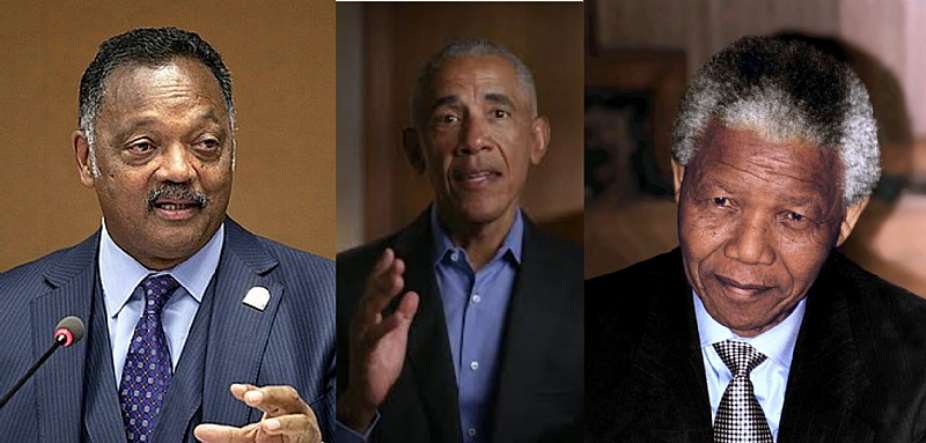
The one most memorable encounter that I had with the Reverend Jesse Louis Jackson (1941-2026) occurred in the scorching red-hot summer of 1990, when the soon-to-be President Nelson Rolithlathla Mandela, freshly released from the globally infamous Robben Island Maximum-Security Prison, after spending 27 years in that veritable labor camp off the coast of South Africa’s Table Mountains and Cape Town, as a political convict for gloriously attempting to overthrow the racist White-Minority Apartheid Regime, paid an official visit to the United States of America at the express invitation of President George Herbert Walker “HB” Bush (1924-2018). Mr. Mandela (1918-2013) would become the First Democratically Elected President of a Multiracial Sovereign Democratic Republic of South Africa.
I personally met the iconic Giant of Twentieth Century Continental African Politics, when the President of the African National Council (ANC) paid an official visit to New York City, at the express invitation of the first democratically elected African-American Mayor of the proverbial Big Apple; that Mayor was, of course, none other than distinguished, urbane and erudite lawyer by the name of Mr. David Norman Dinkins (1927-2020), the 106th Mayor of New York City. It was during the soon-to-be President Mandela’s official visit to the City College of the City University of New York (CCNY of CUNY), where Yours Truly was a graduating senior undergraduate student and an Honorary Member of the African National Congress by a unanimous “Voice Vote” acclamation, primarily on the basis of his avid dedication to highlighting the national liberation activities of the ANC in the College’s main student newspaper, The Campus, published consistently and continuously since 1909, if this author recalls accurately, that is just three years prior to the founding of the oldest indigenous Continental African Political Party in the Twentieth Century.
I had initially attempted to walk into a students’ meeting of the African National Congress, erroneously assuming that as one of the dozens of student clubs on the campus, I could simply and casually walk into one of their meetings and express my membership desire, only to be rudely and forcefully pushed back into the hallway by a strapping doorman who looked like a “Mr. Tee”-like bouncer. Interesting, though, just as I was walking away feeling utterly embarrassed and inexpressibly humiliated, I heard some running at almost a lightening speed after who shouted to be that the leaders of the group wanted to have a word with me. As it turned out, a couple of the ANC who had also taken a course or two with me, had communicated to the executive membership that I was “Kwame, the Ghanaian student who writes a lot on South Africa for ‘Campus.’” That was how I got inducted as an Honorary Member of the ANC.
Later on, it would be explained to me that the African National Congress was the one and only student organization that required South African birth and/or citizenship for membership enrollment, as it was a political party, rather than just any ordinary campus club or student organization. This, in short, was how I accidentally chanced on becoming an Honorary Member of the ANC, a story whose telling I have been reserved for quite a long while, except for an occasional glancing or passing reference. Even as I started recounting a moment ago, the first thought that flashed through my mind was that perhaps this story belongs to a completely different topic and time.
At any rate, suffice it to briefly state, however, that I was so awestruck during my chance encounter with the Reverend Jesse Louis Jackson, among a teeming crowd of people jostling against one another in an attempt to gain access into the main auditorium of City College’s ultra-modern Aaron Davis Theater Complex that when, finally Uncle Jay got to where I was standing and shot his right hand out to me for an offer of a warm and a hearty handshake, I was too frozen to quickly grab it until he had already moved at least two or three persons past me.
Of course, I had seen the Chicago-based foremost African American Human and Civil Rights Spearhead of his generation countless times on network television, but this chance encounter was reality in realtime; and the entire experience seemed exquisitely surreal. The humongous crowd of people, from both the local Harlem Community and, one surmises, all over New York City and the nation at large, was jostling each other to gain access into Aaron Davis Theater, where Mr. Edward James Martin Koppel - better known as Ted Koppel - the nationally renowned ABC-TV News Anchor and longtime host of the “Nightline” current affairs, the latter network’s nightly news flagship program, and his team of broadcast technicians and crew members were scheduled to prerecord an hour-long interview with the long-imprisoned President of the African National Congress.
I would end up securing the very last remaining entrance ticket for the “Nightline” program via courtesy of Dr. George D. McDonald, Vice-President for Students’ Affairs at CCNY of CUNY at the time, if memory serves Yours Truly accurately. Still, the most indelibly memorable picture that I have of the recently deceased legendary Reverend Jesse Louis Jackson was at the 1984 Democratic Party’s Quadrennial National Convention in San Francisco, California, in the year just before this author and his youngest sister, Nana Yaa Agyeman, arrived right here in the United States of America to reunite with our presently deceased parents, who had left us behind in Ghana a little over a dozen years before.
In the late summer of 1985, when my younger sister and I arrived right here in New York City, the proverbial Big Apple or Gotham, on the very hot last Thursday of July, in Washington Heights or Upper Manhattan, the Reverend Jesse Louis Jakson was still the talk of mainstream American political culture, having heroically and seismically shifted the dialogical paradigm of the time by forcing the traditional movers-and-shakers of a staid and a hitherto ideologically insulated, provincial and inward-looking and imperiously overbearing White America to wake up and sit up and seriously reckon with the near-certain and irrefutably convincing possibility of a Black-American Presidency in the offing, that is, either well before or by the close of the Twentieth Century.
In short, for many a reputable political pundit, Jesse Jacksn was the epitome of the proverbial “Enfant Terrible,” in Napoleonic terms. In retrospect, it almost tritely appears that when in San Francisco the then Presidential Candidate Jackson vertically and pontifically declared to the entire nation and, to be certain, the global community at large, that the dawn of an African-American Presidency was here and now, to wit, “Our Time Has Come!” he must have spoken a little too soon and intemperately way ahead of himself, as it were. In reality, however, the proverbial Promised Land was barely a generation into the future. Which means that in “Kingian” terms, as in MLK, Jesse Jackson was smack on the figurative “Mountaintop,” except that he was also far too much in a hurry to come to terms with the practical reality and the grim realization of the fact that just like his savagely slain mentor and ideological father and prime benefactor, the Greenville, South Carolina native, was himself not destined to enter the Promised Land with his long neglected and politically sidelined people.
Tragically, however, unlike the Georgia native via the United States Virgin Islands charismatic Human and Civil Rights Champion and Founding Leader of the Southern Christian Leadership Conference (SCLC), the Reverend Jesse Jackson appears to have been rather much too vaultingly ambitious to have pragmatically and more realistically come to the inevitable realization and acceptance of the fact that his inimitable Post-Kingian charisma and eloquence and poetic riffing and all, notwithstanding, the grim but factual reality was that Jesse Jackson had not, by the temper of the time, not adequately prepared himself to satisfactorily meet the practical and the critical demands of this most managerially exacting and globally challenging job.
Perhaps the Operation PUSH-Rainbow Coalition leader would have made himself more politically attractive and equal to the job he avidly desired to secure, if the ordained Baptist Minister had paid heed to the peevishly derisive but unimpeachably instructive jab by Howard University Professor and Washington, DC Mayor Marion S. Barry about the imperative need for the presidentially ambitious Mr. Jackson to have first sought a lower elective office in order to adequately prepare himself for the most globally formidable one that he was so obsessively preoccupied with securing. “Jesse didn’t want to run nothing but his mouth,” Mayor Barry would be widely reported to have said about the Washington, DC transplant from Chicago (See Peter Applebome “Jesse Jackson, Charismatic Champion of Civil Rights, Dies at 84” New York Times 2/17/26).
A more realistic and professionally pragmatic answer to the cranially exacting demands of the Presidency would, of course, be generously provided by a Columbia and a Harvard universities-educated lawyer and a veteran community organizer by the name of Barack Hussein Obama. Still, Jesse Jackson’s 1984 Democratic Party’s National Convention declaration that: “My constituency is the desperate, the damned, the disinherited, the disrespected and the despised” would be strikingly reflected in the national development policy agenda of the Hawaiian-born (Trust me, he has a genuine and a valid birth certificate, Mr. Trump) and a Continental African-fathered and a White-American-mothered President Barack H. Obama, a real and true “African American” citizen of the United States of America that in 1988, a then Presidential Candidate Jesse Louis Jackson eloquently, poetically and mellifluously described as being inextricably constitutive of the quintessential African American Personality: “There are two types of blood coursing through my veins, one African and the other European.” Of course, the near-certain possibility of a Native-American blood coursing through the veins of my Dear and Beloved Uncle (Kwaku) Jesse Louis Jackson could definitely not be ruled out of our existential equation.
By Kwame Okoampa-Ahoofe, Jr., PhD
Professor Emeritus, Department of English
SUNY-Nassau Community College
Garden City, New York
E-mail: [email protected]

 Police place GH¢100,000 bounty on man for killing two people in Tema
 Ultraviolet sterilisation mandatory for safe water production — FDA warns sachet...
 Cocoa smuggling: Fiapre Circuit Court grants GHC10,000 bail each to four suspect...
 Tensions rise in Bogoso as youth block mine workers over employment dispute
 Police declare military officer wanted over alleged murder of couple, announce G...
 University of Ghana distances itself from unauthorised ‘UG Partner’ app, warns p...
 Ghana's inflation rises marginally to 3.4% in April, up from 3.2% in March — GSS
 Inflation rises to 3.4% in April
 Court remands three suspects over jewelry shop robberies at Airport Residential ...
 Release ex-Buffer Stock CEO and wife immediately — Afenyo-Markin to EOCO, AG


