





Representatives from the African Court on Human and Peoples’ Rights, the European Court of Human Rights, and the Inter-American Court of Human Rights are set to participate in the Fourth International Human Rights Forum from March 3 to 4 in Arusha, United Republic of Tanzania.
Hosted by the African Court, the Forum takes place within the framework of the Court’s 80th Ordinary Session, ongoing in Arusha and scheduled to conclude on March 27. The biennial event rotates among the three courts, with previous editions held in Kampala, Uganda (2019), Strasbourg, France (2021), and San José, Costa Rica (2023).
According to an African Court document obtained by the Communication for Development and Advocacy Consult (CDA Consult), the Forum provides a platform for the three human rights courts to exchange experiences, strengthen cooperation, and engage in dialogue on common challenges and emerging human rights issues. This year’s discussions will focus on the impact of new technologies, including artificial intelligence, on human rights and governance, exploring both opportunities and associated risks.
Judges and officials from the three courts, alongside human rights experts, will also renew a Memorandum of Understanding initially signed in San José, reaffirming their shared commitment to advancing human rights across the regions.
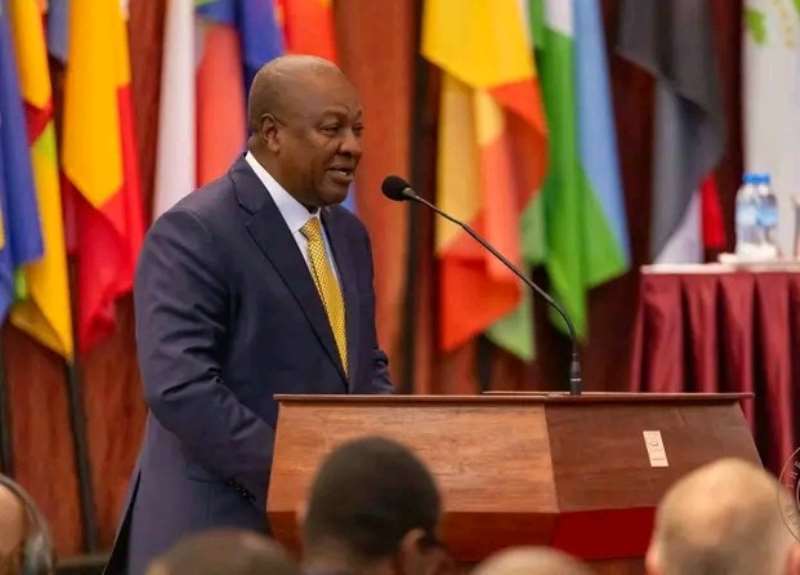
Meanwhile, President John Dramani Mahama of Ghana, speaking on Monday as the special guest of honour at the opening of the 2026 Judicial Year of the African Court, stressed that the rule of law must be central to Africa’s democratic future. “No society can thrive where justice is compromised or institutions are weakened,” he said.
President Mahama emphasized that the strength of Africa’s democracies will ultimately be measured by their commitment to the rule of law, which he described not merely as a constitutional principle but as the foundation for peace, development, and social stability. “Without independent courts and respect for judicial decisions, rights become promises on paper. African states must safeguard judicial autonomy and protect legal institutions from undue political pressure,” he added.
Opening the judicial year and launching the Court’s 20th anniversary celebrations, President Mahama warned that constitutional tensions, disputed elections, and governance challenges across the continent have tested public confidence in state institutions. In such times, he said, strong and impartial judicial systems remain the last line of defence for citizens seeking justice.
The event drew representatives from African Union member states, national, regional, and international courts, African Union organs, national human rights institutions, legal professionals, and members of bar associations. Civil society organisations, academia, media, and other stakeholders involved in human rights protection also participated.
According to the African Court timetable, on March 6, 2026, the Court will deliver six judgments adopted during its 78th and 79th Ordinary Sessions.
The African Court, established by African Union member states, ensures the protection of human and peoples’ rights across the continent. It is composed of eleven judges, each elected in their individual capacity, and meets four times a year in ordinary sessions, with extraordinary sessions held as needed.




 Sandema: Funeral clash leaves four injured, army recruit loses hand
 Upper East: Residents raise concerns over Mahama’s 24-hour market policy
 Ex-Buffer Stock CEO and wife were not denied legal counsel on rearrest — EOCO
 PDS case: Lawyers detained were invited as suspects a day earlier -- EOCO
 Government explores autonomous rapid transit system to modernise intra-city tran...
 AU mourns demise of former Botswana President Festus Mogae
 Economic recovery came at a cost to BoG — Sammy Gyamfi on 2025 losses
 NPP's criticism of BoG 2025 losses disingenuous, hollow — Sammy Gyamfi
 Ghana Armed Forces to conduct counter-insurgency exercise in Bono, Upper East re...
 Site for Adaklu District 24-hour economy market handed over to contractor


