




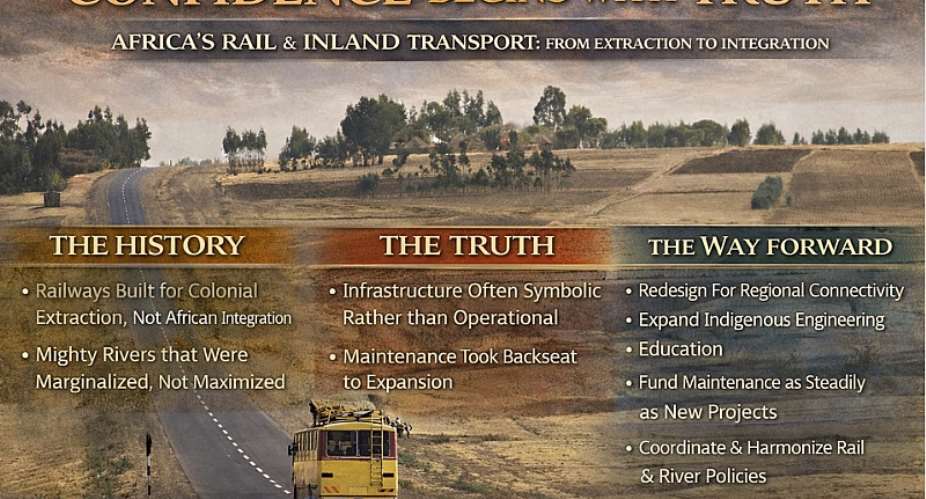
Confidence is not built through slogans. It is not manufactured through ceremonial inaugurations or glossy master plans. Confidence, real, durable confidence, begins with truth. And if Africa is to build transport systems worthy of its economic potential, it must first confront the truth about its rail and inland water transport history.
For more than a century, Africa’s railways were not designed for integration. They were designed for extraction. Colonial rail lines connected mines to ports, plantations to harbors, and resource zones to coastal export terminals. They did not connect African economies to one another. They did not prioritize regional industrialization. They served external markets first. The structural imprint of that design remains visible today: fragmented networks, incompatible gauges, disconnected corridors, and infrastructure that runs to the coast more efficiently than it runs across borders.
The inland water systems tell a similar story. Africa possesses some of the world’s most powerful river systems, the Volta River and Lake, the Congo Basin, the Niger River system, the Nile corridor, and the Zambezi network, yet many remain underutilized or poorly integrated into national logistics strategies. During colonial administration, river transport was often functional but limited to specific commercial routes. After independence, road transport expanded rapidly, while river systems were neglected, underfunded, or left without systematic hydrological management. The result is paradoxical. A continent rich in navigable water potential but poor in a coordinated inland water policy.
The truth is also financial. Many state-owned rail corporations suffered decades of underinvestment following independence. Rolling stock aged without replacement. Track rehabilitation was deferred. Skilled engineers retired without adequate succession planning. In some countries, traffic volumes collapsed under competition from trucking industries that benefited from flexible regulation and faster political support. Structural adjustment policies in the 1980s and 1990s pushed commercialization and privatization models that were unevenly implemented, sometimes improving efficiency, sometimes creating new coordination problems.
The truth is institutional. Infrastructure was often treated as a construction challenge rather than a systems-management challenge. Governments celebrated new track kilometers but underfunded maintenance budgets. Inland ports were upgraded without comprehensive sediment management strategies. New locomotives were procured without parallel investment in technical training and spare-parts supply chains. Expansion occurred without lifecycle planning.
The truth is uncomfortable but necessary: Africa’s transport challenges are not primarily geographic. They are managerial, institutional, and historical.
Truth is not defeat. Truth is clarity. And clarity is the beginning of confidence
There are signs of change. Standard-gauge rail projects have emerged in East and West Africa. Regional corridor frameworks are strengthening cross-border trade logistics. Inland water revitalization discussions are gaining policy attention. Digital tracking systems are improving freight visibility. The African Continental Free Trade Area (AfCFTA) creates new economic incentives for corridor integration. These are important steps, but they must be grounded in long-term discipline.
The way forward requires five continental commitments
First, historical alignment must be corrected. Rail networks should be redesigned not just to move commodities to ports, but to link industrial zones, agricultural belts, and neighboring economies. Integration must replace extraction as the design principle.
Second, maintenance must become non-negotiable. Every kilometer of rail and every navigable river channel requires lifecycle budgeting. Maintenance is not optional spending; it is capital protection.
Third, engineering education must expand strategically. Africa needs railway systems engineers, hydrologists, dredging specialists, signaling experts, data analysts, and transport economists trained within African universities and research institutes. Expertise cannot remain permanently outsourced.
Fourth, data transparency must become standard practice. Performance indicators, freight volumes, turnaround times, accident rates, dredging frequency, track condition indexes, should be monitored and published. Accountability strengthens investor and public confidence.
Fifth, continental coordination must deepen. Rivers do not respect borders. Rail corridors lose efficiency when regulations change at each frontier. Harmonized standards, interoperable systems, and regional regulatory cooperation are essential. Confidence does not come from pretending systems are stronger than they are. It comes from demonstrating that weaknesses are understood and addressed systematically.
Africa’s rail and inland water systems are not doomed to underperformance. They are under-refined. They require continuity, technical depth, institutional memory, and political patience. The continent has the geographic advantage, the demographic energy, and the economic incentive to transform these networks into engines of integration.
Transformation begins with honesty
Confidence begins when policymakers admit where fragmentation persists.
It grows when engineers measure performance without distortion.
It strengthens when governments fund maintenance as seriously as construction.
It endures when planning extends beyond electoral cycles.
Truth is not pessimism. Truth is foundation
And from foundation, systems can rise, not symbolically, but structurally, into the integrated, resilient transport networks Africa’s future demands.
Author: Joseph Fuseini ([email protected])

 NaIMOS arrests 49 suspected illegal miners after armed clash at Adiewoso
 Upper East Regional Minister leads technical assessment for proposed airport pro...
 Missing car dealer found dead as police arrest friend over alleged murder
 Teacher Sir Ola shares inspiring story of sacrifice and compassion
 Extreme heat is a growing threat to health, jobs and food security in southern A...
 Mali lawyer critical of junta abducted overnight
 Two women die on migrant boat near France seeking to reach UK
 Iran offers strait deal, Trump says he's not satisfied
 How faulty fan regulator sparked fire, destroyed two rooms at Suhum Konfine
 Don’t store bread beyond four days – Baker advises


