




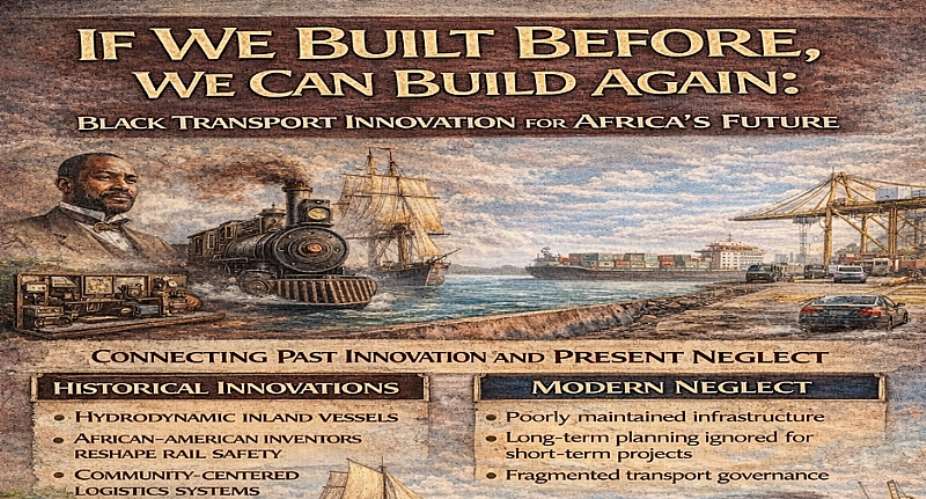
Africa’s transport challenges today, congested ports, deteriorating rail lines, unsafe inland waterways, and fragmented logistics systems, are often framed as evidence of structural incapacity. The narrative is subtle but persistent: Africa struggles to build, to maintain, to engineer at scale. Yet history tells a different story. Black engineers, inventors, navigators, and system-builders have shaped global transport innovation for centuries. The real issue is not whether we have built before. It is whether we have sustained, financed, and institutionally protected what we built.
If we built before, we can build again. But doing so requires confronting modern policy failures with historical clarity
Across the African continent and the diaspora, transport innovation has never been accidental. Indigenous river systems across the Niger, Congo, Nile, and Volta were structured logistics corridors long before colonial railways arrived. Vessel designs reflected hydrodynamic precision. Trade routes were timed to flood cycles. Loading practices accounted for stability and safety. These were not cultural accidents; they were engineered systems responding to geography and commerce.
During the industrial era, Black innovators made measurable contributions to transport safety and efficiency. Granville T. Woods developed railway telegraph systems that improved train communication and collision prevention. Andrew Beard patented automatic railway couplers that enhanced safety in rail operations. Elijah McCoy’s lubrication systems improved locomotive efficiency. These inventions addressed practical transport failures, safety gaps, inefficiencies, mechanical breakdowns. They were policy-relevant innovations grounded in systems thinking.
What these examples reveal is not symbolic inspiration but technical capability. Black transport innovation has historically focused on solving operational problems: reducing accidents, improving coordination, enhancing mechanical performance, and optimizing movement.
Contrast that legacy with contemporary transport policy in many African countries. Infrastructure projects are frequently launched with fanfare but without long-term maintenance financing. Inland water transport corridors are acknowledged in master plans but underfunded in practice. Rail revival projects stall due to procurement bottlenecks, inconsistent governance, or political turnover. Road networks absorb the majority of transport budgets while multimodal integration remains weak.
This is not a failure of engineering talent. It is a failure of institutional continuity.
One modern policy failure is the neglect of maintenance culture. Historically, transport innovation was iterative. Systems were improved continuously because operational survival depended on it. Today, many African transport systems are built without robust lifecycle planning. Roads deteriorate prematurely. Signaling systems fail due to inadequate servicing. Port equipment becomes obsolete because digital upgrades are not institutionalized. Building infrastructure without embedding maintenance finance is not innovation, it is deferred collapse.
Another failure lies in fragmented governance. Transport is inherently interconnected. Rail, road, ports, and inland waterways function best within integrated planning frameworks. Yet ministries often operate in silos, and regulatory overlap creates inefficiencies. Historical transport innovators understood systems. Modern policy too often isolates components.
Financing structures also reveal contradictions. Large capital projects attract international funding and political visibility. Smaller, technically essential investments, such as hydrographic surveys, signaling upgrades, safety audits, and vessel inspection systems, receive less attention because they lack symbolic appeal. But safety and efficiency improvements are precisely what defined earlier Black transport innovation: practical, targeted, impact-driven.
There is also a psychological dimension to policy failure. When historical innovation is not recognized, present ambition shrinks. If a continent internalizes the idea that advanced engineering is imported rather than indigenous, it designs policies around dependency rather than capability. Reclaiming the narrative of Black transport innovation is therefore not merely historical correction, it is strategic repositioning.
WHAT DOES BUILDING AGAIN REQUIRE?
First, policy must shift from project-based thinking to systems-based planning. Inland waterways, for example, should not be treated as secondary transport modes but as energy-efficient freight corridors integrated with rail and road networks. Technical respect must translate into budget allocation.
Second, maintenance must be institutionalized. Dedicated transport maintenance funds, transparent monitoring systems, and performance audits should accompany all major infrastructure investments. Historical innovators solved problems by refining systems; modern governance must do the same.
Third, technical education must align with infrastructure ambition. Engineering schools and maritime academies should integrate African transport case studies, indigenous vessel design, historical rail safety inventions, and adaptive logistics models, into curricula. Innovation flourishes where confidence in local knowledge exists.
Fourth, data-driven policy must replace symbolic planning. Cost-per-ton analysis, lifecycle maintenance projections, emission metrics, and safety performance indicators should inform transport decisions. Innovation historically responded to measurable inefficiencies. Modern policy must do the same.
Africa’s demographic growth, urbanization, and regional trade integration under the African Continental Free Trade Area (AfCFTA) demand transport systems that are efficient, safe, and sustainable. The challenge is not a lack of precedent. It is a lack of policy consistency.
If Black engineers could design safety systems in eras of exclusion, if riverine societies could structure logistics without digital tools, if transport inventors could reshape rail efficiency with limited institutional support, then contemporary Africa, with its universities, technology access, and growing professional class, possesses far greater capacity.
The lesson is clear: history disproves the myth of incapacity. The gap between past innovation and present performance is not technological; it is institutional. If we built before, we can build again. But this time, innovation must be matched with governance discipline, maintenance culture, and strategic continuity.
Transport is not merely infrastructure. It is a statement about whether a society believes in its ability to move itself forward.
Author: Joseph Fuseini ([email protected])

 NaIMOS arrests 49 suspected illegal miners after armed clash at Adiewoso
 Upper East Regional Minister leads technical assessment for proposed airport pro...
 Missing car dealer found dead as police arrest friend over alleged murder
 Teacher Sir Ola shares inspiring story of sacrifice and compassion
 Extreme heat is a growing threat to health, jobs and food security in southern A...
 Mali lawyer critical of junta abducted overnight
 Two women die on migrant boat near France seeking to reach UK
 Iran offers strait deal, Trump says he's not satisfied
 How faulty fan regulator sparked fire, destroyed two rooms at Suhum Konfine
 Don’t store bread beyond four days – Baker advises


