




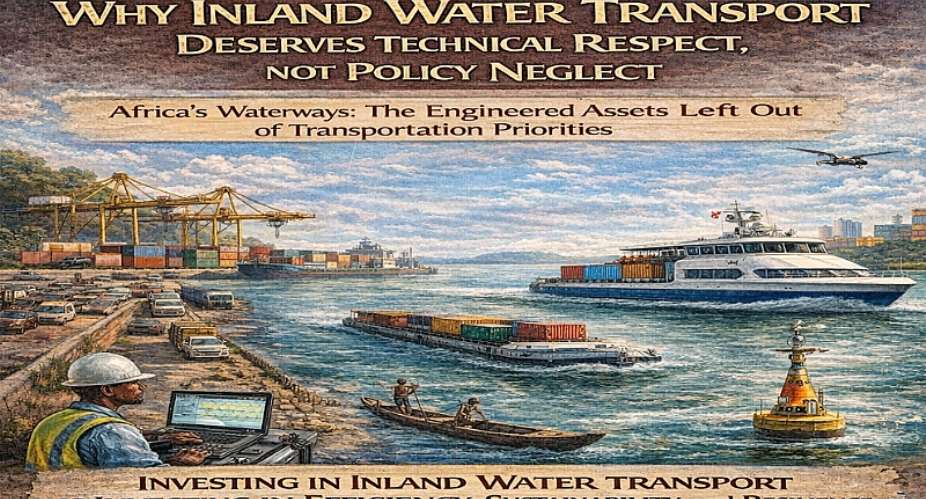
In policy discussions across Africa and much of the developing world, inland water transport (IWT) is too often treated as secondary, an afterthought behind highways, rail corridors, and aviation expansion. Budgets reflect it. Institutional structures reflect it. Even engineering curricula often marginalize it. Yet this neglect is neither economically rational nor technically justified. Inland water transport deserves serious technical respect because it is not a relic of the past, it is a high-efficiency, low-carbon, infrastructure-light transport system with deep engineering foundations.
The global evidence is clear. Inland waterways remain central to freight systems in regions that prioritize efficiency. The Rhine in Europe and the Mississippi River system in the United States move hundreds of millions of tons of cargo annually at a lower energy intensity per ton-kilometer than road freight. The physics is straightforward: waterborne vessels experience less rolling resistance than wheeled transport. Moving bulk cargo by barge requires significantly less fuel per unit of weight than trucking. This is not nostalgia; it is applied mechanics.
Africa possesses vast inland water assets, the Nile, Niger, Congo, Senegal, Zambezi, Lake Victoria, Lake Tanganyika, and Ghana’s Volta Lake, among others. Yet these systems remain underdeveloped relative to their potential. Roads are overburdened. Freight costs remain high. Road maintenance drains public budgets. Meanwhile, navigable waterways lie technically viable but institutionally sidelined.
One reason for this neglect is perception. Inland water transport is often framed as informal, unsafe, or technologically stagnant. But this framing ignores two realities. First, African indigenous water transport systems historically embodied structured engineering knowledge. Vessel design reflected hydrodynamic adaptation to shallow drafts, current velocity, and sediment patterns. Loading practices accounted for stability and trim. Navigation was seasonal, calculated, and systematized. This was engineering rooted in environmental intelligence.
Second, modern inland navigation is not technologically primitive. It integrates hydrographic surveying, channel dredging, navigation buoy systems, GPS tracking, vessel traffic management, hull optimization, and increasingly, hybrid propulsion systems. Where properly supported, inland water transport operates within sophisticated regulatory and safety frameworks.
The technical case for inland water transport rests on three pillars: efficiency, sustainability, and system resilience.
Efficiency is measurable. Waterborne freight reduces congestion on highways, extends the lifespan of road infrastructure, and lowers per-ton transport costs for bulk commodities such as grain, cement, petroleum products, and minerals. For landlocked regions, rivers and lakes can function as cost-stabilizing trade corridors when integrated into multimodal logistics chains.
Sustainability is increasingly non-negotiable. Transport accounts for a significant share of global carbon emissions, with road freight being a major contributor. Inland water transport emits substantially less CO₂ per ton-kilometer than heavy trucks when operating under optimized conditions. For countries pursuing climate commitments while expanding trade, neglecting inland waterways is strategically inconsistent.
Resilience is the overlooked dimension. Overreliance on road networks creates vulnerability to fuel price shocks, road deterioration, extreme weather, and traffic congestion. Diversified transport systems are more robust. Waterways offer redundancy. In times of infrastructure stress, they provide alternative corridors.
Yet policy neglect persists. Inland waterways often suffer from fragmented governance structures. Responsibility is divided among transport ministries, port authorities, environmental agencies, and local governments without coherent coordination. Safety enforcement may be inconsistent. Hydrographic data may be outdated. Vessel inspection systems may be under-resourced. These are not failures of water transport as a mode, they are failures of institutional prioritization.
Ghana offers a clear example. Volta Lake, one of the largest artificial lakes in the world, has the geographic capacity to function as a strategic north-south logistics corridor. It already supports passenger and cargo movement. However, limited navigation aids, underinvestment in modern vessels, and insufficient integration with road and rail planning have constrained its impact. The issue is not feasibility; it is policy attention.
Across West and Central Africa, similar patterns emerge along the Niger and Congo river systems. Significant cargo potential exists, but modernization requires consistent dredging programs, navigation infrastructure, digital vessel registration systems, and professional training in inland naval architecture and marine operations. These are technical investments, not symbolic gestures.
What inland water transport requires is not romanticization but engineering seriousness. It requires inclusion in national transport master plans as a core pillar, not as a marginal supplement. It requires budget lines for hydrographic surveys, safety audits, and vessel modernization. It requires data-driven performance monitoring comparable to what road and rail projects receive.
There is also an intellectual dimension. Engineering schools and maritime academies across Africa should treat indigenous vessel design and river navigation knowledge as case studies in adaptive hydrodynamics, not anthropological curiosities. Research institutions should explore how traditional shallow-draft hull forms can inform modern fuel-efficient designs. Respect begins in curriculum and research priorities.
The global shift toward greener logistics should be Africa’s opportunity to recalibrate its transport hierarchy. If advanced economies continue to invest in inland waterways for cost and carbon efficiency, it is contradictory for African policymakers to dismiss similar systems as outdated.
Inland water transport deserves technical respect because its foundations are scientific, its advantages are measurable, and its future relevance is undeniable. Policy neglect is not a reflection of technical weakness; it is a reflection of strategic oversight.
The real question is not whether inland water transport works. Physics already answers that. The question is whether policymakers are willing to treat it as the engineered asset it has always been.
Author: Joseph Fuseini ([email protected])


 Trump signs order to rename Lake Ontario to 'Lake America' as Carney pushes back
 Police restrict concrete mixer trucks on Accra, Tema roads from August 28
 Supreme Court nominee Anthony Forson Jnr. opposes proposal to cap number of just...
 Justice Bernasko Essah explains why Supreme Court may depart from its previous d...
 Two NDC MPs whose ‘secret’ marriages have shocked Ghanaians
 All you need to know about Hon. Millicent Yeboah-Amankwa, wife of Hon. Mahama Ay...
 ‘A true trailblazer and cultural icon’ – Bawumia mourns Grace Nortey
 Vetting: 'Suspects should sue police if detained beyond 48 hours' - Supreme Cour...
 Speaker Bagbin outdoors uniforms for new parliamentary security guards
 Minority NPP boycotts vetting of three Supreme Court nominees over rushed timeta...

