




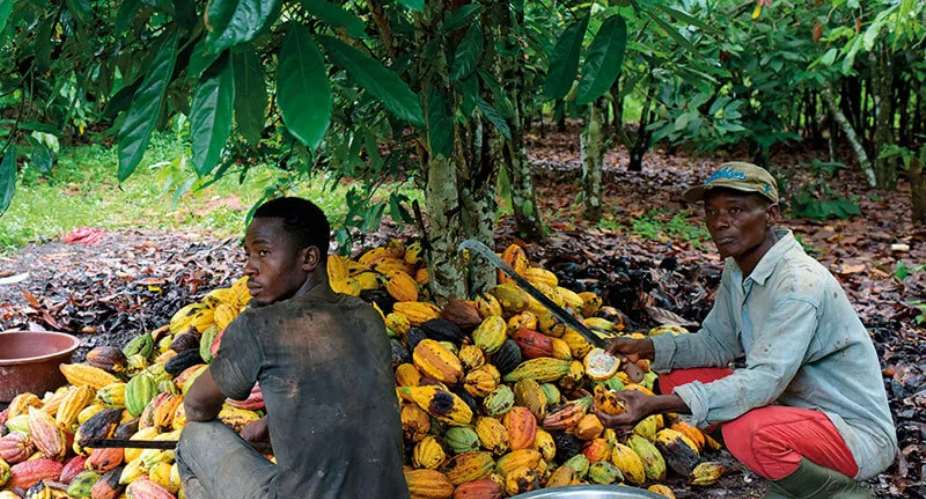
Ghana’s cocoa industry is under pressure. Farmers are feeling the impact of price instability, rising costs, and production challenges, and many are openly questioning whether cocoa is still worth the effort. Some are turning to other crops, while others are telling their children to avoid cocoa farming altogether.
These reactions are real and deeply felt. But they also raise a bigger national question:
Is Ghana ready to let go of the very sector that has long supported rural livelihoods and underpinned economic stability?
Rather than seeing this as a time to walk away, this should be treated as a turning point — a chance to renew confidence, introduce fresh ideas, and rebuild the industry together.
Cocoa still anchors the economy
Cocoa is not just another crop; it is a strategic pillar of Ghana’s economy. It supports rural employment, drives export earnings, helps stabilize foreign exchange, and funds development in many communities. Global demand for cocoa remains strong. The real issue is not whether cocoa has a future, but how Ghana manages price volatility, financing pressures, and falling productivity.
The pressure points: prices and financing
Volatile world prices
Cocoa prices are largely set on global markets, far beyond the control of any single country. When prices swing sharply, they create uncertainty for government planners and hardship for farmers, whose incomes can drop suddenly. Delays and mismatches between world prices and domestic producer prices have already contributed to farmer dissatisfaction and smuggling pressures.
What must change:
- Strengthen price stabilization schemes so farmers are better protected from sudden drops in income.
- Grow local processing and value addition to reduce dependence on exporting raw beans.
- Use risk‑management tools and more conservative forecasting to handle price swings.
- Raise productivity on farms so that even when prices are unfavourable, farmers can still earn sustainable incomes.
The syndicated loan model under strain
For decades, COCOBOD has relied on annual syndicated loans from international banks to pre-finance cocoa purchases. In recent years, delayed disbursements, higher interest rates, and weaker financial planning have turned this model into a source of vulnerability, contributing to lost revenue and limited room to raise farmgate prices.
How financing needs to evolve:
- Tighten financial management and cut operational leakages to improve debt sustainability.
- Diversify funding through blended finance and partnerships with development finance institutions.
- Stabilize export volumes by improving yields and curbing smuggling, which has already cost Ghana significant output.
- Direct more borrowing toward long-term productivity and resilience, not just short-term cash flow.
Shared roles, shared responsibility
Government:
- Reinforce income stabilization so farmers can plan and invest with confidence.
- Invest in farm rehabilitation, climate resilience, and quality inputs for farmers.
- Pursue prudent debt and sector-wide reforms to strengthen the new cocoa financing framework.
- Promote value addition and industrialization to keep more value in Ghana.
- Address smuggling by ensuring competitive prices, timely payments, and efficient logistics.
Farmers:
- Prioritize better farm management and yield improvement.
- Adopt climate-smart and modern practices that protect yields under changing weather conditions.
- Join and actively participate in cooperatives to gain bargaining power and access to services.
- Treat cocoa as a serious agribusiness, making deliberate investments in soil health, replanting, and technology.
COCOBOD:
- Improve operational efficiency and cost control to free resources for farmer support.
- Expand and strengthen extension services and productivity programs.
- Communicate openly with farmers and the public to build trust during periods of stress.
- Modernize financing and risk management strategies to better navigate global uncertainty.
The public:
- Recognize cocoa as a national economic priority that affects jobs, currency stability, and growth.
- Support reforms grounded in data and evidence, not just short-term political pressure.
- Encourage youth to see modern cocoa farming and cocoa-related industries as viable, respectable careers.
Changing the narrative
Price swings, financing difficulties, and smuggling are serious problems, but they are not insurmountable, nor are they unique to Ghana. The real test is how the country responds: by focusing on productivity, efficiency, risk management, value addition, and shared responsibility. Turning away from cocoa might offer short-term relief for some, but it risks long-term damage to rural communities and the wider economy.
Strengthening, not abandoning cocoa
Ghana’s cocoa challenges are complex, but they are manageable. The way forward lies in coordinated reforms and adaptive strategies:
- Government must create the right conditions.
- COCOBOD must operate efficiently and transparently.
- Farmers must modernize and innovate.
- Financial systems must be redesigned for resilience.
- Citizens must support and believe in the sector’s renewal.
Cocoa helped build Ghana’s resilience and international reputation. With deliberate, bold adjustments, it can continue to secure the country’s future. The answer is not to abandon cocoa — the answer is to strengthen it

 Fire Service rescues trapped victim after STC Bus, Taxi collision at Konongo
 Private SHSs in Free SHS pilot programme demand payment of outstanding governmen...
 Police foil planned robbery, recover weapons at Kukuom
 A 53-year-old mechanic remanded for allegedly stabbing another over car battery ...
 Asiedu Nketiah urges IGP to speed up justice for victims of election 2024 killin...
 Each family receives GH¢15,000 support after Accra Police Barracks Fire
 Mussa Dankwah urges ministers to focus on performance amid MoFA–finance minister...
 Selling single cigarette sticks illegal – FDA
 Hungry, unhealthy workforce cannot protect nation’s health – GRNMA
 Health Minister orders suspension of KATH CEO over Emergency admissions directiv...


