




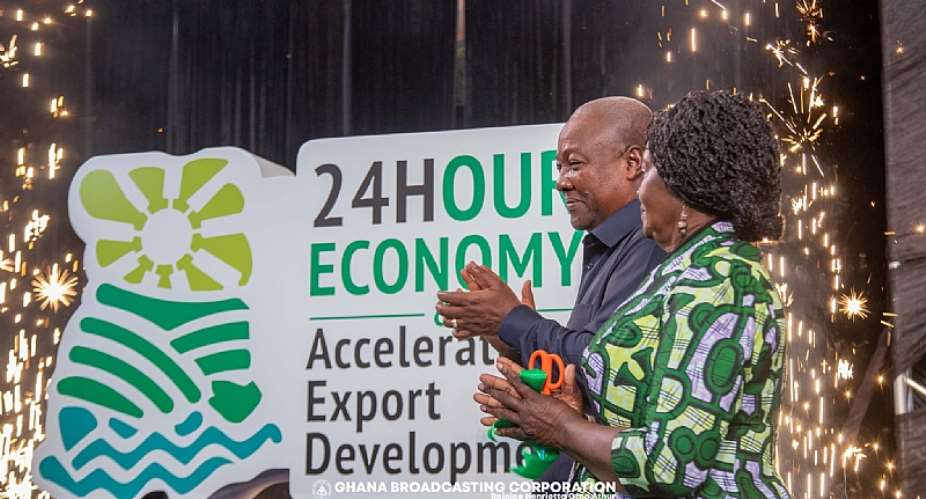
Last week, the Parliament of Ghana took a decisive step by passing the 24-Hour Economy Authority Bill, establishing a corporate body to oversee and coordinate the government’s flagship 24-hour economy and accelerated export development programme. On the surface, the move signals a serious commitment to economic transformation. However, a deeper look at Ghana’s recent governance history suggests that we may be repeating a cycle of administrative bloat that often stalls the very policies it is meant to accelerate.
While the 24-hour economy is a necessary evolution for a modern Ghana, the approach of “building a new road for every new car” is fundamentally flawed. This path does not necessarily translate into success; rather, it often leads to a “logistics of lag.” It will take months, if not years, to house, staff, and operationalize this new Authority. This startup phase does not just delay execution; it significantly inflates government expenditure at a time when fiscal discipline is paramount.
The ghost of zonal authorities
We have been here before. In a bid to implement flagship programs like the “one-constituency-one-million-dollars” promise, the previous administration established three separate zonal authorities: the Coastal (CODA), Middle Belt (MBDA), and Northern Development Authorities (NDA). The results were telling. Instead of accelerated development, we witnessed a landscape of stalled projects and uncompleted works.
The lesson is clear. Specialized authorities often struggle to transition from high-level “coordination” to actual “ground-level” delivery. The establishment of these bodies effectively bypassed our established Regional Coordinating Councils (RCCs) and District Assemblies, leading to a haphazard allocation of resources that rarely met specific local needs.
Evolution over invention
The argument that new policies require new bodies overlooks the natural capacity for our existing Ministries, Departments, and Agencies (MDAs) to evolve. Consider the Ministry of Communications, which successfully transitioned into the Ministry for Communications, Digital Technology, and Innovation to meet the demands of the digital age. This suggests that when foundational ministries exist, the most efficient path is to streamline their objectives toward new policy focuses, rather than creating multiple, centralized, and overlapping agencies.
By creating the 24-HR Economy Authority, we risk creating a “Super Ministry” that duplicates the functions of existing sectors. The policy is built on eight strategic pillars (including Make 24, Grow 24, and Connect 24). Yet, each of these pillars already falls under the mandate of the Ministries of Trade, Agribusiness and Industry, Agriculture, Transport, or Labor. Creating an Authority to “coordinate” these sectors often adds a layer of red tape that creates friction rather than synergy.
The decentralization deficit
Perhaps the most significant risk is the further erosion of local governance, yet we have assumed that all development is local. When development efforts are over-centralized, local District Assemblies often feel a lack of ownership. This “accountability vacuum” is why projects stall; if a local assembly is not part of the planning and oversight, they have little incentive—or power—to ensure completion once the contractors from Accra stop showing up.
If we are to truly transition to a round-the-clock economy, the focus should not be on hiring a new board of directors in the capital. It should be on empowering the District Assemblies to provide the security, lighting, and infrastructure that businesses need to operate at night.
Conclusion
The 24-hour economy is a bold vision, but it is currently being weighed down by an old governance playbook. We do not need a new corporate body to coordinate our growth; we need to optimize the institutions we already have. To avoid the fate of the zonal authorities that came before it, the government must resist the urge to centralize and instead focus on integrating this policy into the DNA of our existing MDAs and local governments.
Success will be measured not by the establishment of an Authority, but by the light of a factory running at 3:00 AM in a district that was empowered to make it happen.
Credit: Critical Analysis of Governance Issues, February 9-13, 2026


 Brazil's President Lula da Silva beats Flavio Bolsonaro to win re-election
 Nurse rescues mother and baby after unplanned delivery in bush
 McCarthy-Mallam road rehabilitation begins amid commuters’ complaints of heavy t...
 TOR briefs IMF on recovery efforts, inherited debt and sustainability plans
 Aseidu Nketia urges NDC contestants to unite after constituency elections
 EC yet to announce Dormaa Central NDC constituency results
 Baaba Cann questions Obuasi SHTS handling of sexual misconduct allegations again...
 Obuasi SHS headmaster case: “It is better to pay for sex with prostitute than ra...
 NDC not worried about NPP’s Kojo Bamba, he is small boy – Azorka
 Resource exploitation fuelling Africa’s conflicts – Mahama



Comments
You're right. Instituting another body to steward the 24-hour economy policy would not only render the MMDAs powerless but also lead to the dissipation of state funds. The new body would need to be resourced, and it's employees would have to be paid. Channelling these resources into optimising the existing assemblies could save the nation billions of cedis.