




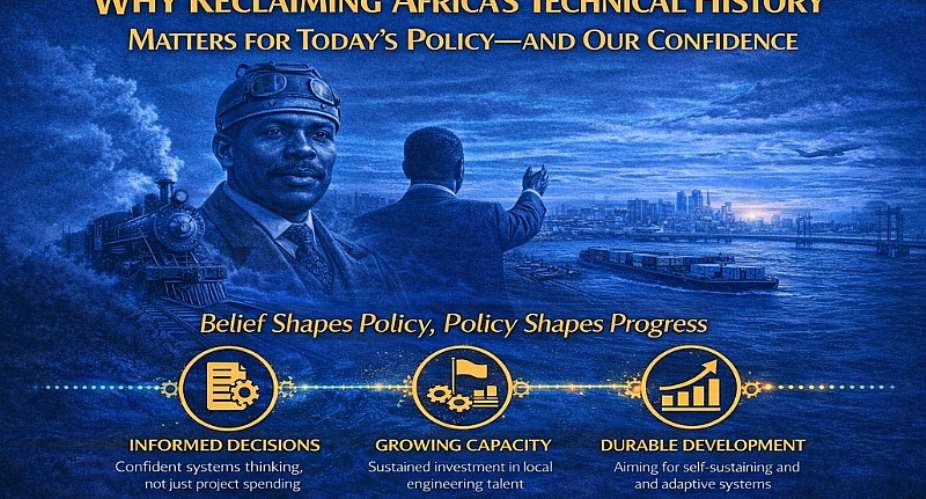
Policy does not operate in a vacuum. Every decision a government makes is shaped, consciously or not, by assumptions about capability. Who can design, who can build, who can maintain, and who can improve systems over time? In Africa’s transport sector, many of these assumptions are inherited rather than examined, and they are deeply influenced by how history has been told. Reclaiming Africa’s technical history is not about revisiting the past for its own sake. It is about correcting the mental framework within which today’s policies are formed.
When technological history presents innovation as something that arrived from elsewhere, policymakers subconsciously plan around external solutions. Infrastructure becomes something to be purchased, not something to be mastered. Capacity-building is treated as a side activity, not as the core of sustainability. Over time, this mindset locks countries into cycles of dependence, where progress is measured by projects launched rather than systems strengthened.
Confidence is the missing link
A policymaker who doubts local technical depth will naturally favor turnkey projects, foreign management, and imported solutions, even when these choices raise costs and weaken long-term resilience. A system built on such assumptions may function temporarily, but it rarely adapts or endures. The issue is not a lack of ambition, but a lack of belief in domestic capability.
Reclaiming technical history reduces this uncertainty. It reminds decision-makers that African participation in complex engineering and transport systems is not a recent aspiration, but a historical reality. This understanding shifts policy from risk avoidance to capacity development. Instead of asking, “Can we handle this?”, policy begins to ask, “What do we need to strengthen to handle this well?”
This shift has practical consequences
In transport planning, it encourages phased development rather than leapfrogging to headline solutions. It prioritizes operational stability, skills transfer, data systems, and maintenance culture. It justifies sustained investment in technical institutions rather than repeated restructuring. Most importantly, it frames infrastructure as a learning system, one that improves over time through local knowledge.
Reclaiming history also matters for professional confidence. Engineers, planners, and operators work differently when they see themselves as part of a lineage of problem-solvers rather than as perpetual trainees. Confidence does not lead to complacency; it leads to responsibility. Systems are maintained better when those running them believe the system is theirs to own and improve.
Education policy plays a critical role here. When curricula integrate Africa’s technical contributions, not as symbolism but as serious engineering history, students internalise possibility. They learn that innovation is not a foreign terrain. This does not lower standards; it raises them, because expectations shift from imitation to excellence.
For Ghana and Africa more broadly, the policy implication is clear: development is as much about narrative correction as it is about financing. Without confidence rooted in truth, even well-funded reforms will underperform. With it, modest investments can compound into durable systems.
Reclaiming Africa’s technical history does not guarantee better policy, but ignoring it almost guarantees its absence. In transport, as in development more broadly, belief shapes design, and design shapes outcomes.
To move forward, policy must remember where we have been, not to look backward, but to plan forward with clarity, confidence, and continuity.
Author: Joseph Fuseini ([email protected])

 South Africa xenophobia: Business allegedly declines after ownership shift from ...
 Kpone Traditional Council announces death of paramount chief after 37 years of r...
 Middle East live: Iran says will target any vessel traffic in Strait of Hormuz
 Bill Gates calls Epstein meetings a ‘grave error’ while defending actions in hou...
 Infantino defends World Cup ticket prices, dismisses referee US entry dispute
 Rainstorms from Nigeria, Benin to trigger thunderstorms in Ghana — GMet warns
 Accra floods: 70 seized excavators to be deployed to NADMO for desilting — Munta...
 Kasseh Market executives stop sale of food near toilet facility
 Three arrested over theft of critical equipment at Komenda Sugar Factory
 Nearly half of Ghanaians say military rule can be justified if governments fail ...


