




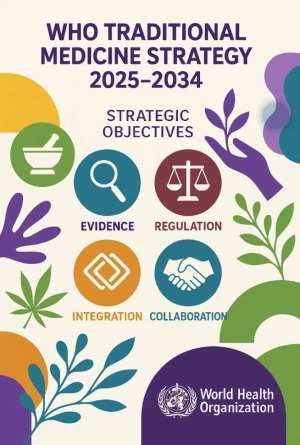
The WHO Traditional Medicine Strategy 2014–2023 was launched following the World Health Assembly resolution WHA62.13. Its overarching aim was to assist member countries in integrating Traditional and Complementary Medicine (T&CM) into their healthcare systems in ways that are safe, effective, and people-centered.
Core Objectives
Harnessing potential: Leveraging T&CM’s role in promoting health, wellness, and person-centered care.
Ensuring safety & effectiveness: Regulating, researching, and integrating T&CM products, practices, and practitioners.
Implementation Focus (2014–2023)
Policy and integration support: Assisting countries in crafting proactive policies and action plans for T&CM integration.
Standards & technical instruments: Developing guidelines on herbal medicines, methodologies for clinical research, and establishing benchmarks for practices like acupuncture and Ayurveda.
Terminology & classification: Incorporating T&CM into ICD‑11 supplementary modules and creating terminology systems for diverse traditional medicine traditions.
Capacity building & networks: Conducting interregional training like workshops in Macau and fostering networks such as the International Regulatory Cooperation for Herbal Medicines (IRCH).
Monitoring & research: Establishing knowledge platforms, clinical evidence databases, global surveys, and T&CM indicators (e.g., outpatient utilization).
These efforts collectively aimed to embed T&CM confidently within national health plans, while ensuring public safety and efficacy.
Transition and Extension: Beyond 2023
Extension to 2025
At the 66th World Health Assembly (2023), member states extended the validity of the 2014–2023 strategy by two more years, asking WHO to develop a new strategy for 2025–2034.
Building the Next Strategy (2025–2034)
Consultation phase: In 2024, WHO initiated a draft for the 2025–2034 strategy and solicited feedback from stakeholders globally.
Regional endorsement: For instance, PAHO’s consultation (Oct 2024) received strong buy-in (over 80%) and emphasized rights of Indigenous Peoples and Afro-descendant traditions.
Official Adoption (May 2025)
The 78th World Health Assembly (May 2025) formally adopted the Global Traditional Medicine Strategy 2025–2034. Key pillars include:
Strengthening evidence-based practice.
Regulatory mechanisms for safety and quality.
Integration into health systems.
Protecting indigenous knowledge and biodiversity
Ensuring equity, collaboration, and innovation
This included major milestones:
Launch of TCIM Dashboards, enabling real-time data visualization and trend tracking through the Third WHO Global Survey (2023–2024).
A US$3 million MoU between WHO and India to integrate AYUSH (Ayurveda, Siddha, Unani) into the International Classification of Health Interventions (ICHI).
Upcoming Global Traditional Medicine Summit in December 2025 (New Delhi) to align global stakeholders behind the strategy.
Moreover, at a G20 health event in mid-2024, countries such as Brazil, India, South Africa, and more affirmed T&CM’s place in advancing universal health coverage and respecting traditional knowledge even marking the WIPO Treaty to safeguard indigenous IP rights.
Summary Timeline: 2014–2024
Year(s) Key Developments
2014 Launch of WHO Traditional Medicine Strategy 2014–2023
2014–2023 Policy support, guidelines, classification integration, capacity building, monitoring infrastructure
2023 Extension of strategy to 2025
2024 Global & regional consultations underway for 2025–2034 strategy
2025 Formal adoption of 2025–2034 Strategy; launch of TCIM dashboards; MoU with India for ICHI inclusion; Summit scheduled for December
Final Thoughts
The 2014–2023 Strategy laid a strong foundation blending integration, safety, regulation, and evidence building to legitimize traditional medicine in modern health systems. As we move into the 2025–2034 era, emphasis shifts toward digital data platforms, safeguarding knowledge, expanding access, and ensuring equity, all while uniting global momentum behind T&CM’s role in achieving universal health coverage and cultural integrity.
Mustapha Bature Sallama
Medical Science communicator.
Private Investigator and Criminal
Investigation and Intelligence Analysis,
International Conflict Management and Peace Building. Alumni Gandhi Global Academy United States Institute of Peace.

 Mysterious illness leaves children struggling to walk, hear in Mafi Kope
 ‘We’ve come back to make sure our father's ideas never die’ – Nkrumah family
 Ghana Jollof: Akosua Manu appeals to Naana Jane to use her influence to free Sal...
 Yellow fever confirmed in Sissala East after 21 mysterious deaths
 Kenyasi man allegedly attacked by prison officers and inmates over yam theft cla...
 Germany’s far-right AfD makes strong gains in two state elections
 Savannah Regional Minister, IGP Yohuno visit Gbindabuor following lynching of po...
 Jehovah's Witnesses make blood component decisions a matter of personal conscien...
 Road contractors fed on contracts for years without completing projects – Alhass...
 Ghana Jollof saga: ‘She has no right to do what she’s doing’ – Inusah Fuseini


