




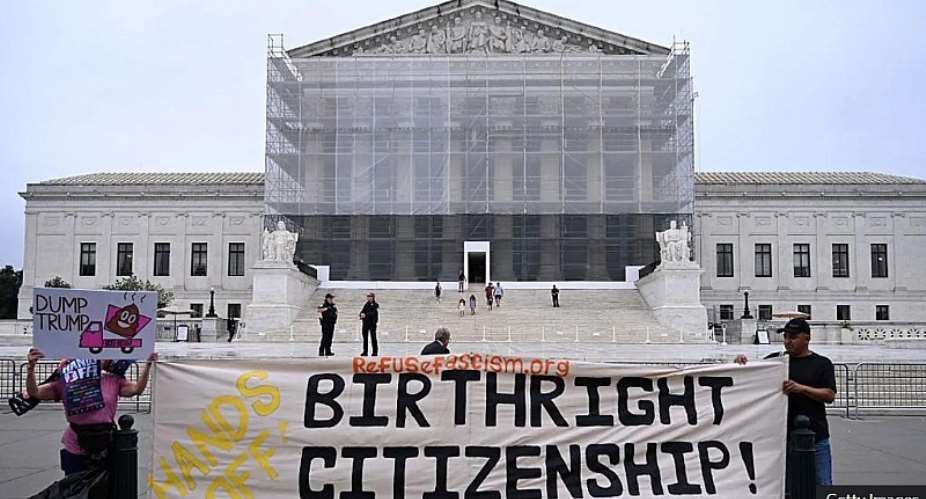
The US Supreme Court has agreed to hear a landmark case that will determine whether the long-standing constitutional guarantee of citizenship for anyone born on US soil will stand.
On his first day in office in January, President Donald Trump signed an executive order to end birthright citizenship, but lower courts blocked the move after multiple challenges argued it violated the Constitution.
The Supreme Court's eventual ruling will decide whether children born in the US to migrants who are in the country illegally or on temporary visas are entitled to citizenship — or whether the 150-year-old principle can be ended by executive action.
The justices will next set a date for oral arguments between the government and the plaintiffs, which include immigrant parents and their infants.
For nearly 160 years, the 14th Amendment has affirmed that anyone born in the United States is a citizen, except for children of diplomats and foreign military personnel. The amendment states: “All persons born or naturalized in the United States, and subject to the jurisdiction thereof, are citizens of the United States.”
Trump's order sought to deny citizenship to children born to people living in the US illegally or on temporary visas.
After the order was challenged, several federal judges ruled that it violated the Constitution, and two federal circuit courts upheld injunctions preventing it from taking effect. Trump then appealed to the Supreme Court. In June, the court ruled that the lower courts had exceeded their authority in issuing the injunctions — though it did not resolve the underlying question of birthright citizenship.
The 14th Amendment was adopted after the Civil War to settle the citizenship status of formerly enslaved people born in the US.
A recent study by the Migration Policy Institute (MPI) and Pennsylvania State University's Population Research Institute estimates that about 255,000 babies born each year would be denied US citizenship under Trump's order. The researchers also projected that ending birthright citizenship could increase the size of the undocumented population by 2.7 million by 2045 and by 5.4 million by 2075.
Source: BBC

 Mysterious illness leaves children struggling to walk, hear in Mafi Kope
 ‘We’ve come back to make sure our father's ideas never die’ – Nkrumah family
 Ghana Jollof: Akosua Manu appeals to Naana Jane to use her influence to free Sal...
 Yellow fever confirmed in Sissala East after 21 mysterious deaths
 Kenyasi man allegedly attacked by prison officers and inmates over yam theft cla...
 Germany’s far-right AfD makes strong gains in two state elections
 Savannah Regional Minister, IGP Yohuno visit Gbindabuor following lynching of po...
 Jehovah's Witnesses make blood component decisions a matter of personal conscien...
 Road contractors fed on contracts for years without completing projects – Alhass...
 Ghana Jollof saga: ‘She has no right to do what she’s doing’ – Inusah Fuseini


