




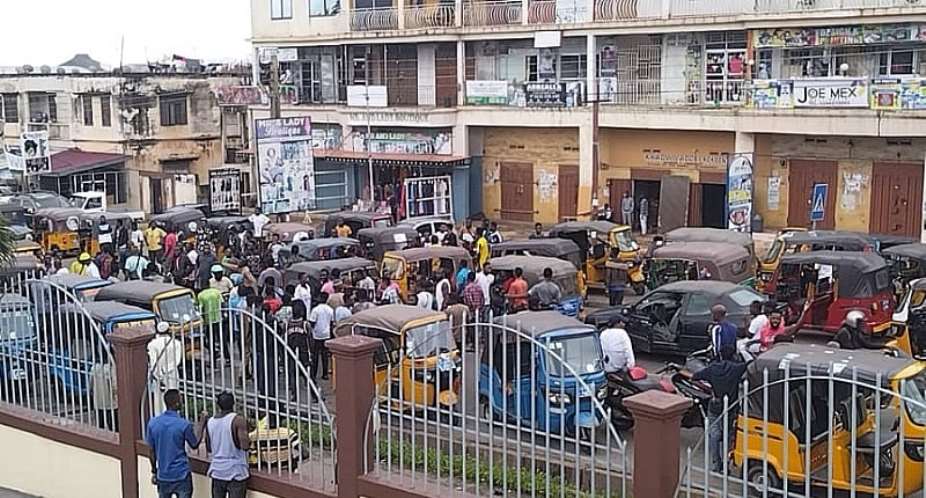
Kumasi, Ghana Economic activities in the Kumasi Central Business District (CBD) slowed on Monday as hundreds of tricycle riders, popularly known as pragia, staged a peaceful demonstration to protest recent operational restrictions imposed by city authorities.
The riders, who serve as one of the most commonly used means of transportation for thousands of residents, marched through Adum, Kejetia, and surrounding areas, calling for the reversal of directives that limit their movement on major routes within the metropolis. Many carried placards reading “Pragia is our livelihood,” “Don’t ban us,” and “We help reduce traffic.”
Background to the Protest
In recent months, the Kumasi Metropolitan Assembly (KMA) and the Ashanti Regional Coordinating Council have raised concerns about the increasing number of tricycles operating in the CBD. Officials argue that the tricycles contribute to congestion, pose safety risks, and violate urban transport regulations.
The new directive restricts pragia riders from using some main roads and commercial corridors, compelling them instead to operate on feeder or community routes. According to authorities, the goal is to streamline transport operations and restore order in Ghana’s second-largest city.
Riders Say Pragias Serve a Critical Transport Need
The riders, however, insist that the directive threatens their livelihoods and ignores the essential service they provide to the city’s commuters.
“Many people depend on us to move quickly through town, especially in areas where taxis and trotros do not easily reach,” said Kwame Owusu, a leader of one of the tricycle unions. He noted that pragia transport offers an affordable alternative for students, traders, and workers who need to navigate the dense and busy city streets.
Indeed, for many residents in the Kumasi metropolis, tricycles have become an integral part of daily movement particularly in communities with narrow, untarred, or congested roads where larger vehicles struggle to operate effectively. Their relatively low fares and accessibility have made them a preferred option for short-distance travel.
Impact on Commuters
The temporary withdrawal of pragia services during the protest left many commuters stranded. Traders and shoppers in areas such as Bantama, Kejetia, and Ashtown expressed frustration, highlighting how deeply the service has become embedded in the city’s transport ecosystem.
“Without the pragia, I have to walk long distances to get to my shop,” said Adwoa Serwaa, a market woman. “They help us carry goods quickly. They may be small, but they are very useful.”
Authorities Promise Dialogue
In response to the demonstration, KMA officials have called for calm and invited leaders of the tricycle unions for dialogue. A spokesperson for the Assembly stated that the intention is not to deprive anyone of employment but to ensure safety and order in the city’s transport sector.
“We recognize the role they play, but we also have a responsibility to reduce congestion and accidents,” the spokesperson said. “We are open to finding a balanced solution.”
Looking Ahead
The standoff highlights the ongoing challenge of regulating emerging informal transport systems in rapidly growing urban centers like Kumasi. As the population expands and mobility needs increase, tricycles have filled an important gap yet their proliferation also raises questions about safety, traffic control, and long-term urban planning.
For now, residents await the outcome of the negotiations, hoping for a resolution that supports both public order and the livelihoods tied to the pragia industry.
Mustapha Bature Sallama
Medical Science communicator.
Private Investigator and Criminal
Investigation and Intelligence Analysis,
International Conflict Management and Peace Building. Alumni Gandhi Global Academy United States Institute of Peace.
[email protected]
+233-555-275-880


 Abronye loses again as Court of Appeal dismisses bid to halt Samson Anyenini’s d...
 Over 30 women feared trapped in prostitution in Savannah as GIS arrests traffick...
 Govt pays GH¢24.8bn to statutory funds since January — Ato Forson
 Seven missing Axim fishing canoe crew located in Togo’s waters — Western Regiona...
 Health Ministry assures Ghanaians of readiness to manage Ebola cases
 FDA shuts down Arcan Bitters factory again over illegal production in Ashanti Re...
 PAC chair praises NPA CEO Edudzi Tameklo’s performance at committee hearing
 Ghanaian jailed nine months in US for using relative’s social security number to...
 Ukraine war: I'm going to Russia to convince President Putin to ceasefire — Maha...
 'Prof. Jane Naana is Vice President of Ghana; not for women and girls' — Victori...


