




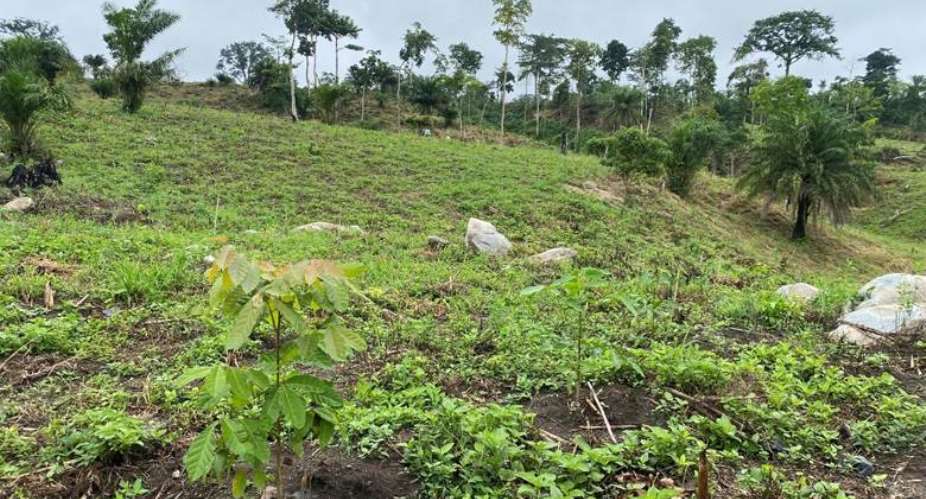
Despite mounting concerns about the rapid depletion of Ghana’s forests and landscapes, driven by illegal mining (galamsey), agricultural expansion, unsustainable timber harvesting, charcoal production, and climate stress, the picture is not only one of loss. Ghana’s journey toward a climate-resilient future is taking shape not just in policy rooms but across its landscapes. From the Northern to the Southern parts of Ghana, communities are leading a quiet but powerful transformation, restoring degraded lands, reviving forests, and securing livelihoods through nature-based solutions.
Under the African Forest Landscape Restoration Initiative (AFR100), Ghana has committed to restoring two million hectares of degraded land by 2030. This initiative forms Africa’s flagship contribution to the global Bonn Challenge and aligns with the objectives of the UN Decade on Ecosystem Restoration. This bold pledge goes beyond tree planting. It signals a national transition toward sustainable ecosystem management that links climate action with rural prosperity, food security, and biodiversity conservation.
Central to this effort is the “Tree for Life” Restoration Initiative launched in March 2025. This initiative is one of Ghana’s flagship landscape restoration programs, integrating climate change mitigation and adaptation. In collaboration with district assemblies, traditional authorities, and development partners, the initiative promotes reforestation and agroforestry systems that integrate ecological recovery with improved local livelihoods.
Ghana is showing that restoring forests and landscapes is not only about planting trees but restoring dignity, opportunity, and hope for future generations. Each revived hectare and empowered community brings the nation closer to a sustainable, low-carbon pathway that demonstrates Africa’s leadership in green growth.
Across multiple regions, farmers are adopting climate-smart practices such as integrating nitrogen-fixing trees with crops, which improves soil fertility and yields. Women’s groups are now at the heart of the restoration movement, producing millions of seedlings for both community and commercial planting, while gaining steady income and leadership roles in local restoration committees. Youth organizations are learning to use drones and remote-sensing tools to track land-cover change and monitor restoration progress, blending tradition with technology to protect Ghana’s natural heritage.
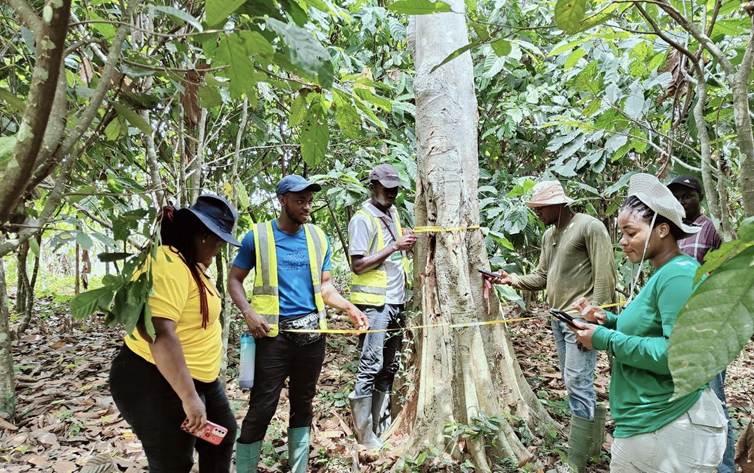
Site verification of restoration actions and biomass monitoring in the Ghana cocoa belt.
To build lasting credibility and impact, Ghana must strengthen its Monitoring, Reporting, and Verification (MRV) systems for restoration. Reliable data is essential to ensure that every intervention is real, measurable, and socially equitable. Developing standardized frameworks for carbon accounting and restoration assessment will not only improve transparency but also enhance investor confidence and policy alignment with international climate goals.
Moreover, it is imperative that Ghana strategically invests in community-based restoration enterprises that not only create employment opportunities but also foster a sense of local ownership and stewardship. Such investments should be designed to actively position women and youth as leaders and decision-makers rather than merely beneficiaries within forest and landscape restoration initiatives. Centering these groups in leadership roles will not only sustain restoration momentum but also promote social equity, enhance institutional capacity, and ensure that ecological gains are translated into enduring socioeconomic development at the local level.
Ghana’s forests may have once been a symbol of loss, but today they are emerging as a symbol of revival. The nation’s evolving restoration story is a reminder that environmental recovery and human development are not competing goals; they are inseparable foundations of true resilience.
By Tabitha Adinorkwor Alimo,
Forester and Carbon Monitoring and Restoration Specialist
Global Observatory for Ecosystem Services (GOES) Lab
Michigan State University.
 Supreme Court unanimously dismisses challenges to Torkornoo's removal process
 TOR rules out immediate removal of refinery margin citing debt burden
 GES debunks viral claims of flood-damaged WASSCE papers
 Accra floods: 1,000 vehicles damaged at Odawna
 Prove NLA’s GH₵3bn giveaway allegation — Razak Kojo Opoku challenges The Fourth ...
 Illegal miners invade Adansi Asokwa Agenda 111 Hospital site
 Trader loses 15 shops in Odawna disaster
 July 2: Cedi sells at GHS12.30 on forex market, GHS11.36 on BoG interbank
 Alajo resident explains why he requested GH¢3,000 from NADMO officers before ret...
 GH¢350 million transferred for flood relief after Mahama orders Finance Ministry

Comments
Good progress so far