




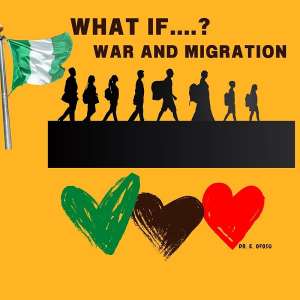
How a Nigerian war could spill into Ghana
If war breaks out in Nigeria, Ghana will feel it almost at once. Not in a year. Not in a quiet, manageable trickle. In a rush. Nigeria has more than 220 million population. When a country that large faces open conflict, people move. They move first inside their own borders. If that is unsafe or overwhelmed, they move outward. The nearest safe, stable and English-speaking country on that axis is Ghana. We like to think our borders and our economy can absorb shocks. The reality is that a sudden movement of very large numbers of Nigerians would place Ghana under a kind of pressure we have not experienced since independence.
The Strain on Cities, Services and Security
Our population is about 34 million. Add even one or two million unplanned arrivals and the arithmetic becomes frightening. Migrants and refugees do not spread themselves evenly across the map. They go where there is work, where their relatives live, and where transport ends. That means Accra, Tema, Kasoa, Ashaiman, Aflao and parts of Kumasi. These places are already struggling with housing, water, schools and clinics. A fast wave of people means rent hikes, overcrowded schools, longer queues in hospitals and louder complaints from Ghanaian traders who already think foreign traders are taking space. The most sensitive part is that not everyone in such a flow is simply a victim. Any large, chaotic cross border movement will contain innocent families, economic opportunists and people who want to disappear. If Nigeria becomes a theatre of armed confrontation, especially if religion is mentioned, then extremists, armed criminals and fraud networks will try to blend in. Ghana has strengthened parts of the northern frontier against Sahel threats. The eastern corridor is softer. A sudden, emotional inflow from Nigeria would stretch immigration, intelligence and the police beyond current levels. If we do not plan screening in advance, we will do it too late.
Economic and Political Shockwaves
Ghana is working hard to stabilise its finances. A rapid increase in population, even by 10 to 15 percent, would force government to spend on things it did not plan for. Temporary shelters, extra border officers, more sanitation, extra teaching materials and fuel for patrols. At the same time rents and food prices would feel the pressure. Investors tend to price West Africa as one basket. A Nigerian war makes the whole basket look risky. That means harder borrowing for Ghana just when we would need money to manage a humanitarian challenge. Politics will not be spared. Ghanaians are warm, but they are also protective of jobs and market space. Once people see busloads arriving and hear stories of crime, there will be louder calls for tighter entry. If government stays silent or slow, rumours will outrun facts. Social media will do the rest. What began as a migration management issue can turn into a Ghanaian versus Nigerian issue, or even a Christian versus Muslim issue, within weeks. That is what must be prevented.
What Ghana Must Do Now
Ghana should be among the earliest West African voices pushing for de-escalation, for investigation of the triggers in Nigeria, and for any action to pass through ECOWAS and the African Union. Every month that Nigeria stays relatively calm is a month in which people do not move. Prevention is cheaper than reception. Government should also complete a proper surge plan for the eastern corridor. Interior, Defence, Foreign Affairs, Local Government, National Security and Immigration should have a written plan for what happens if numbers rise sharply. That plan must name reception points close to the border, include immediate registration and biometrics, and move people onward so Accra is not flooded. Ghana must be ready to apply ECOWAS free movement with common sense. The protocol allows security exceptions. If daily entries rise beyond what services can handle, Ghana can slow the flow, not cancel it, and explain this to neighbours. At the same time Accra should speak to Benin and Togo so arrivals can be shared along the coast. Humanitarian agencies should be quietly alerted so supplies and staff can move faster if the crisis materialises. Government and the National Peace Council should prepare clear messages that explain why people are coming, how Ghana is screening them, and how Ghanaian workers and traders are being protected. If officials do not speak, false stories will.
Some will say this is too dark. It is better to admit that a Nigerian crisis will not stop at Nigeria’s borders. Ghana is attractive because it is calmer, safer and easier to do business in. Magnets do not pick only what they like. They attract everything. The time to plan is before the buses arrive, before the markets complain and before anger replaces sympathy. If war comes to Nigeria, the shock will travel across West Africa. Ghana will be in its path. Planning now is not panic. It is responsible government.
Author: Dr. Enoch Ofosu
Email: [email protected]


 ‘We have turned the tide’ – Ato Forson says Ghana is ready to take off
 Sammy Gyamfi refuses to file defence, hides behind technicalities — Lawyers
 Osahen Afenyo-Markin vows to pursue case against Sammy Gyamfi despite high court...
 Let us all be mentors to our younger generation - Mahama
 Court stops Osenase homecoming over security concerns
 Supreme Court dismisses Solomon Asamoah's bid to stop Sky Train trial
 GRA denies imposing new 20% tax on Netflix, Google and Amazon subscriptions
 Police arrest 16 suspects, seize 209 rounds of ammunition at Gbane mining site
 ‘Mahama has lost his moral high ground’ – Dr Zaato on Affi Agbenyo’s EC appointm...
 Cassava, hemp could offer alternatives to plastics – Zanetor challenges scientis...


