




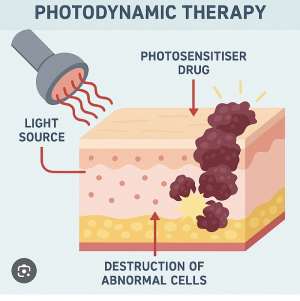
Healthcare systems in Ghana and much of sub-Saharan Africa face significant hurdles. Infectious diseases like tuberculosis, resistant bacterial infections, and ongoing malaria continue to stretch resources thin. Meanwhile, non-communicable diseases, especially cancers, are increasing rapidly. Challenges such as limited access to advanced treatments, high costs of imported medicines, and delayed diagnoses worsen the situation. In this context, photodynamic therapy (PDT) is gaining recognition as an innovative, cost-effective, and flexible solution with the potential to transform healthcare in Ghana.
What is Photodynamic Therapy?
Photodynamic therapy (PDT) is a treatment that involves three main elements: a photosensitizing drug, specific visible light, and oxygen. It begins with administering the photosensitizer, which selectively accumulates in diseased or infected cells. When light from a laser or LED is applied, it activates the drug, leading to the production of reactive oxygen species. These reactive molecules then eliminate nearby harmful cells or pathogens, while largely sparing surrounding healthy tissue. Unlike chemotherapy or long-term antibiotics, PDT is a minimally invasive and localized treatment, reducing systemic side effects. Additionally, PDT can be safely repeated multiple times without cumulative toxicity, making it a valuable option in cancer and infectious disease treatments (Duah et al., in the Journal of Applied Polymer Science titled “Porphyrin cross-linked conjugated polymer nanoparticles-based photosensitizer for antimicrobial and anticancer photodynamic therapies”, 2021).
Fighting bacterial Infections and cancer
Antibiotic resistance is a major global health threat, and Ghana is also affected. Research in Accra, Kumasi, and Tamale shows increasing resistance to common antibiotics for urinary tract infections, respiratory issues, and skin conditions. Patients who previously responded well to initial treatments now experience longer illnesses, higher expenses, and, in some cases, death. Photodynamic therapy offers a promising alternative. Since PDT works through oxygen radicals rather than traditional drug mechanisms, bacteria cannot easily develop resistance. Laboratory studies have shown that PDT can effectively inactivate resistant strains of Staphylococcus aureus, Escherichia coli, and Pseudomonas aeruginosa. These are pathogens commonly implicated in hospital-acquired infections in Ghanaian health facilities. In a research article published by Duah et al. in the Journal of Applied Polymer Science titled “Porphyrin cross-linked conjugated polymer nanoparticles-based photosensitizer for antimicrobial and anticancer photodynamic therapies”, 2021, they successfully synthesized and thoroughly characterized a new water-dispersible conjugated polymer nanoparticle (CPPN) used as a photosensitizer and demonstrated its application in both antibacterial and anticancer phototherapies. The CPPN photosensitizer showed excellent colloidal stability in water, maintaining its dispersibility and photophysical properties for over a month without aggregation, indicating its robustness and potential for medical use. Photophysical tests revealed that CPPN is an effective photosensitizer, exhibiting strong absorption in visible light and a high capacity to generate reactive oxygen species (ROS) upon exposure to white light. This led to its strong antibacterial activity. In vitro studies showed that CPPN had significant photo-induced biocidal effects against Gram-negative bacteria like E. coli and Gram-positive bacteria such as B. subtilis and S. aureus. When bacterial suspensions were treated with CPPN and exposed to white light for 10 minutes, there was more than a 3.5-log (99.9%bacteria killing efficiency) reduction in colony-forming units across all tested strains. Notably, minimal dark toxicity was observed, confirming that the antibacterial effect was strictly dependent on light and ROS production.
Cancer treatment in Ghana continues to face significant challenges. The World Health Organization reports over 20,000 deaths annually due to cancer in the country. The most common types include cervical, breast, prostate, and liver cancers, with many cases detected late. While chemotherapy and radiotherapy are available at teaching hospitals in Accra and Kumasi, patients in rural areas often struggle to access or afford these treatments. Photodynamic therapy (PDT) offers a promising solution to bridge this gap. It has been effectively employed worldwide for early-stage lung, esophageal, cervical, and skin cancers. For example, PDT can treat cervical pre-cancer lesions on an outpatient basis, avoiding surgery and preserving fertility. Additionally, for skin cancers, PDT is less invasive and provides superior cosmetic results compared to traditional surgery. Beyond antibacterial applications, the CPPN photosensitizer synthesized by Ishmeal Kwaku Duah et al. was further explored for the treatment of breast cancer using the MCF-7 breast cancer cell line as a model. Cytotoxicity assays demonstrated that CPPN exhibited minimal dark toxicity toward mammalian cells, even at relatively high concentrations, thereby confirming its excellent biocompatibility under non-irradiated conditions. Upon light irradiation, however, CPPN displayed significant cytotoxic effects on MCF-7 cells, validating its potential as an effective photosensitizer for photodynamic cancer therapy. The combination of negligible dark toxicity, high aqueous stability, efficient ROS generation, and strong light-triggered cytotoxicity positions CPPN as a promising dual-function photosensitizer capable of addressing both bacterial infections and malignant tumors. This study showcased the strategic design and creation of a stable, water-dispersible conjugated polymer nanoparticle system that effectively incorporates porphyrin-based sensitizers via supramolecular catalysis. The multifunctional CPPN platform exhibits broad-spectrum antibacterial properties and strong anticancer effects, providing a versatile and biocompatible option for photodynamic therapy. Jintao Chen and colleagues also reported a groundbreaking study titled "A single-molecule graphene quantum dot: a novel efficient photosensitizer for photodynamic cancer therapy" in the journal Chemical Science. The researchers used a hydrophilic pure graphene quantum dot (HPGQD) as a new photosensitizer for photodynamic therapy (PDT). Owning to its excellent water dispersibility and biocompatibility, HPGQD efficiently gathers in tumor areas. Notably, upon light exposure, it quickly produces a high amount of reactive oxygen species (ROS), essential for triggering apoptosis and necrosis in cancer cells. Preclinical tests showed HPGQD's strong therapeutic potential: in vitro, it had a potent cytotoxic effect with an IC₅₀ of only 0.22 μmol/L, and in vivo, it achieved a 71% tumor weight reduction. These results suggest HPGQD is a highly effective, biocompatible photosensitizer with great promise for advanced PDT-based cancer treatments. The innovative development, synthesis, and application of this single-molecule HPGQD pave the way for faster clinical use of carbon nanomaterials and push forward the progress in nanotherapeutic research.
Economic and Public Health Significance
One major benefit of PDT for Ghana is its cost-effectiveness. Traditional cancer treatments often require expensive equipment like linear accelerators, which are only available in a few Ghanaian hospitals. Antibiotic resistance also leads to longer hospital stays and the use of costly second- or third-line medications. In contrast, PDT employs simpler devices and shorter treatment cycles, making it more affordable over time. Additionally, local natural products such as hibiscus, moringa, and other medicinal plant extracts are being researched as photosensitizers for PDT. Ghana’s rich biodiversity could thus serve as a source of innovative, locally developed medical solutions, reducing reliance on imported medicines.
From a public health standpoint, PDT supports Ghana’s goals for universal health coverage. Community health centers, once fitted with portable light sources, could provide treatment for infections or early-stage cancers locally, reducing the need for patients to travel far. This decentralization would lighten the load on teaching hospitals and promote health equity.
Limitations and the Way Forward
Despite its potential, several obstacles hinder the adoption of PDT in Ghana. The primary challenge is awareness; many healthcare professionals and patients lack knowledge about the technology. Implementing education and training programs will be crucial to developing local expertise. Additionally, although PDT equipment is less complex than radiotherapy machines, it still demands an initial investment. Forming partnerships among the Ministry of Health, universities, and private sector innovators could facilitate pilot projects in major teaching hospitals, paving the way for their nationwide expansion.
In conclusion, if Ghana invests strategically in PDT research and clinical trials, it could become a leader in Africa for this emerging field. In the future, one can imagine district hospitals equipped with portable PDT devices, nurses trained to administer treatments, and patients spared the long journeys to Accra or Kumasi for care. At a time when both infectious diseases and cancer threaten to overwhelm health systems, photodynamic therapy offers a beacon of hope. By harnessing the power of light, Ghana has a chance not only to save lives but also to pioneer an innovative healthcare approach for the continent.


 ‘Too arrogant, too sure of itself’ France confronts its legacy in Africa
 Nigeria's unwritten power-sharing rule looms over presidential race
 Several killed, dozens wounded in Jordan church shooting
 ‘I killed lots of terrorists, but it didn’t make me feel better’: The trauma hau...
 Casualties feared as multi-storey building collapses in Nairobi
 Cabinet approves bill to regulate public relations practice – Shamima Muslim
 Bawumia was right; NDC's economy is only on paper, not in people's pockets – Kwa...
 NDC should credit Bawumia for introducing gold-for-reserves policy – Kwadwo Poku
 Obuasi SHTS sex scandal: Gender Ministry deploys team to support affected studen...
 Adwoa Safo's Dome-Kwabenya comeback bid must push Elikplim Akurugu to deliver mo...


