




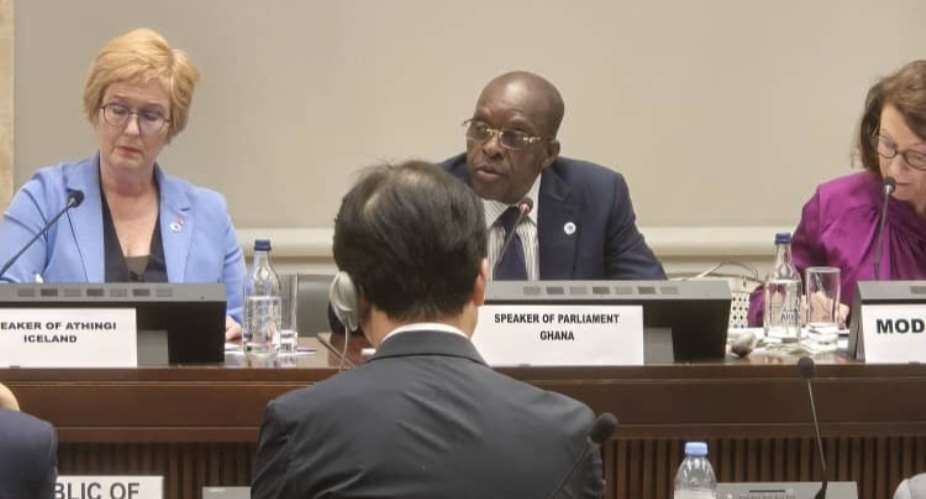
In in accordance to Ghana constitution under article 40 of the 1992 constitution on foreign policy and of global diplomacy, where the drums of war and the trumpets of peace often play in discord, Ghana has once again found her rhythm in the calm voice of her Speaker, Rt. Hon. Alban Sumana Kingsford Bagbin. His appointment to the Inter-Parliamentary Union (IPU) Task Force on the Russia–Ukraine conflict is not merely a political nod; it is a diplomatic affirmation of Ghana’s historical standing as a messenger of peace among nations. Like a lighthouse guiding ships through turbulent waters, Bagbin’s inclusion illuminates Ghana’s unbroken commitment to the ideals of peace, dialogue, and multilateral cooperation.
Ghana’s entry into the global peace arena did not begin today. Since the dawn of independence, when Dr. Kwame Nkrumah thundered before the United Nations that “the independence of Ghana is meaningless unless it is linked with the total liberation of Africa,” the nation has walked a path paved with international solidarity and diplomatic responsibility. Bagbin’s task, therefore, is an extension of Ghana’s long-standing faith in the United Nations (UN) Charter, whose pillars rest upon justice, human rights, and the peaceful settlement of disputes.
Under Article 1 and 2 of the UN Charter, every member state pledges to resolve international disputes by peaceful means and to refrain from the threat or use of force against the territorial integrity of another. Ghana, since 1957, has been one of Africa’s most faithful adherents to these principles. Through both the General Assembly and the Security Council, Ghana’s diplomats have sung the same chorus — that dialogue must always trump destruction, and that the pen of negotiation must always be mightier than the sword of aggression.
It is this same principle that guided Ghana’s ratification of the Vienna Convention on Diplomatic Relations (1961), which remains the cornerstone of modern diplomacy. This convention ensures that even amidst conflict, nations maintain the sacred corridors of communication. Ghana’s commitment to this agreement reminds the world that diplomacy is not the art of surrender but the science of survival, where conversation replaces confrontation.
Ghana’s peace spirit also breathes through the Constitutive Act of the African Union (AU), particularly Article 4(e) and (h). These provisions enjoin African states to resolve conflicts peacefully and empower the AU to intervene in the face of war crimes, genocide, or crimes against humanity. Ghana has stood firmly behind these doctrines, advocating for mediation in continental crises — from Sudan to Mali — believing that Africa must not be a graveyard of peace but a cradle of reconciliation.
Regionally, Ghana’s dedication to peace is embodied in her participation in the ECOWAS Protocol on Conflict Prevention, Management, Resolution, Peacekeeping and Security (1999) and the Supplementary Protocol on Democracy and Good Governance (2001). These agreements bind member states to collective peacekeeping and conflict resolution efforts. When neighbors stumble into strife, Ghana often becomes the first to send not soldiers of conquest but envoys of conciliation — a reflection of her diplomatic soul.
On the global front, Ghana has been among the early signatories of the Treaty on the Prohibition of Nuclear Weapons (TPNW), reaffirming its moral and strategic stance against weapons of mass destruction. In doing so, Ghana proclaimed to the world that true power lies not in arsenals but in ideals, and that disarmament is not weakness but wisdom. Such moral courage aligns Ghana with the peace architecture of the United Nations and the aspirations of humankind.
Moreover, Ghana’s ratification of the Geneva Conventions (1949) and their Additional Protocols signifies her commitment to the laws of war — to protect civilians, prisoners, and the wounded even in times of conflict. These conventions breathe life into Ghana’s humanitarian diplomacy, ensuring that even when the guns roar elsewhere, Ghana’s conscience still speaks for the voiceless.
Equally important is Ghana’s role in environmental and developmental diplomacy through instruments like the Paris Agreement (2015) and the Sustainable Development Goals (SDGs). The linkage between peace and sustainable development is codified in SDG 16 — Peace, Justice, and Strong Institutions. Ghana’s policy framework interprets peace not only as the absence of war but as the presence of justice, equality, and good governance.
Through decades of participation in UN peacekeeping operations, Ghana has transformed her soldiers into ambassadors in uniform. From the war-torn streets of Congo to the dusty plains of Mali, Ghanaian peacekeepers have guarded hope with humility. Their presence affirms that Ghana’s diplomacy is not only spoken in conference halls but acted out on battlefields — defending peace without seeking conquest.
During her 2022–2023 tenure on the UN Security Council, Ghana once again lifted the banner of neutrality, urging dialogue between Russia and Ukraine, championing humanitarian corridors, and calling for accountability under international humanitarian law. In that diplomatic theatre, Ghana was not a spectator but a small nation with a big moral megaphone, echoing truth amidst tension.
All these engagements are enshrined in Ghana’s 1992 Constitution, Article 40, which directs the state to conduct foreign affairs in consonance with international law and to settle disputes by peaceful means. This constitutional mandate transforms Ghana’s diplomacy from mere political strategy to a moral and legal obligation — a commitment embedded in the nation’s very governance DNA.
Thus, Bagbin’s appointment to the IPU Task Force is both symbolic and substantive. It embodies the continuum of Ghana’s foreign policy — from Nkrumah’s Pan-African vision to Rawlings’ peacekeeping ethos and today’s parliamentary diplomacy. It shows that Ghana’s Parliament is not just a law-making chamber but a moral compass, guiding conversations that shape global peace.
In the turbulent theatre of global politics, where superpowers flex and smaller states often fade, Ghana stands as a moral referee, reminding the world that peace is not the silence of guns but the harmony of understanding. Bagbin’s role at the IPU is thus not just a personal honor; it is Ghana’s rebirth as the conscience of dialogue, carrying the weight of Africa’s peace tradition into Europe’s storm.
As the sun of diplomacy sets over one continent and rises over another, Ghana’s voice remains steady — echoing through the halls of the United Nations, the AU, and now the IPU. In the words of the philosopher Spinoza, “Peace is not the absence of war; it is a virtue, a state of mind, a disposition for benevolence, confidence, and justice.” And in that virtue, Ghana — through the calm wisdom of Speaker Bagbin — continues to show that even small nations can speak great truths, and that peace, once sown, can outlive the noise of war.
By:
Zakari GUA JNR a. k. a Scorpio 🦂
SECURITY AND JUSTICE ADVOCATE/ ANALYST


 Obuasi SHTS alleged sexual abuse: Kwasi Kwarteng criticises Education Minister o...
 ECOWAS’ $250,000 flood relief donation arrives in Ghana – Ablakwa
 Kennedy Agyapong has not resigned from NPP – Kwasi Kwarteng
 State failure, not GoldBod, driving galamsey – Daryl Bosu
 A Rocha Ghana raises alarm over human rights abuses in mining communities
 ECOWAS, AfDB discuss ways to advance West Africa’s development priorities
 October 16: Cedi gains against dollar, sells at GHS12.25 on forex market, GHS11....
 Galamsey: Ghana’s rivers now run chocolate and milk colour — Sam Jonah
 A nation of job-seekers will always be poor — Sir Sam Jonah
 “If you attack us with pepper spray, we’ll fight back” — NDC Yakubu Tony Aidoo w...


