




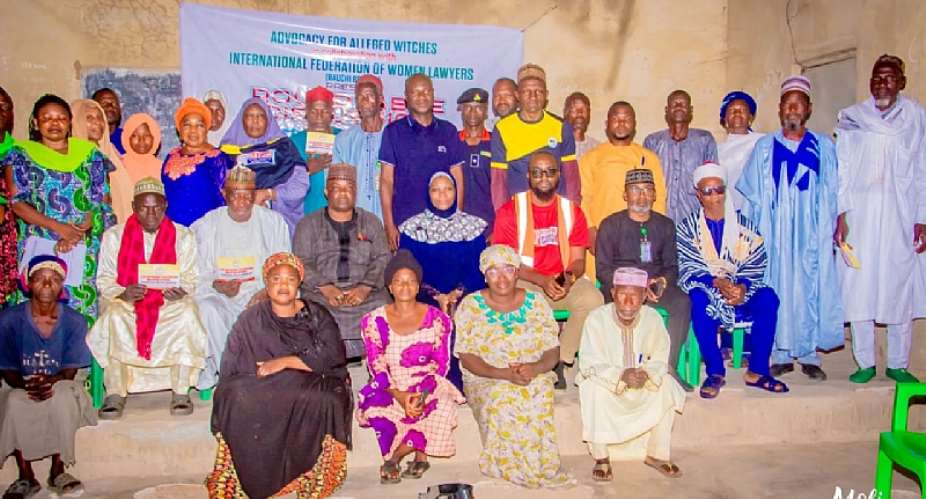
Following the successful roundtable discussion in Lapai, Niger State, with the Mixed Observers Team, the Advocacy for Alleged Witches (AfAW) turned its attention to Bauchi State, which was fast becoming a hotspot for witchcraft accusations and persecutions, particularly against women. The rising number of cases inspired a partnership with the International Federation of Women Lawyers (FIDA), Bauchi State branch, resulting in a joint roundtable discussion held on October 17, 2015.
The event took place at the Government Day Secondary School, Tafawa Balewa Local Government Area, located over 80 kilometers from Bauchi town.
The discussion commenced with a welcome address from Hauwa Abubakar, Esq., Chairperson of FIDA Bauchi, who noted that the engagement aimed to enlighten community members about the dangers of stigmatization and harmful traditional beliefs. She emphasized that the campaign sought to protect vulnerable individuals, especially women, and to prevent abuses linked to witchcraft accusations across communities in Bauchi State.
In his goodwill message, Dr. Leo Igwe, Director of AfAW, commended FIDA for co-organizing the event and reaffirmed AfAW’s commitment to combating witch-hunting and related abuses. He highlighted that victims of witchcraft accusations are predominantly women, children, and the elderly, mostly from poor rural communities.
Dr. Igwe observed that Bauchi State remains one of the Nigerian states where abuses linked to witchcraft beliefs and ritual attacks are frequently reported. While acknowledging the efforts of FIDA, the National Human Rights Commission (NHRC), and the Nigeria Police Force in prosecuting offenders, he emphasized that much more needs to be done.
Calling for sober reflection, Dr. Igwe urged participants to remember victims such as Talatu Joshua, Damina Lamba, Hafsat Bala, Sunday Sale, Ezekiel Samaila, and a recently abused 7-year-old girl in Bauchi. He encouraged attendees to interrogate why witchcraft accusations persist, why they disproportionately target vulnerable groups, and what gaps exist in current interventions.
He concluded by calling on all stakeholders to take active roles in ending witch persecution, warning that “in a society like ours, everyone is a potential victim.” Dr. Igwe reaffirmed AfAW’s readiness to continue working with FIDA, NHRC, and other agencies to make witch-hunting history in Nigeria and across Africa.
The session was highly interactive, featuring testimonies from victims, community members, and officials.
The representative of the Divisional Police Officer (DPO) commended the timeliness of the event, noting that many individuals attribute personal misfortunes to superstitious beliefs rooted in ignorance. He cited a case handled by the police in which a self-proclaimed “witch hunter” confessed that he labeled people as witches “out of hunger,” admitting that it was merely a means of survival and that he possessed no supernatural powers.
Mrs. Hanaatu, a resident of Tafawa Balewa LGA, shared her ordeal following a witchcraft accusation in September 2025. Her neighbors accused her of using spiritual powers to “pour pepper into their mother’s eyes,”. To prove her innocence, the local chief and her accusers demanded that she drink a concoction prepared by a local priest. Her refusal led to threats of attack, banishment, verbal abuse, and stigmatization. She reported the incident to the police, and her accusers have since been charged to court.
Another victim, Rose, recounted her experience through her son. She was accused by her deceased friend’s family of initiating the deceased’s daughter into a coven and using her for witchcraft. Rose and the deceased had been lifelong friends, sharing many personal and social experiences. According to her son, the allegations were devastating. Rose was coerced to take a concoction to prove her innocence but resisted. In retaliation, the community banished her and vowed that she would not be buried there upon her death. Despite reporting the matter to the police, Rose and her son continue to live under threat and stigma.
Both Hanaatu and Rose identified their traditional head, Sarkin Malan Musa of Dunga, as playing a central role in their persecution. They alleged that he supported and encouraged the threats against them and even attempted to influence the DPO to compel Rose to visit the local priest. The DPO reportedly refused to cooperate, instead advising the community to desist from further abuses.
Another victim, Mrs. Gloria Musa, recounted that in 2014, she was accused by her husband and his family, particularly her mother-in-law, of using witchcraft to steal from her husband. She recalled being isolated and treated like a stranger in her own home, which had a profound emotional impact and strained her marriage.
A representative of the National Human Rights Commission expressed appreciation for the program and urged community members to report all cases of witchcraft-related abuses to appropriate authorities. He emphasized the Commission’s mandate and readiness to intervene in such matters and provide redress for victims.
Other participants, including relatives of victims and representatives of partner agencies, shared similar experiences and observations. They highlighted the widespread nature of witch-hunting in rural communities, attributing it to ignorance, superstition, and lack of awareness. They called for sustained community engagement, grassroots sensitization, and collaboration among stakeholders to curb the menace.
In response to the cases of Hanaatu and Rose, the Advocacy for Alleged Witches (AfAW) has committed to monitoring their cases and has provided material support to both victims.
The roundtable discussion successfully brought together victims, law enforcement officers, human rights advocates, religious and traditional ruler, CSOs and community members to deliberate on the rising wave of witchcraft accusations and persecutions in Bauchi State.
The engagement reinforced the urgent need for education, legal intervention, and community collaboration to end witch-hunting practices. AfAW and FIDA reaffirmed their shared commitment to protecting vulnerable individuals and ensuring justice for victims, while calling on all stakeholders to play active roles in eradicating witch persecution from Nigerian communities.
Dooyum Dominic Ingye,
Program Manager,
Advocacy for Alleged Witches

 Thousands attend Kenya opposition rally amid anger over political violence
 Trump slams AI sceptics as Altman pauses OpenAI IPO plans over safety concerns
 WASSCE: School officials helped students cheat for years, but we now see the tru...
 Probe alleged military killing of lecturer in Bawku – Kusaug Youth demands
 ‘If we all pay GH¢1,000 each, we should be able to construct National Cathedral’...
 Mahama inspects proposed site for Upper West Regional Airport
 Mahama reiterates government's commitment to end double-track SHS system
 Police interdict officer over death of 23-year-old Ivan Baidoo on Tema Motorway
 Improved invigilation is exposing true performance of Ghanaian students — Mahama...
 There's no policy to introduce Arabic, Chinese in all public schools — Mahama


