




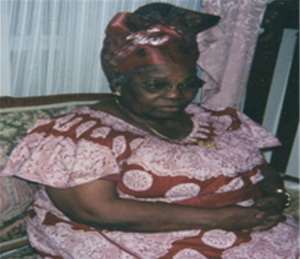
I originally published this tribute in October 2013. I am republishing it in memory of her 12th anniversary of her death.
Joanna Gbeh Passawe, affectionately called Aunty Jo, was a source of the Nyanfore-Nimley family history. She was the matriarch and advisor. I met her over fifteen years ago in the US, though I had heard of her as a boy in Liberia. She was the daughter of Princess Nyanfore Boryonoh, a tough and strong Grandcess woman from Liberia. Grandaunt Boryonoh called herself "woman passed man" because of her strength and energy. I did not see her, but heard a lot about her. Aunty Jo, like her mother, believed in our African traditional culture. She would say boldly and with pride that she was a "Siklio Ploh, Krao Ploh", meaning I am a Grandcess woman, a Kru woman. As a young woman, she would tie her lappa, shake herself, and walk majestically, just like her mother used to. As she grew older, she became the family unifier, historian, head mother, and a leader. She died Tuesday, October 8, 2013, in Monrovia, Liberia. She was 84 years old.
Aunty Jo was born April 15, 1929 in Grandcess, Grand Kru County, in Liberia unto the union of Charles Wolo and Nyanfore Boryonoh. The union produced sixteen children, but only three lived to adulthood. Aunty Jo, her older sister Jestina Doe, and her young brother Ben Wolo were the surviving siblings. Jestina, named Sarwrobo in Kru, was born on November 27, 1919. Ben, named Weah, was born in March 1932. He was the gbawelleh, meaning the last child of his mother, Boryonoh. She was the daughter of Dagbayonoh Nyanfore, king of Grandcess from 1901-1908 during the administrations of Presidents Garriston Gibson and Arthur Barclay respectively.
Dagbayonoh was also a warrior, fought against Western imperialism and against control by the central government. Boryonoh was the sister of Dagbayonoh Kiah Nyanfore, my grandfather. He named her daughter Sarwrobo, praying that the child and those who would follow live to adulthood. The family is from the Niteor panton or Niteor-Nyapo panton, an offspring of the Nyapo panton, one of the original eight pantons in Grandcess. They are "Wlapor, Chiepor, Kleapor, Tuan, pluka, Nyanpor, Nmahpor, and juwrepor. The number later increased to 17."
In the 1800s, Grandcess was an independent entity before it became part of the Liberian geographical ruling boundary of the central government. The area is an oceanfront land with white sand beaches, coconut trees, and a golf course-like inland landscape, just like Palm Beach, Florida, without the manufactured structures. The late President Edwin Barclay praised the land's beauty when he visited Grandcess and Barclayville during his administration. Kplepo, the original and traditional name of Barclayville, was changed in the 1930s to the latter name after Barclay.
Aunty Jo discussed her parents in a research interview. "My mother was a tomboy growing up in Grandcess. She would wrestle and defeat the boys. She hung out with them. My grandfather, King Dagbayonoh Nyanfore, was concerned about my mother's activities. Then she met my father, Wolo, who, on the other hand, was quiet and stayed to himself. He was an orphan. His parents died shortly after his birth. The village generally raised him and cared for him. So my grandparents advised my mother not to be rough and difficult with Wolo, who was interested in her. People in the village thought that he did not have a chance with her. To the surprise of the villagers, my mother changed in her behavior with my father. They married later".
Aunty Jo and her two siblings lived in Grandcess until they came to Monroevia. First, Jestina went to Grand Bassa for school. In Monrovia, she married Christie Doe, giving birth to Gloria and to five other children, including Scholastica Gbeh Doe and Stephen Doe. Ben married Lucille Johnson, giving birth to eight children, including Charles, Boryonoh, Nyema, and Ben Wolo, Jr. He also had a child, Benedicia, his firstborn. In 1944, at 15, Aunty Jo came to Monrovia to live with Jestina. But she returned to Grandcess because she missed her mother. However, she came back to Monrovia later and stayed for good. She married Jacob Passawe in the 50s. Mr. Passawe came from Grand Cape Mount and was a medical dresser or nurse with Firestone. The family moved to Bomi Hills. They birthed Maiah Tonia, William, Willie, Wilfred, Andrew, Famatta, Jacob, and Rose.
Although Aunty Jo loved her mother and supported her on many matters, she spoke out when she felt her mother was wrong, sometimes trying to take control of the house when her mother visited. She said further. "My husband did not appreciate that, and I supported him. But that was Mama; to her, we, the women, were still her girls. This take charge or take control behavior was part of her as a Nyanfore; fearless, and always in control". Equally, speaking out and taking a position on an issue is a family legacy. For instance, the late Thorgues Sie, a family member, stood up against injustice during Tubman's regime in Liberia and was jailed for many years in the 50s. Boryonoh's nephew, James Nyanfore, stood up for what he believed was right.
When Aunty Jo came to the US to spend time with her children, Wilfred, Famatta, and Rose, I had the opportunity to interview her for my genealogical research on the family. I had missed interviewing her older sister, Jestina, whom I felt would have provided more information since she was an older sister. But Jestina died before I could interview her. I felt bad about that. Gloria, her daughter, was mad at me, too. We all, with the late Gwen Lee, had made the family history project our mission. However, when I met Aunty Jo, I was amazed by her wealth of family information. She was like a working encyclopedia. She knew dates, names, places, events, people, and their relation to the family. She had the family history on her fingertips. I cross-checked her information, and they were accurate.
Gloria and her sister Wanneh, or Jestina Doe Anderson, initially interviewed Aunty Jo and Brother Ben Wolo, Sr. That interview showed the extension of the family connection beyond Grandcess to other places. Unfortunately, Ben died shortly after the interview. Gloria also passed on. With Ben's death, Aunty Jo became the only surviving sibling of the Nyanfore Boryonoh –Charles Wolo's children. She also became the oldest member of the Nyanfore family.
Ben and Aunty Jo were closed. He was the little one, and the sisters would defend him. Aunty Jo and the late teacher Kpan, a relative on the mother's side, were instrumental in removing him from a non-family member's home, where he was mistreated as a boy. He was quiet and did not complain about his mistreatment. Like Aunty Jo, he came to Monrovia. He resided with his sister, Jestina, who also had experienced similar treatment in Grand Bassa. Ben attended St. Patrick's School in Monrovia. As stated before, he later married Lucille, who, as a girl, went to St. Theresa Convent.
By 2005, Aunty Jo left the US to go to Ghana to care for her grandchildren and son Jacob, who had gone to Ghana because of the Liberian civil war. Among the children was Famatta's son Bill, who had accompanied her to Ghana. "I brought him with me so he can experience Africa and learn Kru", she told me when I visited the family in Ghana a year later. Bill was certainly speaking Kru. I was impressed. "I want him to know his language", she added. But a few years later, Famatta suddenly died. Aunty Jo was devastated and heartbroken. Famatta, like her grandmother Boryonoh, was like a rock, a pillar, and she stood for the family. Aunty Jo mourned her for months, nearly a year, but she remained strong. She continued caring for the children, including Famatta's daughter Marie and granddaughter Kula, in Monrovia until her death.
A few days before her death, she and her daughter Rose sang Kru religious songs. She was, in essence, singing in her cultural language, thanking God and saying goodbye. She said goodbye to her son, Wilfred, when she advised, a day before passing, to prepare the house for visitors. She knew she had performed her duty well and told her story and family history well. She advised us to move on and carry on the family legacy.
As I looked back at the many materials I had collected on the family, I thanked Aunty Jo and other deceased family members who had provided me with information in my research on my people.
Recording and documenting our history has been a pleasure. I would encourage others with elderly family members to talk to them and document family history before they pass on. They do not have to be public officials, celebrities, or famous. Every person has a story, and every family has a history. Please write it down, value your own! Talk with Aunty Jo was an honor. She was not rich materially but wealthy with value, dignity, integrity, the family she raised, and the story she told of herself and of her people. I will miss her caring, singing, talking, and laughter in our traditional culture. But with video recording technology, we can always see and hear her telling family stories. Future generations also will listen to her. She was a great source.
Thank you again, Aunty Jo.
May your soul rest in heavenly peace!

 NPP rejects Mahama's appointment of Emelia Agbenyo as EC deputy, demands withdra...
 Excessive consumption of processed meat can expose one to cancer – Health expert...
 Education Minister appeals to University Administrators to call off strike, resu...
 'You're doing yeoman’s job' — Mahama lauds Police over declined unresolved murde...
 Wilmar Africa, De Heus, other food processing companies face CID action over dat...
 NPP’s Baba Amando runs to police over alleged death threats
 Ghana repatriates 120 Nigerians arrested in cybercrime operations
 PIAC unable to verify GH¢21million petroleum-funded projects in Ayawaso West
 Wontumi pleads not guilty to five charges in GH¢30m Exim Bank fraud case
 Ghana among stronger-performing economies in sub-Saharan Africa — IMF


