




Kwabeng’s Cry is a ceremonial restoration article—strategic, dignified, and mobilizing. It weaves my lived memory with civic urgency and geographic precision to chart a restoration roadmap for Kwabeng and Atiwa West. Anchored in ancestral stewardship, youth mobilization, and evidence-based advocacy, this piece calls on traditional leaders, MMDCEs, MMDAs, and Ghana’s youth to rise with purpose. It transforms ecological grief into a movement of healing, positioning Kwabeng as the ceremonial epicenter of Ghana’s environmental renewal including a call to action for youth-led business ventures—rooted in memory, dignity, and economic renewal.
🕊️ Prologue: Memory as Mandate
In the 1970s, Kwabeng was a living tapestry of abundance. The Awusu River flowed freely. Palm wine trickled through the streets like libation. Forests stood tall with ancestral pride. Ambassador Kwame Tenkorang and I walked those lands when galamsey was but pickaxe digging—rudimentary, restrained, and far from the ecological devastation we now face.
Today, Kwabeng is a shadow of its former self. The rivers are gone. The palm wine is no more. Galamsey has evolved into a 24/7 industrial assault, with excavators replacing shanphengs and poisoned soil replacing fertile ground. The district’s health, food security, and cultural memory are under siege.
This is not just an environmental issue—it is a moral emergency.
🛡️ Ceremonial Call to Action
We call upon:
- Traditional Leaders to invoke ancestral stewardship and legitimacy, restoring the covenant between land and lineage.
- MMDCEs and MMDAs to declare selective states of emergency in verified hotspots, enabling swift intervention and resource allocation.
- Youth Brigades to rise with tools of restoration—not destruction—armed with seedlings, shovels, and civic pride.
- Coalition Partners to repurpose seized excavators for healing, not harm—transforming machines of ruin into instruments of renewal.
Let Kwabeng become the ceremonial epicenter of Ghana’s restoration movement.
🗺️ Evidence Base: Mapping the Crisis: A Narrative of Degradation and Duty
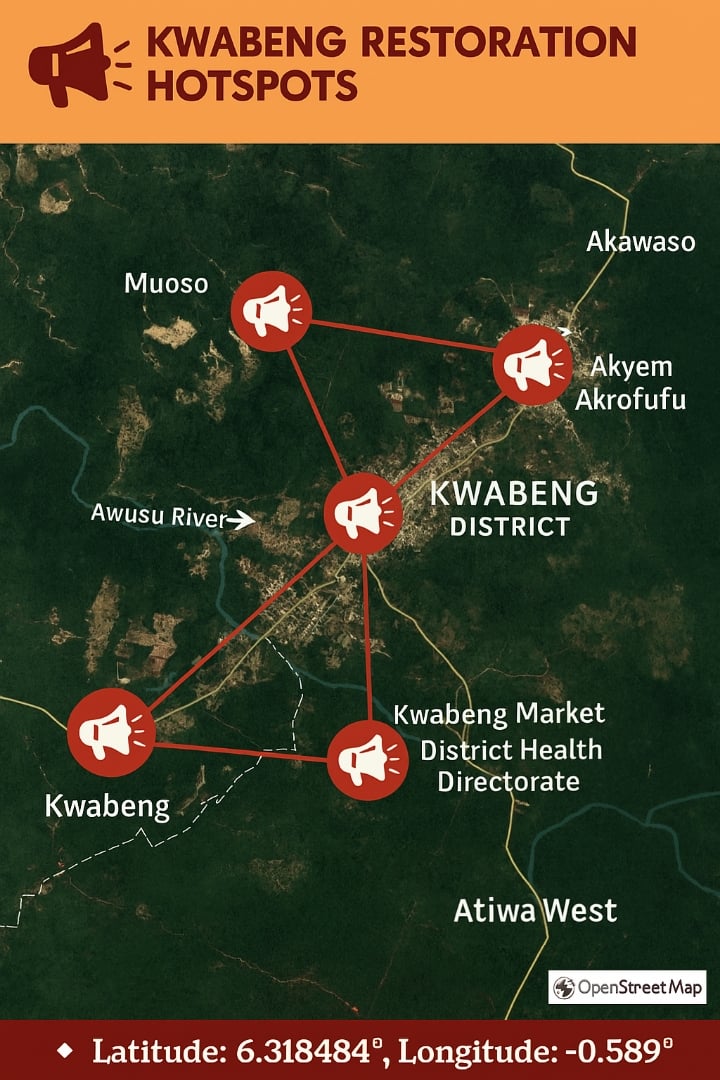
Using Google satellite imagery and OpenStreetMap coordinates, we trace the degradation:
The ecological wounds of Kwabeng and its surrounding communities are not abstract—they are visible, traceable, and urgent. Through satellite imagery and ground reports, we can now map the crisis with clarity and ceremonial purpose.
Near Akyem Akrofufu and Muoso, the forest canopy has been torn apart. What was once a lush green corridor is now a patchwork of exposed soil and stagnant pits. These zones lie dangerously close to residential areas, threatening both biodiversity and human health. The scars here are fresh, wide, and expanding.
Kwabeng Market, once a hub of agricultural exchange and communal life, now sits within a zone of vulnerability. Soil contamination from nearby galamsey operations has seeped into the ground, affecting food safety and market viability. Traders speak of dwindling yields and rising sickness—an economic and public health alarm.
Just steps away, the District Health Directorate faces its own siege. The absence of clean water sources and the proximity to degraded land have increased the risk of waterborne diseases. Health workers report spikes in skin infections, gastrointestinal illnesses, and respiratory complications—symptoms of a poisoned environment.
The Awusu Riverbed, once the lifeblood of Kwabeng, is now a dry memory. Satellite coordinates (Latitude: 6.31848°, Longitude: -0.589°) mark its former path—a ceremonial line that once carried fish, stories, and spiritual significance. Today, it is a trench of silence, calling for restoration.
These coordinates are more than data points. They are ceremonial anchors. Each one marks a place where healing must begin. Each one is a summons to chiefs, engineers, youth, and coalition partners to rise—not with lament, but with tools of renewal.
Geospatial Anchor: Latitude: 6.31848°, Longitude: -0.589°
Each scar is a call to heal. Each coordinate is a point of mobilization.
🛠️ Coalition Restoration Roadmap
Phase 1: Verification & Mobilization (Weeks 1–4)
- Deploy civic scouts and drone mapping teams to confirm hotspot data
- Host ceremonial town hall in Kwabeng to launch the Restoration Pact
- Engage chiefs and elders for land blessing and youth endorsement
Phase 2: Engineering & Excavator Repurposing (Weeks 5–12)
- DCE to commission Sappers (field engineers) for soil testing and water tracing
- Convert seized excavators into eco-restoration tools (e.g., terracing, rechanneling)
- Begin pilot restoration at Awusu Riverbed
Phase 3: Youth Brigades & Cultural Replanting (Weeks 13–24)
- Mobilize youth for tree planting, erosion control, and cultural signage
- Integrate Adinkra and Kente motifs into restoration zones for ceremonial dignity
- Launch “Palm Wine Revival” campaign—symbolic and agricultural
Phase 4: Monitoring & Legacy Building (Months 7–12)
- Establish Restoration Watchtower with GIS dashboard and community alerts
- Document oral histories and ecological testimonies for civic education
- Host annual “Kwabeng Restoration Festival” to renew commitment
📣 Final Charge: Let Our Voices Be Heard
Kwabeng is not just a place—it is a memory, a mandate, and a mirror. Let our voices echo through the valleys of Atiwa West. Let the soil remember our footsteps. Let the rivers rise again—not just with water, but with purpose.
This is our ceremonial charge. This is our civic inheritance.
Let the land remember. Let the youth rise. Let the chiefs speak. Let Kwabeng stand.
This is not the end—it is the beginning of a movement rooted in memory, guided by evidence, and crowned with purpose. We do not mourn the past; we mobilize the future. From poisoned rivers to sacred soil, from excavators to seedlings, from silence to song—Kwabeng shall rise again.
Let every scar become a site of healing. Let every coordinate become a call to action. And let every voice—from the palace to the classroom—echo the truth:
Restoration is not a project. It is a covenant.
And within this covenant, let us plant the seeds of youth-led enterprise. Let the sons and daughters of Kwabeng revive the delicacies we once shared—Nkukor Nketekete, snails, grasscutters, and the cherished ebunu ebunu soup. Let fish ponds replace mining pits. Let palm wine flow again—not just in memory, but in market.
We call on the youth to rise—not only as restorers, but as innovators. Let them lead ventures in aquaculture, regenerative farming, and cultural gastronomy. Let every restored plot become a business. Let every harvest become a hymn.
This is our charge. This is our covenant. This is Kwabeng’s cry—and Ghana’s call.
Atitso Charles Akpalu
Retired Senior Citizen
Teshie-Nungua
[email protected]

 NaIMOS arrests 49 suspected illegal miners after armed clash at Adiewoso
 Upper East Regional Minister leads technical assessment for proposed airport pro...
 Missing car dealer found dead as police arrest friend over alleged murder
 Teacher Sir Ola shares inspiring story of sacrifice and compassion
 Extreme heat is a growing threat to health, jobs and food security in southern A...
 Mali lawyer critical of junta abducted overnight
 Two women die on migrant boat near France seeking to reach UK
 Iran offers strait deal, Trump says he's not satisfied
 How faulty fan regulator sparked fire, destroyed two rooms at Suhum Konfine
 Don’t store bread beyond four days – Baker advises


