🛡️ This is not merely a campaign—it is a moral summons. From poisoned rivers to scarred forests, Ghana’s land bears the wounds of unchecked destruction. This restoration call rises from verified galamsey hotspots and civic anguish, guided by strategic clarity and ceremonial resolve. It invites youth brigades, coalition partners, and state custodians to act—not in delay, but in dignity. The time to heal is now.
🔥 Tolerance Is Not Weakness—Tuesday, September 23, 2025
The NPP-led demonstration against galamsey passed without arrests or intimidation—a rare moment of civic peace. It revealed a leadership posture under President Mahama that values tolerance and listening. But tolerance alone cannot restore poisoned rivers or reclaim ravaged forests. The time for half-measures is over. The time for restoration is now.
🌍 The Galamsey Wound: Mapping the Hotspots
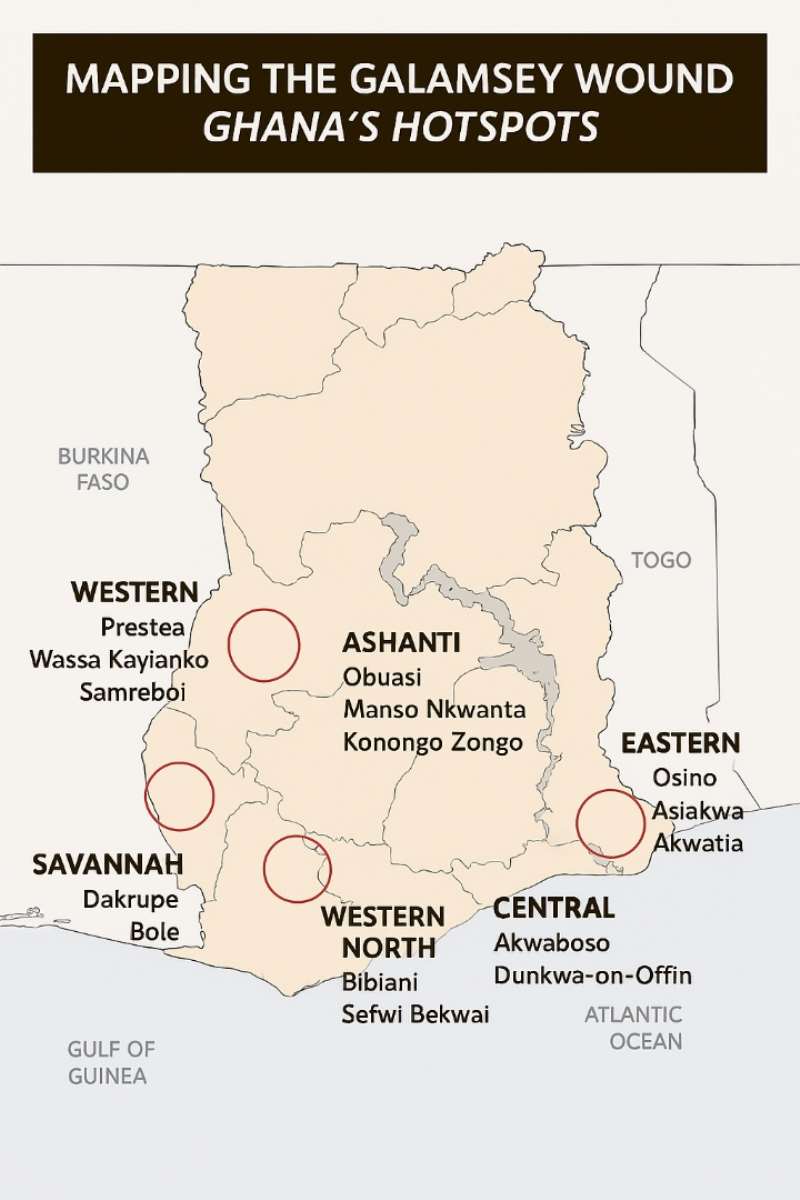
Ghana’s environmental crisis is no longer scattered—it is concentrated, documented, and deadly. According to recent government and EPA reports, 44 galamsey hotspots have been identified across six regions:
🗺️ Mapping the Galamsey Wound: A Journey Through Ghana’s Scarred Lands
Ghana’s soil is crying. From the lush forests of the Western Region to the riverbanks of the Eastern corridor, illegal mining—galamsey—has carved deep wounds into our land. These are not distant tales. They are real places, real communities, and real rivers now gasping for breath.
Let us walk through the map of destruction—not to despair, but to understand, and to act.
These areas suffer from mercury-laced rivers, arsenic-contaminated soil, and toxic food chains. The Pra, Offin, Birim, and Ankobra rivers now run brown and lifeless. Crops and fish in these zones show dangerous levels of lead and cyanide.
🌳 Ashanti Region: The Heart of Gold, Now Bleeding
Once the pride of Ghana’s mineral wealth, Ashanti now bears the scars of reckless mining.
- Obuasi: Once a model mining town, now surrounded by toxic pits.
- Manso Nkwanta: Rivers here run brown, and cocoa farms are vanishing.
- Konongo Zongo: Mercury traces found in water sources used by schoolchildren.
🌲 Western Region: Forests Falling, Rivers Dying
The Western Region’s green canopy is thinning.
- Prestea & Wassa Kayianko: Heavy machinery operates day and night, often under the cover of silence.
- Samreboi: Once a timber hub, now a hotspot of soil erosion and water contamination.
🌿 Western North: The Forgotten Frontier
Here, the damage is quieter—but no less deadly.
- Bibiani: Illegal pits dot the landscape like open wounds.
- Sefwi Bekwai: Community wells now test positive for arsenic and lead.
💧 Eastern Region: Rivers Turned to Poison
The Birim River, once a source of life, now flows with sorrow.
- Osino & Asiakwa: Galamsey has crept into school zones and farmlands.
- Akwatia: Diamond dreams turned into environmental nightmares.
🏞️ Central Region: The Offin River Cries Out
- Akwaboso & Dunkwa-on-Offin: River dredging by illegal miners has left aquatic life devastated.
- Fisherfolk report declining catches and rising illnesses.
🌾 Savannah Region: The New Frontier of Destruction
Galamsey has moved north, chasing untouched lands.
- Dakrupe & Bole: Drylands now host illegal operations, threatening fragile ecosystems.
🛡️ Why This Map Matters
This is not just geography—it is a moral map. Each hotspot is a call to action. Each poisoned river is a plea for restoration. Each scarred forest is a reminder that our legacy is at stake.
Let us not wait for the land to die before we act. Let us rise now—with youth brigades, military engineers, seized excavators repurposed for healing, and a ceremonial call for a selective state of emergency in these zones.
🛠️ Strategic Recommendations for Restoration
Restoration must be bold, coordinated, and ceremonial in its dignity. We propose:
1. Selective State of Emergency
- Invoke Article 31 of the 1992 Constitution in the 44 identified hotspots.
- Empower government to restrict movement, seize equipment, and deploy emergency resources.
2. Military Field Engineers & Sappers in the Lead
Deploy Ghana Armed Forces engineering units to lead:
- River dredging and purification
- Reforestation and erosion control
- Construction of water treatment stations
3. Seized Excavators for Restoration
Repurpose confiscated galamsey machinery for:
- Dredging polluted rivers
- Filling abandoned pits
- Transporting seedlings and restoration materials
4. Youth Mobilization Brigades
- Form Eco-Guard Units in schools and communities.
- Train youth in environmental monitoring, drone mapping, and civic reporting.
5. Cultural Campaigns
- Use Adinkra symbols like Nkyinkyim (transformation), Eban (security), and Duafe (cleanliness) in banners, murals, and scrolls.
- Mobilize artists, poets, and designers to reframe restoration as a sacred duty.
📣 Call to Action: Restoration Is a Legacy, Not a Luxury
We call on:
- Parliament to approve emergency declarations and fund restoration.
- Faith leaders to preach stewardship from pulpits and mosques.
- Traditional rulers to reclaim sacred lands and enforce bans.
- Media houses to spotlight restoration heroes and expose saboteurs.
- Diaspora partners to fund eco-technology and community health clinics.
Let us remember: “The one who climbs a good tree is given a push.”
Let us push each other toward restoration—not division.
🕊️ Final Word: Restoration Is the New Patriotism
Galamsey is not just illegal—it is immoral. It poisons our children, desecrates our ancestors, and threatens our future. Restoration is not a partisan ambition—it is a patriotic obligation.
Let us rise—not as NPP or NDC—but as Guardians of Ghana.
Retired Senior Citizen
Founder, Heritage Shield Ghana
Teshie-Nungua
[email protected]

 Parliament to reconvene on May 21 following Easter break
 Passengers isolating on cruise after Cape Verde ban over suspected virus deaths
 Stop blaming Akosombo inferno for current dumsor — Okoe Boye tells Energy Minist...
 President Mahama to host global leaders for high-level reparations conference
 Refrain from cheating — United Party advises 2026 BECE candidates
 Support us to serve you better — Fire Service urges public
 BECE 2026: Minority urges candidates to stay focused
 Prisons Service warns public over fake social media accounts soliciting money in...
 Fighting racism 'must be at heart of presidential debate', French mayor tells RF...
 From this year, persons indicted in the Auditor General’s reports will be prosec...