




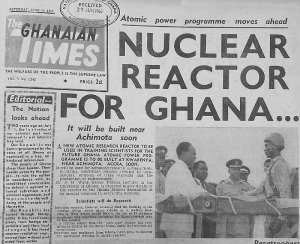
In 1967, the Ghanaian Times published a revealing perspective: while Dr. Kwame Nkrumah was making plans to build a stable nuclear power plant to provide electricity, industrial growth, and scientific advancement for his people, the United States was investing heavily in the creation of atomic weapons of mass destruction. This striking contrast—one leader seeking light and progress, another nation pursuing fear and dominance—symbolizes the global contradictions of power and governance during the Cold War era.
Nkrumah’s Vision: Science for Liberation
From the moment Ghana gained independence in 1957, Nkrumah believed that political freedom without scientific and technological empowerment was incomplete. His government established the Ghana Atomic Energy Commission (GAEC) in 1963 to spearhead research in nuclear science, with the ultimate aim of generating clean and stable energy for Ghana’s growing industries and cities.
To Nkrumah, atomic energy was not about warfare—it was about light for villages, power for factories, and progress for Africa. He invested in training young Ghanaian scientists abroad, acquiring nuclear research reactors, and positioning Ghana as a pioneer of scientific development on the continent. He envisioned an Africa where nuclear science would heal, feed, and empower, not destroy.
The Western Response: Fear and Resistance
But this vision unsettled the global powers. In the 1960s, the Cold War defined the world order. For the United States and its allies, nuclear technology was primarily associated with weapons and deterrence. To see a small African nation, led by a bold Pan-Africanist, striving to master nuclear science outside of Western control was deeply threatening and they flew the atomic nuclear facility to the US.
The Ghanaian Times captured this irony in 1967:
- Nkrumah sought a nuclear plant to power Ghana.
- America built atomic weapons to dominate nations.
The contrast was not just technological—it was moral. It was about whether nuclear science would serve humanity’s progress or its destruction.
Why Nkrumah Was Overthrown
Nkrumah’s overthrow in 1966, barely a year before that article, was not a mere coincidence of domestic dissatisfaction. Declassified CIA documents and scholarly research confirm that the coup had Western fingerprints. Nkrumah’s independent policies, his call for African unity, his ties with the East during the Cold War, and his determination to use science for Africa’s self-reliance made him an obstacle to Western geopolitical interests.
One of the reasons behind the coup, as reflected in Ghanaian public discourse at the time, was precisely this:
- While the West feared an Africa in control of its own nuclear energy, Nkrumah saw nuclear science as the pathway to freedom from dependence.
The coup that removed him derailed Ghana’s atomic dream and sent a clear warning to other African leaders who dared to think independently.
The Call for African Solidarity
Nkrumah’s vision remains unfinished. Today, Ghana has a research reactor at the Ghana Atomic Energy Commission, contributing to medicine and science, but the full dream of an atomic power plant remains unrealized.
The lesson of 1966–1967 is still alive:
- If Africa does not support Africa, others will exploit divisions and crush progress.
- If Africa does not protect visionary leaders, external forces will ensure their downfall.
- If Africa does not control its own science and technology, it will remain dependent.
Nkrumah’s atomic project was not just about energy. It was about Africa’s dignity, independence, and future.
As the Ghanaian Times implied in 1967, history is a tale of two paths:
- One path uses science to uplift and empower.
- The other uses science to dominate and destroy.
Africa must choose the first—and guard it fiercely.


 'Grounds for removal of Chief Justice and justice of superior court shallow, eph...
 Ghanaian banks write Off GH¢1.23bn in bad loans in first half of 2026
 Family of Gbewaa Training College lecturer killed by curfew soldiers vows legal ...
 Don't be a Bar that flips on principles but a Bar that is consistent — AG tells ...
 Fully completed GH¢213,490 SOCO volleyball court abandoned after Bongo youth rej...
 24-hour economy market projects poorly planned, lacks consultation – Minority
 Stan Dogbe orders Greater Accra Regional Coordinating Council to restore Kpeshie...
 Police probe mysterious death of popular primary school teacher at Ampabame No. ...
 NACOC arrests three members of ‘Bolle Jos’ Network over French cocaine seizure
 Regular sex is not prostate cancer prevention — Urologist cautions


