




When a commodity chart starts beating a tech darling, the world pays attention. A widely shared graphic drawing on ICCO and Yahoo Finance data shows cocoa prices soaring in early 2024 outstripping even Nvidia’s headline-grabbing rally. The comparison, strictly speaking, isn’t apples-to-apples: the cocoa line is a futures-based index and Nvidia is a single stock. Still, the message is unmistakable - the market says cocoa is precious.
Yet the Ghanaian farmer, who tends trees through droughts, swollen shoot disease, aging stands, and the rising cost of inputs, is not feeling that preciousness. After a recent, marginal upward adjustment in the producer price, too many households still face the impossible arithmetic of doing more with less. The result is a slow-motion tragedy: some farmers are cutting down cocoa to chase quick cash in illegal mining, sacrificing soil, water, forests and the nation’s green reputation for a few uncertain grams of gold.
If there was ever a moment for the ruling NDC to prove that campaign promises were more than slogans, this is it. The government pledged to restore dignity and real income to cocoa households, to tackle illegal mining decisively, and to invest in productive, climate-smart agriculture. Delivering on that agenda now would change lives, and anchor Ghana’s leadership in a turbulent global food system.
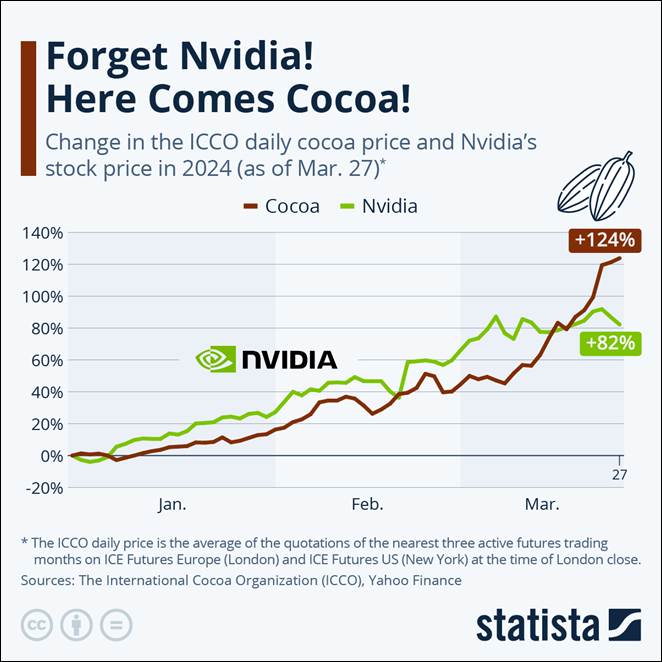 Graph caption: Cocoa outpaced even Nvidia in early-2024: ICCO daily cocoa price index vs. Nvidia stock, YTD to Mar. 27, 2024 (+124% vs. +82%). Source: Statista, compiling ICCO & Yahoo Finance. Note: these series aren’t like-for-like—cocoa reflects an average of the nearest three active futures on ICE Europe/US, while Nvidia is a single equity price.
Pay Farmers Their Share of the Boom
World-market prices have moved sharply. Ghana must ensure that farm-gate prices move meaningfully too. That means going well beyond token increases and committing to a transparent formula that gives farmers a stable, predictable share of export value. A credible target is to guarantee not less than 70–80% of the net FOB as the farmer share over the season, with automatic pass-through of the Living Income Differential (LID) and any quality premiums. When the market rallies, farmers should not be left behind by hedging losses, legacy debts or opaque deductions.
Why it matters: a bold price signal is the single fastest way to stop the conversion of cocoa farms into illegal pits. When cocoa pays, cocoa stays, and forests, rivers, and communities are safer.
Invest Like Cocoa Is Strategic, Because It Is
Ghana cannot “price its way” to a resilient cocoa sector without investment. The government should table a Cocoa Futures Fund, not a financial instrument, but a real-economy plan to deliver:
Replanting & Rehabilitation at Scale: Finance the replacement of diseased and senescent trees, with compensation during the unproductive years. Pair high-yielding, disease-tolerant varieties with farmer-preferred shade trees to buffer climate extremes.
Inputs on Time, Not on Paper: Timely mass spraying, affordable fertilizers and soil amendments, and last-mile delivery that is tracked digitally to curb leakage.
Rural Roads & Warehousing: Farmgate prices are hollow if transport costs and post-harvest losses eat the margin. Fix feeder roads, expand storage, and roll out smart weighing and moisture testing at buying centers.
Finance That Fits the Farm: Expand low-interest, seasonal credit tied to good agronomic practices and traceability, not collateral farmers don’t have.
Value Addition at Home: Give tax and power-tariff incentives to local grinders and chocolate makers in exchange for domestic procurement contracts and farmer premium schemes. Every extra percent of processing in Ghana is more jobs, more taxes and more leverage in price negotiations.
Climate Services: Support on-farm irrigation where viable, agroforestry extension, early-warning for pests/weather, and community nurseries. Cocoa is now a climate-risk business; treat it like one.
Make Illegal Mining the Unprofitable Choice
Enforcement matters, but incentives decide behavior. A living cocoa income, paid on time and in full, undercuts the lure of illegal mining. Government should ring-fence a portion of LID and carbon/forest finance for community payments where forest cover is maintained and child labor risks are demonstrably reduced. Pair this with specialized mining courts, asset seizures for repeat offenders, and rehabilitation funds paid for by fines not by farmers who did nothing wrong.
Keep the Receipts: Traceability and Trust
Buyers increasingly demand proof-of origin, of forest protection, of labor standards. Ghana should finish the job on end-to-end digital traceability, with farmer IDs, plot polygons, and electronic receipts. Transparency isn’t a burden; it’s a premium. It unlocks better contracts and shields farmers from middle-mile opacity.
A Promise Worth Keeping
The NDC told the nation it would reward productivity, clean up galamsey, and put farmers first. Here is how to turn that into action quickly:
- Announce a mid-season top-up that materially lifts the producer price, explicitly tied to global price movements and LID flows.
- Publish a farmer-share formula and a quarterly dashboard showing what percentage of export value reaches the farmgate.
- Launch a 24-month Replanting Acceleration with compensation for unproductive years and community shade-tree targets.
- Deploy a Cocoa-Galamsey Strike Package: joint task forces, fast-track courts, and a PES (payment for ecosystem services) bonus for communities that keep forests standing.
- Sign local processing MOUs linking power-tariff relief to guaranteed farmer premiums and local jobs.
Hope is a policy, not a slogan
The Statista chart that has everyone talking again, not a strict like-for-like comparison captures a deeper truth: global markets are screaming that cocoa matters. Ghana must answer with policies that say farmers matter more.
Imagine a 2026 in which no farmer needs to fell a cocoa tree for a risky pit; where replanting is financed, roads are passable, inputs arrive before the rains, and the price at the buying center reflects the price on the screen. That is not utopian, it is a budget choice and a governance choice.
Cocoa built schools, clinics, port cities, and reputations. It can still do so if we pay the people who grow it and invest in the places they live. The world’s sweet tooth hasn’t dimmed; neither should the prospects of Ghana’s cocoa families.
Reference to figure:
“Forget Nvidia! Here Comes Cocoa!”—Statista chart based on International Cocoa Organization (ICCO) daily price index and Yahoo Finance (Nvidia), YTD to Mar. 27, 2024. Reminder: the two series measure different things and are not directly comparable, but they underscore the extraordinary strength of cocoa prices.


 ‘We have turned the tide’ – Ato Forson says Ghana is ready to take off
 Sammy Gyamfi refuses to file defence, hides behind technicalities — Lawyers
 Osahen Afenyo-Markin vows to pursue case against Sammy Gyamfi despite high court...
 Let us all be mentors to our younger generation - Mahama
 Court stops Osenase homecoming over security concerns
 Supreme Court dismisses Solomon Asamoah's bid to stop Sky Train trial
 GRA denies imposing new 20% tax on Netflix, Google and Amazon subscriptions
 Police arrest 16 suspects, seize 209 rounds of ammunition at Gbane mining site
 ‘Mahama has lost his moral high ground’ – Dr Zaato on Affi Agbenyo’s EC appointm...
 Cassava, hemp could offer alternatives to plastics – Zanetor challenges scientis...


