




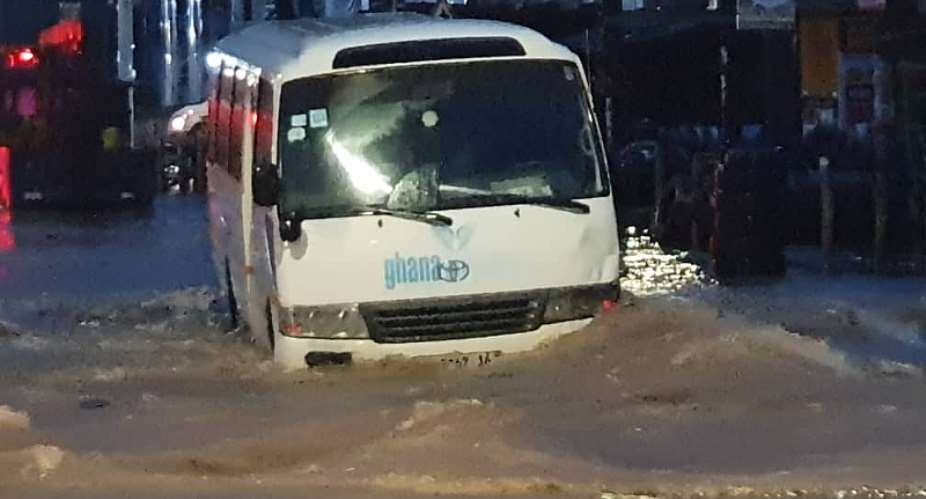
Accra's persistent battle with flooding is not a simple matter of too much rain. It's a complex issue of urban capacity, where a moderate tropical downpour can bring the city to a standstill. But as other global capitals have shown, from Tokyo's massive underground tunnels to Copenhagen's green streets, innovative solutions can turn a recurring disaster into a manageable challenge. For Accra, the path to resilience is clear, and the work has already begun.
On June 3, 2015, a devastating flood and a subsequent petrol station explosion claimed over 150 lives and caused an estimated US$100 million in damage, marking one of Accra's darkest days. Since then, images of submerged cars on major roads and families navigating chest-deep water have become an all-too-common feature of the rainy season.
The critical question is: how much rainfall should it take to inundate a major city? While Ghanaian meteorologists classify anything over 50 mm in 24 hours as "heavy rain," recent research suggests that for Accra, an "extreme" rainfall event can be as little as 45 mm. Such figures are not unusual in the tropics and should not automatically lead to chaos. The key difference lies in a city's capacity to manage stormwater through effective drainage, channels, and storage.
Global Lessons in Flood Resilience
Other major cities, once plagued by similar challenges, have invested in long-term solutions that now protect their residents and economies:
- Tokyo's Underground Cathedral: The Japanese capital is home to the G-Cans project, a colossal underground flood diversion facility that cost between $2.6 and $3 billion to construct. This system features a 6.3-kilometer tunnel that can pump approximately 200 cubic meters of water per second into the Edo River. This massive undertaking has been instrumental in sparing neighborhoods from deluges that once caused widespread flooding.
- Singapore's Strategic Investment: After disruptive floods on its famed Orchard Road, Singapore significantly raised its drainage design standards. The nation has invested in the Deep Tunnel Sewerage System (DTSS), a project costing around S$10 billion, designed to meet its water management needs for the next century. This "superhighway" for used water frees up valuable land and enhances the country's production of NEWater, its brand of ultra-clean, reclaimed water.
- Copenhagen's Green Transformation: A 2011 cloudburst that caused nearly $1 billion in damages prompted Copenhagen to rethink its approach. The city's "Cloudburst Management Plan" is a 20-year, 300-project initiative to protect against a 100-year storm. It focuses on creating green streets, retention parks, and deep tunnels, proving that climate adaptation can also enhance urban living.
Accra's Path Forward: The GARID Project
Accra's flooding challenges are specific and, importantly, solvable. The primary drainage channel, the Odaw-Korle system, is often undersized and choked with sediment and refuse. This is compounded by informal construction that obstructs waterways. When a major storm coincides with high tide, the drainage system can stall, pushing floodwaters into homes, markets, and clinics.
Fortunately, there is a comprehensive plan in action. The Greater Accra Resilient and Integrated Development (GARID) project, with significant funding from the World Bank, is a major step towards mitigating these risks. This five-year initiative (2020-2025) is designed to improve flood risk management and solid waste collection for about 2.5 million residents.
Recent progress on the GARID project includes:
- The commencement of dredging in the Odaw channel.
- The start of construction on the Nima and Akweteyman storm drains.
- An additional $150 million in financing approved by Ghana's parliament in May 2024 to further support drainage improvements, solid waste management, and the creation of a flood early warning system.
The project's success, however, hinges not just on major engineering works but also on consistent, everyday actions. This includes improved waste collection to prevent drains from clogging, regular clearing of inlets, and the enforcement of planning laws to keep waterways clear.
The Urgency of Adaptation in a Changing Climate
Climate change is raising the stakes. Projections for coastal Ghana indicate a future with fewer, but more intense, rainfall events, a pattern that is particularly effective at overwhelming urban drainage systems. The World Bank has warned that approximately US$3.2 billion in assets in Greater Accra are already at risk, a figure that could quadruple by 2050 if action is not taken. As the city continues to grow, this exposure will only increase unless new developments are steered away from flood-prone areas.
A flood-resilient Accra is within reach. It's a city where streets may temporarily collect water during a major storm, but homes and critical services remain safe and dry. This vision requires completing the vital upgrades to the Odaw River, creating green corridors and "water squares" to absorb excess rainfall, and integrating effective waste management into the city's daily operations. By making space for water before the storms arrive, Accra can follow the successful blueprint of other major cities and ensure a safer, more prosperous future for its residents.
Dr. Enoch Ofosu
University of Waterloo, Canada.
Email: [email protected]


 ‘We have turned the tide’ – Ato Forson says Ghana is ready to take off
 Sammy Gyamfi refuses to file defence, hides behind technicalities — Lawyers
 Osahen Afenyo-Markin vows to pursue case against Sammy Gyamfi despite high court...
 Let us all be mentors to our younger generation - Mahama
 Court stops Osenase homecoming over security concerns
 Supreme Court dismisses Solomon Asamoah's bid to stop Sky Train trial
 GRA denies imposing new 20% tax on Netflix, Google and Amazon subscriptions
 Police arrest 16 suspects, seize 209 rounds of ammunition at Gbane mining site
 ‘Mahama has lost his moral high ground’ – Dr Zaato on Affi Agbenyo’s EC appointm...
 Cassava, hemp could offer alternatives to plastics – Zanetor challenges scientis...


