




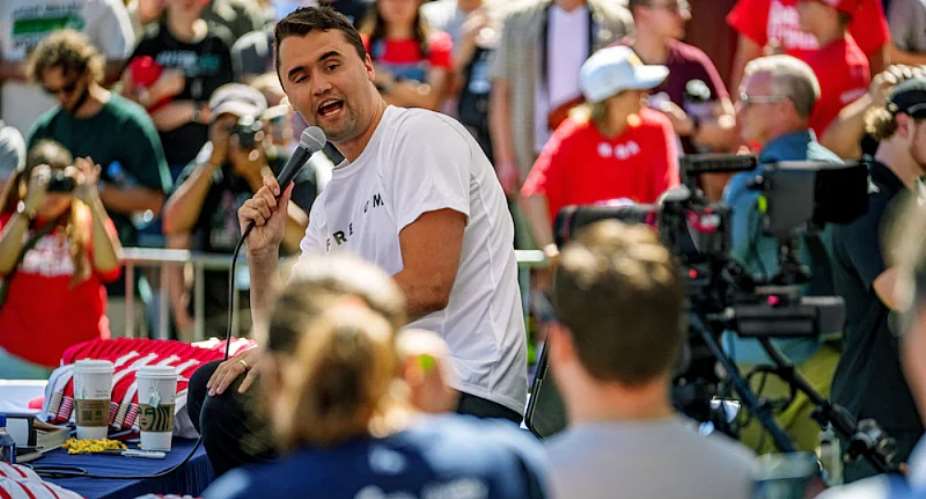
We are living in what can only be called an Age of Rage—a moment when political violence has become as normalized in public life as school shootings, homicides among Black men, and the loss of civil rights once taken for granted. The latest, tragic proof: the assassination of Charlie Kirk, shot and killed at a large public event at Utah Valley University on September 10, 2025. A 31-year-old public figure whose voice was loud and often provocative, Kirk’s death is being treated by many—including Utah’s governor—as a political killing.Reuters+4AP News+4The Guardian+4
This moment demands that we look back over the past decade to see how we got here, what rhetoric and early triggers paved the way, and what we must do now.
Early Triggers: 2015-2016
The roots run deep. As early as 2015, the rhetoric of political outsiders began to shift from policy disagreement to personal demonization—words like “traitor,” “enemy,” “witch hunt” became commonplace. Social media exploded with memes and partisan propaganda painting entire groups as threats. The rise of Donald Trump in 2015-2016 was pivotal—not just for policy change, but for redefining what is acceptable in political speech: harsh, mocking, threatening. The 2016 election saw scores of incidents where supporters or opponents were physically accosted, harassed, and intimidated. Institutions meant to protect norms (press, judiciary, public office) were attacked rhetorically as corrupt or illegitimate. In 2016, Trump said that he could “shoot somebody” on the street and not lose any votes. The last time I checked, shooting is violent.
From Threats to Bullet Points: 2017-2021
After Trump’s first inauguration, political violence escalated. In 2017, white supremacist and alt-right violence made a return in Charlottesville. In subsequent years, threats against public health officials during the COVID-19 pandemic, mass mobilization of militias, and attacks on election institutions have occurred. The January 6, 2021, Capitol riot represented a high-water mark: not only for the number of people, but for the betrayal of democratic norms.Journal of Democracy+1
Language from leaders and media—accusing opponents of being enemies, traitors, or threats to the nation; invoking conspiracies of stolen elections; demeaning and delegitimizing institutions—helped numb the public to increasingly violent acts.
Escalation: 2022-2025
In more recent years, the violence has become more direct. The number of threats against elected officials rose dramatically: over 9,000 in 2024 alone, as the U.S. Capitol Police investigated.Fox News+1 In Minnesota in June 2025, we saw the violent murder of Melissa Hortman, her husband, and attacks on other lawmakers—all by a single perpetrator, apparently driven by political opposition.Wikipedia+1 And now, Charlie Kirk’s killing—to many, the latest blow in a long series of politically motivated attacks.AP News+2Reuters+2
At the same time, rhetoric from many quarters has become more incendiary. Leaders on both sides have used language to frame enemies as existential threats. Declarations of “war,” “traitors,” “evil,” “insurgents,” etc., have become normalized. Sometimes this rhetoric comes from fringe media, other times from mainstream political figures. What was once fringe has become mainstream.
Who Has Spewed the Most Violent Rhetoric?
While exact quantification is difficult—because what counts as “violent rhetoric” varies, and much of it is in social media or speeches not always transcribed—some patterns emerge:
- The political figure most frequently cited for incendiary, dehumanizing, or violent metaphors over the past decade is Donald Trump. From calling opponents “vermin,” “rabid dogs,” or “traitors,” to claiming they'd “destroy the country,” his rhetoric often borders or crosses into framing enemies as threats to public order or national survival.
- On the other side, while Democratic leaders have also used strong rhetorical frames (“bigotry,” “fascism,” “white supremacy”), they have used violent imagery less frequently.
- Extremist media outlets, fringe groups, conspiracy circles, and social media amplify the harshest rhetoric—sometimes feeding ideas of assassination, violence, or forced removal of civil rights.
Why is This Normalizing Violence?
Because when every disagreement is framed as an existential struggle, dehumanization follows. Once we start saying that those on the other side are “evil,” “traitors,” or worse, the barrier to violence falls. Because threats are no longer shocking—they are expected. Once death threats and protests with violence become common, we see shootings in the halls of government or outside events as inevitable rather than extraordinary.
And because social media and cable news create feedback loops, a shocking threat or violent statement gets amplified, becomes headline news, and becomes fodder for reaction. Many politicians then feel compelled to “one-up” with equally extreme language, believing that the only way to avoid being outflanked is to escalate.
What This Means for Us
Empathy must return to the center of public life. Hebrews 4:15 states that Jesus empathized with human weakness. 1 Peter 3:8 calls us to be empathetic, like-minded, loving one another, compassionate, and humble. Additionally, Romans 12:15 exhorts us to mourn with those who mourn. These are not political statements—they are human ones. When someone is killed, threatened, or traumatized, we do not ask “which side” first; we ask “what happened” and “how do we stop this.”
We cannot accept political violence becoming routine. We must pause the rhetoric. Leaders must lead—not inflame. Tongues must be tempered; truth must matter more than applause. Public figures must take responsibility: to call out violence, to refuse to normalize threats, to affirm that even our worst enemies are still human.
A Call to Pause, Together
In this moment—on the eve of our 250th anniversary as a nation (1776-2026) —we stand at an apex. We can still choose a different path. A path of respect. Of dialogue. Of civil disagreement without fear. Let the memory of those murdered or threatened—including Charlie Kirk, Melissa Hortman, and too many others—be not just sorrow, but turning points.
Let us demand empathy. Let us refuse fear. And let us reclaim an America where even sharp disagreement does not end in threat or bloodshed. Charlie Kirk’s tragic murder shows the danger isn’t guns — it’s toxic rhetoric, low emotional intelligence, and outright hate. As a pro–Second Amendment thought-leader, I argue for reforms that target criminals while protecting rights. The real enemy isn’t the Second Amendment — it’s the culture tearing us divisively apart.
ABOUT THE AUTHORS
Edmond W. Davis is a Social Historian, Speaker, Collegiate U.S. Government Professor, International Journalist, and former Director of the Derek Olivier Research Institute. He is an expert on various historical and emotional intelligence topics. He’s globally recognized for his research on the Tuskegee Airmen and Airwomen. He’s the Founder and Executive Director of America’s first & only National HBCU Black Wall Street Career Fest. Justice Hampton is a native of Mississippi and a former research assistant at the Derek Olivier Research Institute (DORI) at Arkansas Baptist College.


 Ayariga challenges BoG to cite law behind arrests over cedi money bouquets
 Trump targets tax-free diesel as Republicans approach midterms
 Govt releases GH¢9.1 billion covering six quarters of DACF to MMDAs - Ayariga
 Manhyia South MP charged over alleged GH¢9.85m loss to SIC Life
 'I didn’t know the process would be that fast' – Nana B explains missing NPP swe...
 'Who is Karbo to defy my orders?' – Buttey fumes over NPP conference clash
 'Kojo Bamba can’t stop NDC' – Gbande warns NPP against shielding anyone from arr...
 Mahama pardons 863 convicted persons, 11 from death sentence
 NDC confirms Dzifa Gunu’s disqualification from La Dadekotopon constituency secr...
 Nigeria's Tinubu confirms 32 dead after military plane crash


