




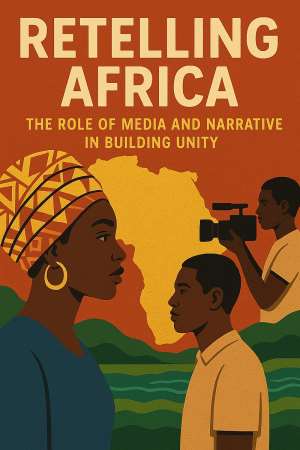
Africa’s story has too often been told by others and when the pen is not in our hands, the ink can wound us. From the days of colonialism, the media has been a powerful tool in shaping perceptions of the continent. Unfortunately, for decades, that power has been used not to celebrate our achievements, but to magnify our struggles. The result? A distorted mirror in which Africans see themselves as broken, and outsiders see only tragedy.
This is the invisible yet enduring face of media colonialism. While the flags of independence were raised in the 20th century, the airwaves, publishing houses, and global newsrooms remained under foreign control. Africa’s realities are still filtered through the eyes and biases of distant editors. It is not uncommon for a war in one African country to be presented as a “continental crisis,” while a technological breakthrough in another barely makes the news. The world’s mental image of Africa is often curated by those who have never set foot on its soil.
The solution is not to merely complain about bias, but to seize the tools of storytelling. We must own our content from newspapers to streaming platforms, from publishing houses to film studios. Content ownership is more than a business venture; it is a cultural necessity. It ensures that our heroes are not erased, our languages are not sidelined, and our histories are not rewritten to suit someone else’s agenda.
A truly united Africa needs a shared curriculum, one that teaches our children about Mansa Musa alongside Napoleon, about the Mali Empire alongside the Roman Empire, about the Asante resistance alongside the American Revolution. When our young people learn history that reflects their true heritage, they will see themselves not as colonial appendages, but as heirs to ancient civilizations and innovators of tomorrow.
In this vision, African cinema and literature are not just entertainment; they are nation-building tools. Our films should capture the humor of Lagos streets and the courage of Kigali’s recovery. Our novels should sing with the poetry of the Sahel and the rhythm of the Cape. We must support directors, authors, poets, and playwrights who dare to imagine an Africa beyond the wounds of the past and who are unafraid to expose both the failures and triumphs of the present.
Unity is not built solely on treaties and trade; it is woven through the stories we tell about ourselves. When a Senegalese child grows up watching a Kenyan superhero, when a Tanzanian student reads a South African novel, when a Nigerian family tunes in to a documentary made in Ghana that is continental citizenship in practice.
For too long, others have been the narrators of our journey. The time has come to reclaim the microphone, the camera, and the printing press. The African story must be retold not as a continent defined by its scars, but as a tapestry of resilience, creativity, and unbroken spirit.
And perhaps, when the world finally hears Africa in her own voice, it will be impossible to ignore her chorus of unity.


 Nigeria's onion dispute with Ghana tests West African free trade
 Uganda suspends military ties with Turkey over extradition of Museveni critic
 US fears wider Middle East escalation after Houthi attack Riyadh
 Pop star Ed Sheeran calls Gaza situation “unjustifiable” amid controversy
 'We have spent 60years arguing about Nkrumah and rather less time doing what he ...
 Judge recounts attempted MoMo scam on him moments after jailing scammer
 'Systemic failure due to NACOC removal from port inspections' – Inusah Fuseini o...
 Foreign Affairs Ministry releases 200-page RTI response on GH¢49.7m South Africa...
 Chartered flights account for GH¢27.18m of South Africa evacuation cost


