




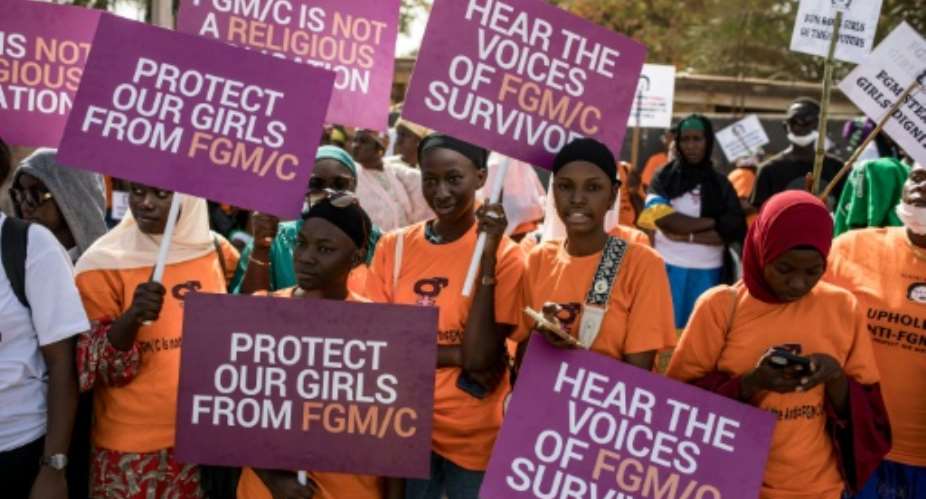
Rights activists in The Gambia are calling for justice after a one-month-old baby's death was linked to female genital mutilation, a widely practised but illegal procedure up for review before the country's Supreme Court.
The Gambia has one of the highest rates of FGM in the world, with 73 percent of women and girls aged 15 to 49 having undergone the procedure, according to 2024 figures from UNICEF.
The baby girl was pronounced dead upon arrival at a hospital in the capital Banjul after being "allegedly subjected to circumcision" and developing severe bleeding, The Gambia Police Force said in a statement Sunday.
The death has sparked outrage among women's rights defenders working to combat the deeply rooted cultural and religious practice that they say is a harmful violation against women and girls.
"FGM is not a cultural tradition to be defended -- it is a form of gender-based violence that can kill," Santana Simiyu, a human rights lawyer with rights group Equality Now, said in a statement sent to AFP Tuesday.
Two women allegedly involved in the case are in custody, police said, as an investigation is carried out in the western town of Wellingara, where the incident occurred.
Researchers at Britain's University of Birmingham estimated in a study published in 2023 that approximately 44,320 girls and young women die each year due to FGM in the countries where it is practised.
Former Gambian dictator Yahya Jammeh, now in exile, outlawed FGM in 2015, branding it outdated and not a requirement of Islam.
Parliament later that year adopted the first law specifically banning the practice, which is now punishable by up to three years in prison but is rarely enforced.
In July 2024, lawmakers revisited the matter, upholding the 2015 law despite pressure from religious traditionalists.
But the ban was immediately challenged before the Gambian Supreme Court, where the petition remains pending.
"If the Gambia's Supreme Court rules that the country's law prohibiting FGM is unconstitutional, it would have a hugely detrimental impact on the well-being of women and girls, leaving them without legal protections," Simiyu said.
FGM involves the partial or total removal of the female external genitalia or other injuries to the female genital organs.
It can lead to serious health problems including infections, bleeding, infertility and complications in childbirth.


 Nurse rescues mother and baby after unplanned delivery in bush
 McCarthy-Mallam road rehabilitation begins amid commuters’ complaints of heavy t...
 TOR briefs IMF on recovery efforts, inherited debt and sustainability plans
 Aseidu Nketia urges NDC contestants to unite after constituency elections
 EC yet to announce Dormaa Central NDC constituency results
 Baaba Cann questions Obuasi SHTS handling of sexual misconduct allegations again...
 Obuasi SHS headmaster case: “It is better to pay for sex with prostitute than ra...
 NDC not worried about NPP’s Kojo Bamba, he is small boy – Azorka
 Obuasi SHTS: 'Children are not buffet' – NPP’s Fatimatu confronts Zuba
 Resource exploitation fuelling Africa’s conflicts – Mahama


