




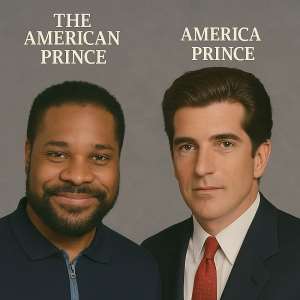
CNN is calling John F. Kennedy Jr. (1960-1999) "American Prince" in its recent series special tribute—and for many, that title feels automatic. The son of a martyred president, the face of post-Camelot charm, JFK Jr. was royalty by birthright. But if America truly believes in meritocracy, dignity, and long-standing cultural impact, then the title of The American Prince belongs not to a fallen heir, but to a man who’s quietly reigned for four decades with dignity, artistry, and example: Malcolm Jamal Warner (1970-2025). This showdown is between two American sons, one from an American president, the other from America’s #1 TV sitcom, family.
From 1984 to 1992, Warner was America’s son—the heart and soul of the most-watched sitcom in the 1980s, The Cosby Show. Theo Huxtable he wasn’t just a character—he was a cultural bridge. Theo was intelligent but flawed, funny yet serious, relatable to white suburban teens and inner-city Black kids alike. Warner’s presence helped redefine the image of young Black men on TV. He didn’t sag, curse, or conform to the stereotypes. He studied, struggled, loved his family, and wore sweaters like armor.
These young American males—Malcolm-Jamal Warner and JFK Jr.—didn’t have a gun fixation, a rough agenda right or left, mental health issues, drug problems, or socially abstract anomalies. They represented possibility, not pathology. In a country where so many young men are now discussed through the lens of violence or dysfunction, they stood for elegance, excellence, and example.
But let’s go deeper—side by side, by the numbers:
🔹 Age 15
- Malcolm-Jamal Warner (1985): Already starring on The Cosby Show, the #1 show in America, as Americans demonstrated over 30 million weekly views according to NPR. He was a teenage national role model, shaping the image of Black boys with empathy, intelligence, and humor.
- John F. Kennedy Jr. (1976): A sophomore in high school at Phillips Academy. Still privately mourning his father and growing up in elite social circles, not yet publicly engaged in any form of cultural leadership.
Analogy: At 15, Malcolm-Jamal Warner was already America’s son. JFK Jr. was America’s mystery.
🔹 Age 28
- Malcolm-Jamal Warner (1998): Starred in and co-produced Malcolm & Eddie, a successful sitcom that ran for four seasons. Behind the scenes, he was directing music videos, performing spoken-word poetry, and branching into jazz performance—creating art across disciplines. He was the co-composer to the introduction song to Malcolm & Eddie.
- JFK Jr. (1989): Admitted to the New York State Bar on his third try according to the LA Times. He worked as a prosecutor in Manhattan for four years, a respectable but low-impact public service role, largely shielded by his name and image. His public life still revolved around fame, not function.
Analogy: At 28, Warner was building a multi-platform artistic legacy. JFK Jr. was learning how to carry his name without fully using it.
🔹 Age 38
- Malcolm-Jamal Warner (2008-09): Released The Miles Long Mixtape, further establishing himself as a jazz/funk musician. He had also directed numerous TV episodes, performed on stage, and published poetry. Still scandal-free, still evolving.
- JFK Jr. (1999): Tragically died in a plane crash en route to Martha’s Vineyard. At that point, George Magazine —his most ambitious project—had folded, and his political aspirations remained unrealized.
Analogy: Warner was refining his legacy; JFK Jr.'s remained delayed in potential.
While JFK Jr. was saluting his father’s casket in 1963—a moment frozen in American grief—Malcolm-Jamal Warner was being born into a very ‘different world’, no pun intended, in 1970. By the time Warner hit 14, he wasn’t just acting—he was shaping culture. Millions of Americans tuned in weekly to watch Theo navigate adolescence, responsibility, and young Black manhood with heart and humor. He was America’s son on-screen and off.
But here's where the comparison gets compelling. JFK Jr., while beloved, was never truly of the people. He was featured on magazine covers and evoked a misty nostalgia. He co-founded George Magazine—a bold, if brief, attempt to mix politics with pop culture. He dated actresses, made the tabloids, and had a few appearances in courtrooms (not as a defendant, but always with the glint of privilege).
Malcolm-Jamal Warner, by contrast, never relied on tabloid buzz or scandal. He worked. He wrote. He evolved.
After The Cosby Show, Warner didn’t fade—he transformed. His acting expanded (Malcolm & Eddie, Suits, The Resident). He picked up a Grammy for Best Spoken Word Album in 2015. He’s a masterful poet, a celebrated podcaster, and a bassist who’s jammed with the best in jazz and soul. He remained clean, dignified, and powerful in an industry that often consumes child stars and spits out hollow headlines.
Warner is not just a legacy—he is a living one, even in his passing. He’s the blueprint for success for all young actors/actresses. JFK Jr. is remembered for what he could have been. Warner showed us what is possible since 1982.
And yet, when we talk about “American Royalty,” the narrative remains lopsided. If you come from power, you’re automatically treated like it. If you come from purpose, you’re often overlooked.
Let’s be honest: JFK Jr. was handsome, polished, and destined for something greater. But that destiny was more media prophecy than measurable impact. Yes, his tragic plane crash in 1999 froze him in time—young, princely, and unrealized. But history must go beyond myth.
Warner, meanwhile, has lived his impact. He raised generations, shifted paradigms, and never needed a rerun to remain relevant.
Ask a Baby Boomer, a Gen Xer, or a Millennial who “Theo Huxtable” is, and they’ll smile. Ask them who edited George Magazine, and you may get silence. JFK Jr. deserves admiration. His charm was real. His loss was tragic. But Warner’s presence is historic. He was a cultural son raised in real time on America's most-watched stage. And four decades later, he’s become a cultural father—modeling excellence, artistry, and integrity.
So why isn’t he given the same “prince” label?
Because Black excellence, when it’s consistent and clean, rarely gets crowned. Because Malcolm-Jamal Warner has never needed America’s sympathy—only its respect. And that’s harder to earn. He didn’t need a father who was president. He didn’t need a yacht or the Hamptons. He had a gift, a platform, and a generation watching. And he delivered.
Warner’s story doesn’t end in tragedy—it continues in legacy with his family led by his wife, daughter, mother, and family. He is the prince who stayed the course. The prince who grew up with us, who never stopped teaching, and who made “Theo” a timeless archetype of growth, intelligence, and heart. CNN got one version of the story. But America needs the whole truth. JFK Jr. may have been a prince. Malcolm-Jamal Warner is The American Prince.
Disclaimer: In the United States, the term "prince" holds no official political, cultural, or social recognition due to the nation's foundational rejection of monarchy. Instead, such titles are often used for glamorization or to sensationalize figures within society’s upper echelons. In a free nation, anyone may refer to themselves as a prince, princess, king, or queen as a form of personal or artistic expression. In that spirit, both of these American icons are referred to as "prince" in this context—meant not to diminish but to honor their unique and powerful legacies. God bless their families, this nation, and this world.
ABOUT THE AUTHOR
Edmond W. Davis is an American Social Historian, Collegiate Professor, International Journalist, and former Director of the Derek Olivier Research Institute. He is an expert on various historical and societal topics. He’s globally known for his research on the history of the Tuskegee Airmen and Airwomen. He’s the Founder and Executive Director of America’s first & only National HBCU Black Wall Street Career Fest.


 'We don't reject partnerships, but those partnerships must be on our terms' — Ma...
 Mahama receives five reports ahead of Ghana’s 2027 AU chairmanship
 Police arrest suspect in GH¢1.1m fake gold deal in Berekum
 C/R: Wildlife Guard shot dead by suspected poacher at Kakum Forest Reserve
 Here are areas affected by planned power interruption on Sunday from 3 AM to 6 P...
 Upper East youth raise concern over ‘snail-paced’ development
 Gold buyer reportedly shot dead in daylight robbery at Manso Adubia
 50 Aspirants Pick Forms for 11 National Executive Positions in NPP Elections
 Amoah: Minority’s Questions on GoldBod Are Legitimate and Necessary

