




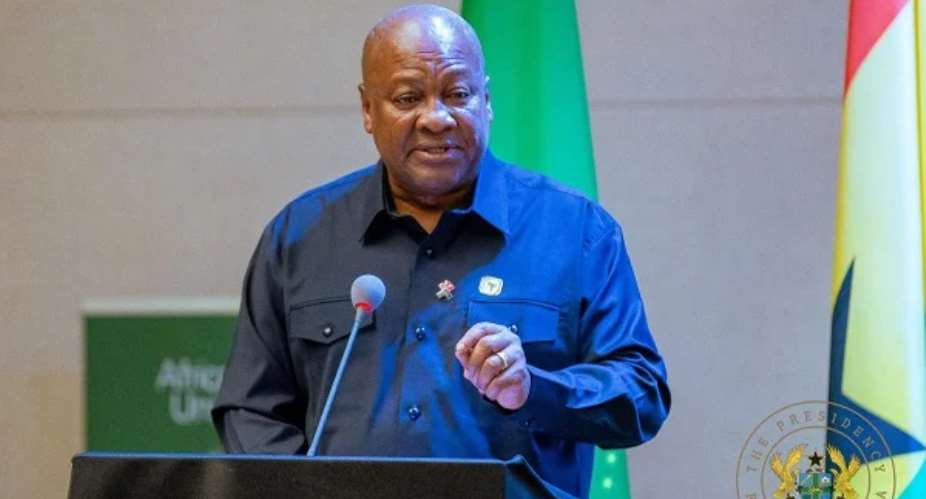
President John Dramani Mahama has called for a fundamental shift in Africa’s relationship with the rest of the world, urging the continent to move from economic dependence towards greater self-reliance, control of its natural resources and stronger influence in global decision-making.
Speaking on TRT World’s Bigger Than Five programme on Friday, August 21, 2026, President Mahama said Africa’s economic challenges were partly rooted in a global system that had left the continent dependent on external assistance while limiting its ability to benefit fully from the resources it possesses.
He described his proposed approach as an “Accra Reset”, stressing that Africa should continue to engage international partners but do so from a position of greater strength and with its own interests at the centre.
“We don't reject partnerships, but those partnerships must be on our terms. We must have a greater say in what those resources are used for,” he said.
From political independence to economic liberation
President Mahama said Africa had successfully fought for political independence but that the continent now faced a different struggle centred on economic freedom.
“The challenge that us leaders of Africa today face is not the liberation struggle that was fought by Kwame Nkrumah and our forebears. It is the economic struggle,” he stated.
According to him, African economies continue to lose significant value because the continent exports raw materials and subsequently imports finished products at higher prices.
He said this pattern had contributed to Africa’s continued dependence on foreign assistance while limiting the continent’s ability to control the value generated from its own resources.
“And so we live on the handouts that the West gives us. And then, aside from that, we don't control our resources. Our resources are bought at prices that are set by the West and exported. And the finished products are sent back to us at prices that are set by the West,” he said.
He argued that African countries must increase local processing and manufacturing, create jobs and retain a greater share of the wealth generated from their natural resources.
‘Africa cannot continue to be a dependent continent’
President Mahama said Africa’s dependence extended beyond trade and natural resources to the continent’s broader position in international affairs.
“Africa cannot continue to be a dependent continent. There are things we can do so that we're able to have a better voice in global affairs,” he said.
He cited healthcare as one area where African countries needed to build greater self-sufficiency.
According to him, the continent must strengthen its health systems and increase local pharmaceutical production to reduce excessive dependence on imported medicines.
“We must create more resilient health systems. We must produce more of our medications locally in Africa. We must own our health outcomes more ourselves,” he stated.
He said the same principle should apply to Africa’s minerals, agricultural commodities and other strategic resources.
‘Africa’s prosperity is not a threat to anybody’
President Mahama rejected the argument that a more prosperous and self-reliant Africa would threaten other parts of the world.
“Africa's prosperity is not a threat to anybody. Indeed, Africa's prosperity will be a benefit to the whole global economy,” he said.
He argued that stronger African economies would create larger consumer markets, attract investment and provide greater opportunities for international businesses.
He also maintained that economic growth would give African countries greater capacity to address challenges in education, healthcare and social development.
For President Mahama, therefore, economic self-reliance should not be confused with isolation. Instead, Africa should maintain partnerships while negotiating from a position of greater economic and political strength.
Greater African voice in global affairs
The President further called for stronger African representation in institutions responsible for global decision-making, particularly the United Nations Security Council.
He argued that Africa deserves permanent representation on the Council and urged countries on the continent to develop common positions on major international issues.
He said a united African position would enable the continent to negotiate more effectively and exert greater influence in shaping global policies.
President Mahama linked this diplomatic objective directly to economic strength, arguing that Africa’s ability to influence global affairs would depend partly on its capacity to become more economically independent.
Reparations and global justice
The interview also touched on calls for reparations over the transatlantic slave trade.
President Mahama said the issue should not be viewed solely through the lens of financial compensation but should also involve acknowledgement, justice and healing for Africans and people of African descent.
He also criticised what he described as inconsistencies in the application of international law, particularly in relation to the conflict in Gaza.
“As long as we continue to distort justice, depending on who it is, we'll continue to live a lie,” he said.
He argued that international rules should be applied consistently, regardless of the identity or geopolitical influence of those involved.
Africa’s resources, Africa’s future
At the heart of President Mahama’s message was a call for Africans to take greater ownership of the continent’s economic future.
He said Africa must break away from the cycle of exporting raw materials and importing finished goods by investing in processing, manufacturing and value addition.
Ghana, he noted, is seeking to increase local processing of key commodities, including cocoa and minerals, with the goal of significantly expanding domestic value addition by 2030.
He also pointed to Africa’s youthful population and growing technological capabilities as opportunities that could help the continent overcome some of the structural challenges that have constrained its economic development.
President Mahama stressed that the objective of the “Accra Reset” was not to sever Africa’s relationship with the international community but to redefine it on the basis of equality, mutual benefit and African interests.
“We don't reject partnerships, but those partnerships must be on our terms,” he reiterated.
He maintained that a stronger and more prosperous Africa would not only benefit its people but would also contribute positively to the global economy.
“Africa's prosperity is not a threat to anybody,” President Mahama said.
 YEA deploys over 11,700 youth under Community Police Assistant Model – Basintale
 Parliament’s Human Rights Committee demands swift investigations in Obuasi SHTS ...
 'Let the law take its course' – Veep on Obuasi SHTS sexual abuse allegations
 Obuasi SHTS sex scandal: 'The powerful ride the law to trample the weak' – Kofi ...
 19-year-old remanded over alleged fatal stabbing of boyfriend at Ofankor
 Woes of SHTS Headmaster deepen as he resigns as old students’ chairman
 'NPP has 35 NDC scandals to drop from now till 2028 elections' — Sammi Awuku
 'NDC will pay for Obuasi SHTS sex scandal' – Sammi Awuku warns
 Use of hormonal contraceptives linked to increased breast cancer risks – Doctor ...
 ECOWAS deepens EU cooperation to improve disaster response in West Africa



Comments
Great message as usual from you , Mr President. The global positioning of Africa in the technology revolution is more than necessary to pay attention to our current opportunities. Well spoken