




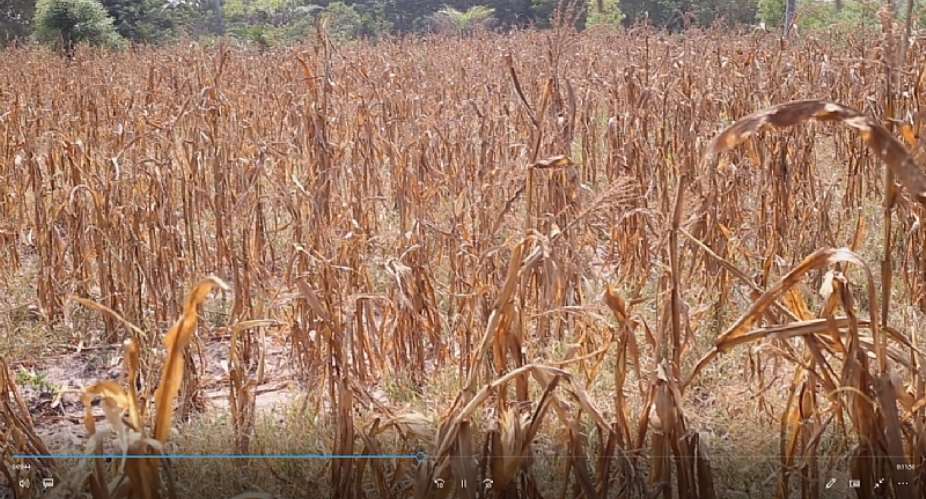
In the heart of the Volta Region, in Akatsi South, where lavish greenery once covered the land, climate change has become a silent, relentless force that disrupts the lives of many. Among them are Edem Akuaku, a young farmer with big dreams, and Dofui, a 59-year-old mother of four and disabled who has spent decades working the land. Both are struggling to survive as the impacts of climate change, particularly drought, devastate their crops and livelihoods.
Edem’s 90-acre maize field, along with his 108 acres of pineapple and rice, was his pride. He also reared cattle, goats, and pigs. The future of his family, his farm, and his community all rested on the success of these ventures. Dofui, on the other hand, had just 5 acres of maize, but for her, those acres were everything her source of income, food, and security.
The Silent Crisis
The year began with great hope. Both Edem and Esther had prepared for the season, expecting the rains to arrive as they always had, bringing life to their fields. But the rains failed to show up. Instead of the life-giving water that once arrived predictably, the land began to dry out, and the weather grew increasingly erratic.
Dofui, who has lived through many seasons, was the first to notice the change. "In all my years of farming, I’ve never seen something like this. The rains used to come at the right time, and now... they are unpredictable. My crops are dying because they don’t have enough water," she says with a heavy sigh.
Dofui, lamented bitterly not having money to buy pesticides and fertilizer, Her 5 acres of maize, which had once been bountiful, began to wither under the sun. Without the steady rainfall she had relied on for decades, the maize plants turned brown and brittle. Dofui, tried to water them manually, but the water was too scarce, and the damage was done. "The land has always been good to me, but now, it feels like I’ve lost everything. I don’t know what I’ll do,” Dofui adds, a sense of despair creeping into his voice.
Edem's Bigger Battle
For Edem, the drought hit even harder. His maize field, spanning 90 acres, was the first to be affected. As the dry months dragged on, his crops dried-up and died. His once-thriving pineapple and rice fields, totaling 198 acres, faced a similar fate. The lack of rainfall and the extreme heat cracked the soil, leaving his crops vulnerable to the harsh conditions. His animals’ cattle, goats, and pigs also began to suffer. Without fresh grass to graze, he was forced to buy expensive feed to keep them alive. "The drought has made everything harder. The animals are hungry, and so am I. It feels like every time I try to stand up, the ground shifts beneath me," Edem says, the weight of the loss evident in his eyes.
The situation was further exacerbated by the rising cost of water and feed, which drained what little resources Edem had left. "I thought that with enough hard work, I could make it through anything. But this... this is different. It’s beyond my control," he adds, his voice tinged with frustration.
A Community in Crisis
Edem and Dofui are not alone. The entire Akatsi South Municipality is struggling with the effects of climate change and drought. Farmers across the region are watching their livelihoods vanish as the changing weather patterns wreak havoc on crops and livestock. The once reliable patterns of rainfall have become unpredictable, and with it, the foundation of agricultural life in this area is crumbling.
"For many of us here, farming is all we know. The land has always been good to us, but now, we see our crops die, our animals struggle, and we don’t know where to turn," says Dofui. "It’s not just about the crops anymore. It’s about survival."
The Struggle for Hope and Adaptation
Despite the challenges, both Edem and Dofui are determined to keep going. Dofui, though devastated by the loss of her maize, is considering planting drought resistant crops next season. "I’ve been hearing about crops that can survive in the heat and dry soil. I want to learn more. I can’t give up," she says.
Edem has also started exploring climate-smart farming techniques. He’s been experimenting with rainwater harvesting in small dam, mulching to retain moisture in the soil, and diversifying his crops to reduce the risk of losing everything in one season. "I know I can’t control the weather, but I can learn how to adapt to it. I have to keep trying," Edem says, his resolve firm despite the uncertainty that lies ahead.
Both farmers are also calling for greater support from the government and agricultural organizations. They believe that access to resources like better irrigation systems, financial support during times of drought, and climate-resilient crops could make all the difference.
"We need help," Esther says. "Without it, we’ll lose everything. It’s not just about us; it’s about our children and grandchildren. What will they inherit if we don’t fight back against this?"
A Shared Vision for the Future
Edem and Dofui’s stories are a microcosm of the larger climate crisis that is affecting farming communities across the Volta Region. The once predictable weather patterns are no longer a guarantee, and the challenges that farmers face are becoming more complex. But despite the hardships, there remains a shared vision of hope and survival.
"I know it’s going to be hard, but we can’t give up. The land will come back. It has to," Edem says, looking over the remains of his fields.
Dofui nods in agreement. "We’ve seen tough times before, but this is different. We can’t do it alone. We need each other, and we need the support to keep going."
Together, Edem and Dofui’s stories reflect the resilience of farmers in Akatsi South. Though their fields are dry, their hope is not. They continue to fight, adapting to the changing world around them, determined to rebuild their lives and protect the future of farming in the region.
The Impacts of Climate Change On Rice And Maize Production
Climate change has significant effects on agricultural production on staple crops like maize (corn) and rice.
Temperature Changes
Heat Stress Higher temperatures can lead to heat stress in maize and rice, reducing yields. Maize is particularly sensitive to high temperatures during the flowering stage, which can lead to reduced kernel formation.
Water Availability
Drought, increased temperatures can lead to more frequent and severe droughts, particularly affecting maize, which requires significant water during its growing season.
Disease Development, Certain diseases may become more prevalent or severe due to changing climatic conditions, impacting crop health and yields.
Crop Management Challenges
Adaptation Needs, Farmers may need to adopt new management practices, such as changing planting dates, crop varieties, and irrigation methods, to cope with changing conditions.
Economic Impacts, Changes in crop yields can affect food prices and farmers' incomes, leading to economic instability in regions dependent on maize and rice production.
Food Security Implications
Nutritional Impact, as maize and rice are staple foods for billions of people, changes in their production can have significant implications for food security and nutrition, particularly in developing countries.
Addressing the impacts of climate change on maize and rice production requires a multifaceted approach, including the development of climate-resilient crop varieties, improved water management practices, and policies that support sustainable agricultural practices. Adaptation strategies will be crucial to mitigate the adverse effects and ensure food security in the face of a changing climate.
By: Emmanuel Gameli Dovia
Climate/Environmental Journalist
 Fire Service rescues trapped victim after STC Bus, Taxi collision at Konongo
 Private SHSs in Free SHS pilot programme demand payment of outstanding governmen...
 Police foil planned robbery, recover weapons at Kukuom
 A 53-year-old mechanic remanded for allegedly stabbing another over car battery ...
 Asiedu Nketiah urges IGP to speed up justice for victims of election 2024 killin...
 Each family receives GH¢15,000 support after Accra Police Barracks Fire
 Mussa Dankwah urges ministers to focus on performance amid MoFA–finance minister...
 Selling single cigarette sticks illegal – FDA
 Hungry, unhealthy workforce cannot protect nation’s health – GRNMA
 Health Minister orders suspension of KATH CEO over Emergency admissions directiv...


