




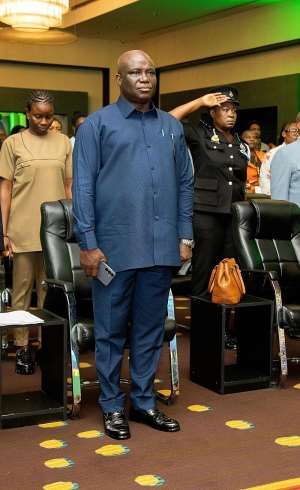
The Minister for Food and Agriculture, Mr Eric Opoku, has outlined an ambitious strategy to eliminate Ghana’s rice deficit and achieve full rice self-sufficiency within the next 10 years.
He described the country's rice production gap as a major economic opportunity rather than a challenge.
Speaking at the West Africa Rice Investment Roundtable in Accra on Tuesday, the Minister said the government was implementing targeted interventions to improve local rice production, attracting private investment, and reducing the country’s dependence on imports.
According to him, Ghana consumed approximately 1.71 million tonnes of rice in 2025 but produced only about 960,000 tonnes, resulting in a deficit of nearly 751,000 tonnes and a self-sufficiency rate of 56 per cent.
The shortfall, he noted, compelled the country to spend about US$320 million on rice imports.
“Our rice deficit is not simply a burden on our balance of payments. It is the single largest untapped agribusiness opportunity in our staple food economy,” Mr Opoku stated.
The Minister announced the introduction of a rice import quota policy that would require importers to establish and verify partnerships with local rice producers before being granted import permits.
He explained that the policy is designed to strengthen the domestic rice value chain, encourage local production, and create stronger market linkages between producers and importers.
Mr Opoku disclosed that the government had completed advanced satellite-based mapping of rice-suitable lands across the country. The initiative, he said, would provide investors with reliable, location-specific data to support investment decisions and agricultural expansion.
The Minister expressed confidence that with the right investments and policy support, Ghana could attain 100 per cent rice self-sufficiency within a decade.
He projected that the achievement of this target could save the country an estimated US$2.1 billion in foreign exchange, attract more than US$400 million in private sector investment, and generate over 200,000 jobs across the rice value chain.
Mr Opoku stressed that increasing local rice production forms a critical part of the government's broader agenda to strengthen food security, promote agribusiness development, and stimulate economic growth through agriculture.

 Ghana gaining notoriety for cocaine — Bawumia
 Bawumia exposes NDC's ‘scam’ promises to Ghanaians
 NPP chairmanship: Sammy Crabbe backs John Boadu in last-minute show
 EOCO detention won't stop me from representing Salomey – Baffour Awuah
 NPP’s focus is to reclaim power in 2028 — Osahen Afenyo-Markin
 NPP must put aside differences, unite to rebuild party – Odeneho Kwaku Appiah
 NPP delegates approve 14 constitutional amendment motions
 NDC's 24-hour economy has turned into ‘24-hour demolition’ — Bawumia
 NPP adopts amendment to make flagbearer party leader
 NDC delegation exit NPP conference over delays, poor communication


