




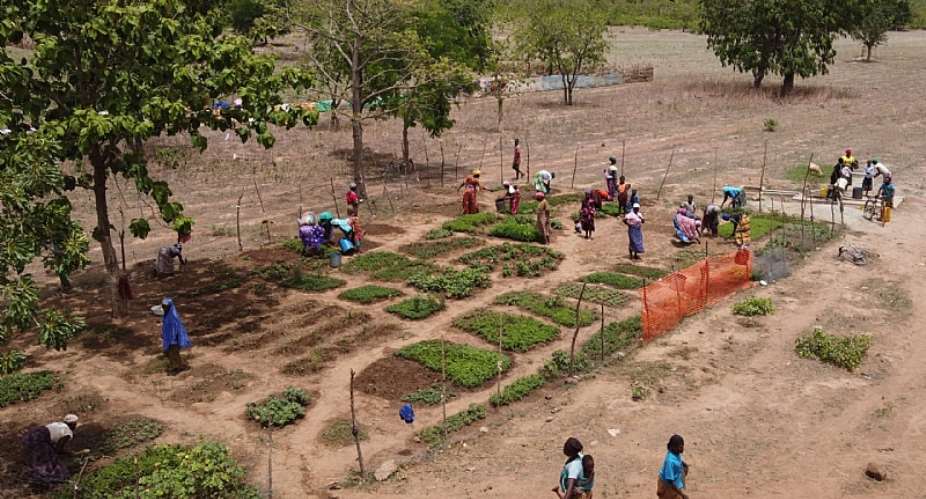
Wednesday, May 28 was celebrated as World Hunger Day 2025. The day is marked every year to encourage everyone in the world to take one action or the other to help end hunger and malnutrition. According to The Hunger Project, over 343 million people across 74 countries worldwide are experiencing acute food insecurity and the situation is being exacerbated by climate change.
The theme for this year’s celebration, “Sowing Resilience”, aims to draw attention to the growing impact of climate change on food insecurity and emphasize the need to invest in resilient food systems. Extreme weather events such as droughts, floods, and heatwaves are disrupting food systems and driving up food prices, making it harder for millions to afford nutritious diets. According to the World Food Program (WFP), more than 1 million people in Ghana face food insecurity, and 1 million children under the age of five suffer from chronic malnutrition.
The Hunger Project recommends the following actions as steps individuals and institutions could take to help end world hunger. First, buy from local farmers. What you eat and where you shop from, can support sustainable food systems. Choose to buy from local farmers so they can directly earn more money and be empowered to continue growing foods. Second, urge government and other stakeholders to invest in climate-resilient agriculture. Public policies and funding that promote sustainable farming, soil regeneration, and water conservation are essential to helping small-scale farmers adapt to the impacts of climate change. Third, support programs that empower small-scale farmers to adopt climate-smart agriculture. Providing training, resources, and innovative techniques like agroforestry, drought-resistant crops, and efficient irrigation, enables farmers to produce food sustainably in the face of a changing climate.
I would want to add a fourth suggestion. Let’s all engage in household farming. Let’s take advantage of any small piece of land near our homes to grow vegetables and other crops. No matter how small the space, we can all play a part in growing our own food. Let’s make use of every little patch of land around our homes, whether it’s a backyard, a front yard, or even a few containers on the veranda, to grow food. Through this, we would be able to harvest fresh, healthy produce for some of our daily meals, save money, improve family nutrition, and protect the environment through sustainable, low-impact practices.
Household farming is well aligned with the new government’s Feed Ghana Program. When President John Mahama launched the program in Techiman a few weeks ago, he said; “Everybody will be encouraged to get some land near your house or behind your house and have a garden where you grow tomatoes, garden eggs, okra, onions, and pepper.”
“We have done this before. For those of you who grew through the Operation Feed Yourself years, you remember that your parents used to have backyard gardens. And so, when you went there to pound fufu, sometimes you didn’t have to go to the market. You just go into the garden, you take some pepper, some onion, tomato, and then go and make the soup and pound the fufu,” President Mahama added.
There have been other programs aimed at encouraging household gardening in recent times that will be worth acknowledging. The “One Household, One Garden” initiative rolled out by Agrihouse Foundation and AGRA supported households in northern Ghana to establish vegetable gardens to augment their diets. The foundation offered practical training on essential gardening techniques such as soil sterilization, seed nursing, and transplanting. They also distributed 11 different types of vegetable seeds, as well as watering cans, wellington boots, fencing materials, compost, organic pesticides, and other materials to residents, to establish their gardens. “It was more of a COVID response and it became a national crave because everybody was looking forward to how they can grow their own food and eat their own food. Beyond enhancing nutrition at the household level, I think AGRA supported in having the mindset change. Now everybody is adopting to home gardening,” founder of Agrihouse Foundation Alberta Nana Akyaa Akosa, explained.
“Not that it wasn’t there. But AGRA set the pace to transform it again. AGRA set the pace to arouse our consciousness and to drive us. We were able to make significant impact through AGRA’s support. We can talk about the 17 districts within the northern region that we worked in. We had the target of about 2000 but we're able to support over 5000,” she said.
Portia Asunda who is one of the women beneficiaries of the project in the Bawku West District said the initiative improved their diets and helped them raise additional income. “We have really benefited a lot from this because the dry season, it's hard to get vegetables. It is very expensive. But now that they have brought us this garden, we have our own okra, everything is cheap for our women,” she said. “They are able to use it to cook for their children and they are able to even send some to the market and sell and get income to be able to put in the susu box or the village savings, so that at the end, they can pick and help themselves,” she added.
Others have benefitted from household gardening. So, let’s all turn every backyard, balcony, and empty plot into a source of nourishment and hope. When we embrace household farming, we can take charge of our food, improve our nutrition, and build a more resilient future. Start small, grow strong, and be part of the solution.


 ‘Too arrogant, too sure of itself’ France confronts its legacy in Africa
 Nigeria's unwritten power-sharing rule looms over presidential race
 Several killed, dozens wounded in Jordan church shooting
 ‘I killed lots of terrorists, but it didn’t make me feel better’: The trauma hau...
 Casualties feared as multi-storey building collapses in Nairobi
 Cabinet approves bill to regulate public relations practice – Shamima Muslim
 Bawumia was right; NDC's economy is only on paper, not in people's pockets – Kwa...
 NDC should credit Bawumia for introducing gold-for-reserves policy – Kwadwo Poku
 Obuasi SHTS sex scandal: Gender Ministry deploys team to support affected studen...
 Adwoa Safo's Dome-Kwabenya comeback bid must push Elikplim Akurugu to deliver mo...


