




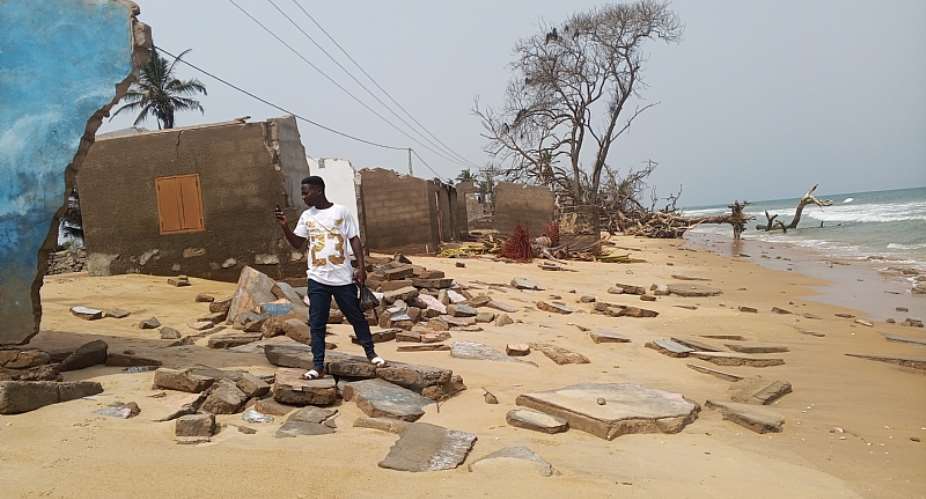
Along the once serene coastlines of Ghana’s Volta Region, communities that have thrived for centuries on fishing and farming now find themselves battling an invisible yet relentless enemy: coastal erosion. In villages like Agavedzi, Salakorfe, Amutinu, Abutiakorfe, Dzelukorfe,Fuveme and Kporkporgbor in the Ketu South,Keta and Anloga Municipalities the waves are rising faster than the land can keep up, taking off their homes, livelihoods, and the very stuff of these coastal communities.
Rising sea levels and changing weather patterns driven by climate change have made coastal erosion one of the most pressing threats to the lives and futures of those who call these shores home. With homes crumbling into the ocean, livelihoods vanishing, and fears for the future growing, these communities are at a breaking point. Despite efforts like the West Africa Coastal Areas (WACA) Project, which has yet to be executed in the region, local communities and the Ghanaian government are actively searching for solutions to stem the tide of devastation.
The Rising Tide A Silent Crisis
For generations, the people of Agavedzi, Salakorfe, Amutinu, Abutiakorfe, Dzelukorfe, Fuveme and Kporkporgbor have relied on the ocean for their survival. Fishing, an ancient tradition passed down through families, provided the backbone of their economy. But today, the sea that once nurtured them has become their greatest threat.
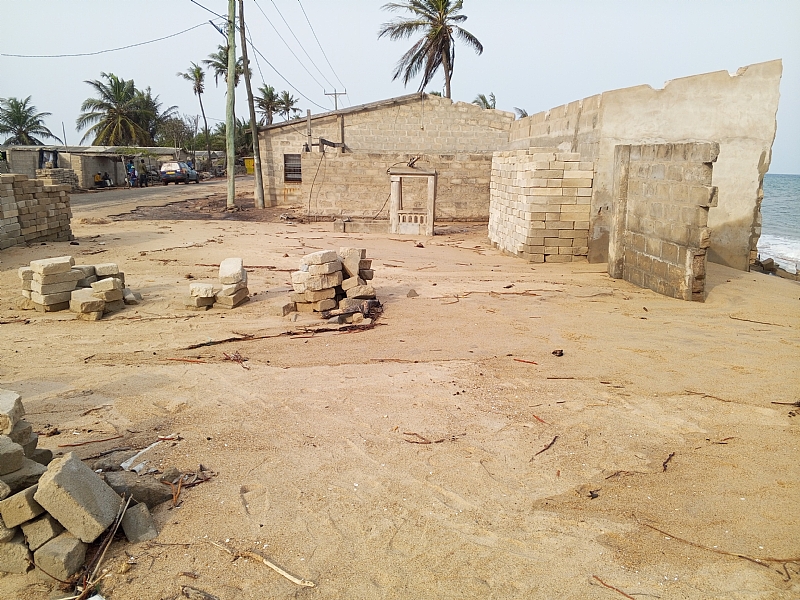
Coastal erosion is eating away the lands, especially in places like Agavedzi, where the sea is just meters from the main Aflao – Keta road. The once lush mangrove forests, at Anyanui through to Fuveme which acted as a natural defense against the waves, have largely disappeared due to overharvesting and coastal development. Storm surges are more frequent, pushing salty water inland and salinizing fresh water sources, leaving the communities without access to clean water.
Chief Fisherman Emmanuel Anumu Tetteh, who has spent decades as fisherman of Agavedzi, describes the devastation of the coastline as a tragedy beyond comprehension. “When I was young, our homes were far from the sea. Today, the waves are at our doorstep. We have lost not only our homes but also our source of livelihood. Fish stocks have dwindled because their breeding grounds have been destroyed by the sea erosion,” he lamented.
The Assemblyman for the affected communities, Mr. Eben Ansah, shared his frustrations regarding the slow pace of intervention. “Over 500 households have been displaced by the tidal waves just these few days which is worse than the previous year. Families are living in makeshift structures, and children can no longer go to school regularly. The WACA Project was supposed to help us, but we are still waiting,” he stated. Although our member of parliament Hon Dzifa Gomashie is also doing her best to support but needs more help for lasting solution.
Women in the community, especially fishmongers like Madam Esi, have also been severely affected. “We used to buy and process fish for sale, but now, there is nothing. The fishermen cannot go to sea because their canoes have been destroyed. Even when they do, they return empty-handed,” she said.
The Impact on Livelihoods
The economic impact on the Ketu South Municipality, Keta Municipality and Anloga District is profound. Fishing, which has long been the heart of these coastal economies, is in peril. Fishermen who once cast their nets into the sea to return with bountiful catches are now finding their livelihood washed away. Agavedzi, Salakorfe, a village that depended on its rich aquatic resources, has been forced to scale back its once-thriving fishing operations due to receding shorelines and the loss of productive fish habitats.
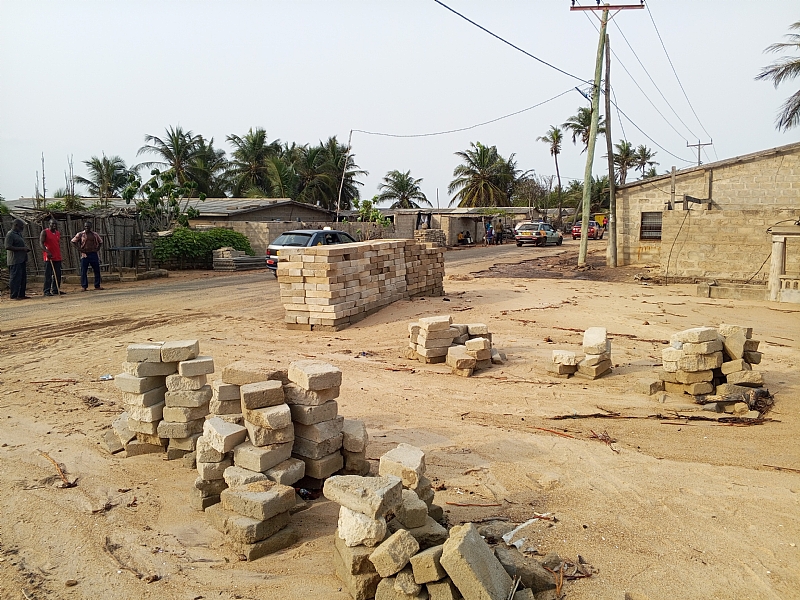
In Fuveme, the story is no different. The once-bustling markets are quieter as the fishermen return with fewer catches, and the land that sustained generations of families has totally vanished into the ocean. As the coastline retreats, the people of Kporkporgbor have seen their homes once nestled safely along the shore become victims of the very tide they once revered.
The erosion is not just about lost income; it’s about the destruction of a way of life. Children growing up in these areas are increasingly faced with migration as families are forced to leave their homes in search of safer, more stable living conditions. This disruption in community cohesion also takes a toll on local culture and traditional practices that have bound these communities together for centuries.
The Struggle for Survival and Adaptation
Despite the disheartening challenges, the coastal residents are not giving up. They have begun to fight back against the eroding shores through local adaptation strategies and innovative solutions.
In some parts of Kporkporgbor and Agorkedzi, mangrove restoration projects are underway, with local communities and organizations working together to replant mangroves along the shoreline. These resilient trees, which once thrived on the coastline, are seen as a crucial natural defense against storm surges and rising seas. The roots of the mangroves not only provide habitat for fish and other marine life but also act as a barrier to the waves, preventing further erosion.
Other initiatives include the construction of sea walls and the elevation of homes, which provide some level of protection against the rising tides. Community awareness programs are educating locals about the dangers of coastal erosion and on how to adapt to the changing environment. Still, for many, these measures are only temporary fixes in the face of a growing global crisis.
The WACA Project and Government Intervention: A Long-Awaited Solution
The West Africa Coastal Areas (WACA) Project was introduced as a potential solution to coastal erosion problems in several countries along the West African coast, including Ghana. However, despite the global recognition of the project’s importance and the funding allocated, the WACA Project has yet to be executed in the Ketu South, Keta Municipality and Anloga District through to Ada. Local residents are still waiting for the long-promised interventions that the project was supposed to bring, such as coastal protection infrastructure, mangrove restoration, and sustainable coastal management practices.
The Need for Immediate and Effective Climate Action
Ghana’s coastal erosion problem demands urgent attention from the international community. Global climate change agreements, like the Paris Agreement, must be honored with real action and adequate funding. Governments must prioritize the protection of vulnerable coastal communities by providing the resources needed to build resilience and protect the environment.
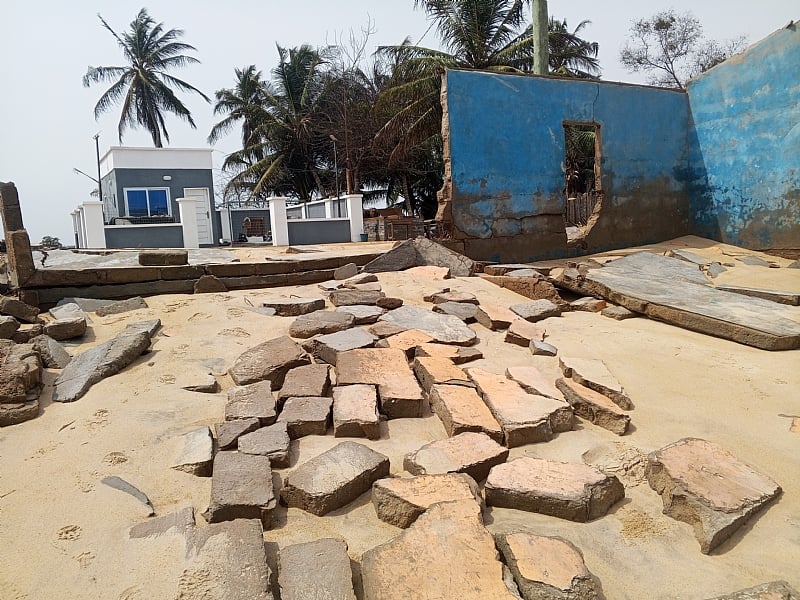
Furthermore, climate finance must be directed toward sustainable, long-term solutions. Mangrove restoration, green infrastructure, and sustainable coastal management must be part of the global conversation on climate change adaptation. These communities are on the front lines, but they cannot fight this battle alone.
A Glimmer of Hope Resilience and Unity
Despite the overwhelming challenges, there is a glimmer of hope. In the face of rising tides and sinking homes, the people of Agavedzi, Salakorfe, and Amutinu have shown remarkable resilience. There is still hope as the government released amount of GHC 200 million to support the victims while plans are under way for the construction of the phase two of the sea defense project from Agavedzi to Aflao.
But time is running out. The clock is ticking, and the sea continues to rise. The world cannot afford to ignore these coastal communities any longer. For the people of Ghana’s coastal communities, the fight against coastal erosion is not just a local issue; it is a matter of survival.
Conclusion
The waves are relentless, but so is the spirit of the coastal communities of Agavedzi, Salakorfe, and Amutinu. It’s time for the world to respond with the urgency and commitment that this crisis demands. The people of the Volta Region are standing firm, but they need more than just hope—they need action. Their future is at stake. The question remains: will the world rise to meet the challenge, or will we let these communities fade away into the rising tide?
While others have tamed the sea and developed their coastal lands into Mega Marine Drives, Mega Cities, Metropolises, Megapolises and Conubations, Ghana's 550-km coast is at the mercy of the sea. By so doing, Ghana has lost many hundreds of metres of its beach front lands and assets and several millions of cubic metres of beautiful pristine, golden, sparkling, and fine-grained sand to the sea. Meanwhile, beach tourism is a great resource to coastal countries and cities.


 September 29: Cedi finishes day selling at GHS12.20 on forex market, GHS11.67 on...
 ‘We’ll explore another constitutional option for narcotics probe’ – Minority on ...
 Speaker Bagbin adjourns Parliament indefinitely after rejecting narcotics probe ...
 Food Buffer Stock seeks stronger liquidity buffer despite record GH¢91.7 million...
 Ex NAFCO Boss trial: Court adjourns trial to hear application for return of seiz...
 Bagbin backs Mahama’s call for national dialogue on social media insults
 National conversation should not become an exercise in suppressing dissent — Bag...
 ‘Don’t reward only bitter tongues, it encourages others to copy’ – Bagbin tells ...
 We have cut cost of capital by more than half since Mahama took office – Ato For...


