




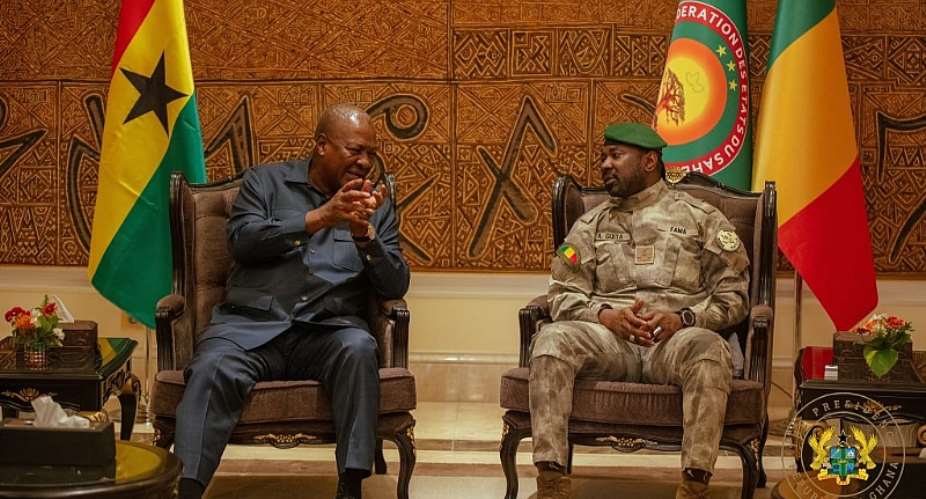
From the outset, the newly elected Ghanaian president John Mahama indicated his strong interest in resolving the tension between the ECOWAS and AES. The three Sahel countries announced their departure from ECOWAS last year, citing dissatisfaction with ECOWAS's approach to governance and security issues. The President of Ghana has this week embarked on a diplomatic mission to Mali, Niger, and Burkina Faso, as part of efforts to restore the broken ties between the breakaway Sahel nations and ECOWAS.
Ghana has ultimately taken a leading and active role for several strategic reasons and interests. First, the prevention of regional insecurity from spillover into Ghana. It is well known that instability in the Sahel has led to increased terrorist threats across the coastal West African states, putting Ghana, “in a threat anticipatory anxiety mode.” (Read more on: "The Jihadist are Coming"! (https://lnkd.in/d4aVNjpj).
Historically, the ripple effect of the Sahel’s instability has been felt in Ghana, with heightened security alerts and threats in the northern regions bordering Burkina Faso. This underscores the imperative for Ghana to engage pre-emptively with the ECOWAS and AES. Indeed, when the divide between the two bodies deepens further, terrorist groups can exploit the fragmentation to expand their operations into Ghana and beyond.
Groups such as the Islamic state in the Greater Sahara are known for exploiting political vacuums and regional discords, making the ECOWAS-AES fissure a potential catalyst for expanded terrorist operations into a stable coastal West African country including Ghana. This means that resolving these differences will, to a larger extent, help prevent the spread of violent extremism and cross-border attacks through collaborative efforts and intelligence sharing.
Second, successfully brokering a resolution will enhance Ghana's diplomatic influence as a regional power and diplomatic leader in sub-Saharan Africa. This comes at a time when Nigeria and other member states have taken firm and bold positions against the military juntas. Ghana, and the "new president" in this light, is seen as a neutral and trustworthy broker, consequently strengthening the country’s international standing and key mediator of future conflicts. Ghana’s previous role in mediating the Liberian civil war under ECOWAS, sets a precedence for its capacity to embark on the current endeavours with AES.
The country is equally interested in preventing the escalation of this rift and the attendant humanitarian crisis. Further deterioration and escalation could lead to more sanctions, frequent border conflicts, and worsening economic conditions. The humanitarian fallouts can strain Ghana’s resources and destabilize local communities, underscoring the urgency of Mahama’s intervention.
Ghana's strategic responsibility is to push for a resolution to avoid further suffering and displacements in Sahelian states, recognizing that such repercussions of such are unavoidable for Ghana itself! But will Ghana be able to mediate the ECOWAS- AES disagreements, or in a matter of time, it will become a bystander to West African fragmentations like other countries? One thing for sure is that when the AES is pushed further, "an alternative order’ will certainly emerge, and the truth is that ECOWAS will not survive it!


 Ms. Emelia Affi Agbenyo must honourably resign as new EC Deputy Chairperson to p...
 Why have US-Ukraine relations soured ahead of the midterms?
 Govt to meet Free Zones Authority, Trade Ministry over Customs Act concerns
 Kojo Bamba was never my driver or bodyguard — Nana B
 Ekow Assafuah petitions OSP to probe alleged World Cup visa facilitation irregul...
 Africa attracting wrong waste management solutions – GAIA report
 Summon Kofi Adams, GTA boss over 2026 World Cup visa scandal — NPP tells Parliam...
 Obuasi SHS headmaster accused of sexual abuse is NDC constituency secretary – Ma...
 Family demands answers over death of 14-year-old student at Abomosu STEM SHS
 Osahen Afenyo-Markin reflects on loneliness of public service, says survival is ...


