




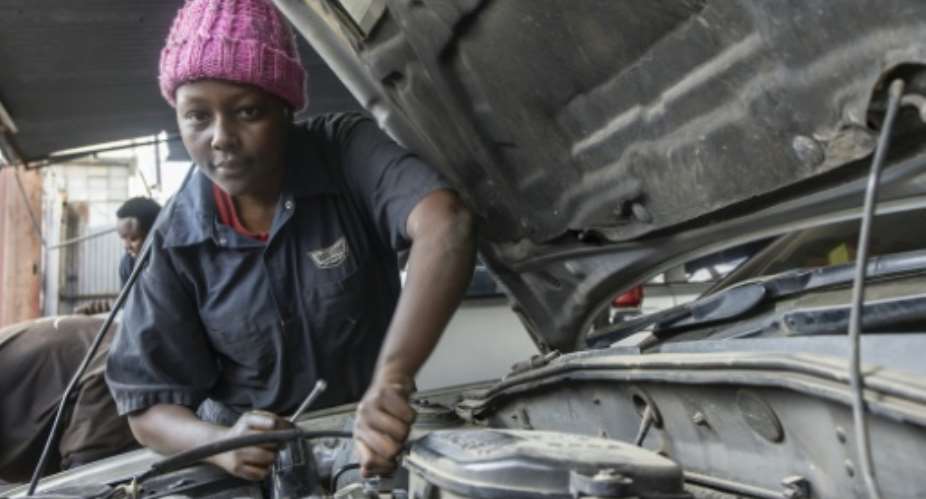
Growing up in a Kenyan slum, Annastacia Mwende always loved cars but never thought of being a mechanic. Now, she is the star pupil at a back-street Nairobi garage.
Kenya needs more like her, say experts: learning practical skills that lead to actual jobs.
Too often, young Kenyans feel pressured into university to learn medicine, law or office management, only to find there are no jobs for them.
That is particularly true in places like Kibera, one of the East African nation's largest and oldest slums.
"You can look for a plumber around here until you faint," said Martha Otieno, a youth worker for CFK Africa, a charity working with young people in slums. "How many office managers do we really need?"
Like the rest of Africa, Kenya's population is young: 80 percent are aged under 35, according to government figures.
Their prospects are not great. Half the urban population live in slums and fewer than 20 percent of jobs are in the formal sector.
Rather than chasing those few white-collar jobs, CFK Africa argues that young people need skills to get ahead in the "Jua Kali" (literally "fierce sun") sector: the informal world of tin-shack entrepreneurs who build, fix and salvage.
"If you look at people who are established in these communities, they are artisans, but it's taken them a long time to develop their skills," said CFK Africa's head Jeffrey Okoro.
The charity hopes to speed up the process with an experimental apprenticeship scheme.
Its first cohort of 100 Kibera youth were matched last year with electricians, mechanics and other "master craftsmen" to "realistically transition young people into job opportunities".
"We wanted to go beyond 'Here's a certificate'... to 'Where is the money?'" said Okoro.
'So in love'
Mwende, 20, is a typical case.
She learned to love cars from her mechanic father -- "He came home with dirty hands and it looked really fun," she said -- but she thought it better to study human resources at university.
Then she ran out of money and had to drop out. Even with a degree, competition for an office job would likely have been insurmountable.
CFK Africa's apprentice programme came to the rescue, funding her placement at the Timed Performance Garage in a Nairobi suburb, fixing German cars.
Within months, her mentors offered her a full-time job.
"I'm so in love with it, I'd rather do this over being a doctor, a pilot, a lawyer," she said.
Across town, Nicholas Odhiambo, 22, apprenticed at a beauty salon and has also been taken on.
"Most people's mentality is this job is only for ladies. I wanted to prove them wrong," he said.
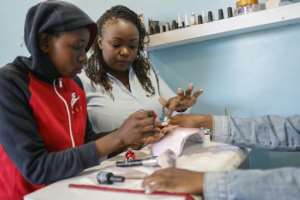 Beauty salon owner Jane Anjili (R) is one of the 'master craftsmen' imparting her skills. By SIMON MAINA (AFP)
He hopes the CFK Africa project will help others discover life outside the slum.
"Most youth in Kibera think that's where they will be born, grow up and die.
"The MC (master craftsman) saw something in me and gave me the opportunity. It's an amazing thing. I'm not depending on anyone," he said.
His "MC", Jane Anjili, has trained three others already and says this is what youngsters need.
"If you have skills, you can work anywhere, you can start your own thing and be independent," she said.
'Ripe' for industry
Renson Muchiri, an economist at Nairobi's KCA University, said the post-independence idea of a degree bringing prestige on the village and guaranteeing a public sector job no longer matched reality.
The government has recognised the problem in the last decade, building many new vocational colleges.
But slums remain neglected and the government's apprentice schemes are "riddled with politics", said Muchiri.
He said schemes were often used to buy votes in certain localities, while entrepreneur support was poorly funded and bogged down by red tape.
"The government has made the right noises, but the heart is not there," he said.
 CFK Africa head Jeffrey Okoro says the slums are ripe to develop light industry. By SIMON MAINA (AFP)
Charities like CFK Africa aim to fill the gap, and Okoro hopes the apprenticeship scheme will be self-sustaining and replicated elsewhere.
Kibera and similar slums are "ripe" to become mini-industrial hubs, he said.
"There is a potential for us to move the story of informal settlements to actually productive sites where income is generated and products are produced."


 ANC Suffers Worst-Ever Municipal Election Result, Coalition Talks Loom Across So...
 Bawumia Proposes Binding National Masterplans to Ensure Development Continuity
 Drug store operator arrested after allegedly spending 3 days in coffin at Foase ...
 Pastor and wife whose petition sparked service passport scandal revealed
 'NDC has now become more attractive' — Dr. Otokunor
 'You are stepping on too many toes' – Adutwum cautions Sam George
 ECG to disconnect customers with unpaid bills in 18-day nationwide revenue mobil...
 Foreign Ministry interdicts two officers, terminates 10 illegally issued Service...
 Mahama announces $9bn investment plan to drive job creation from 2027 to 2030
 GHS makes health declaration forms mandatory for all travellers entering Ghana f...


