




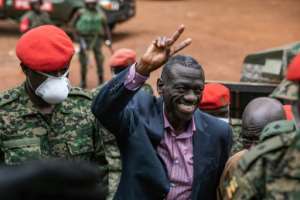
On November 16, the Ugandan army conducted a military operation on Kenyan territory in the capital Nairobi, ignoring international deportation and repatriation procedures in which it arrested a veteran opposition politician, Dr Kiiza Besigye. The development has since attracted global-scale reactions with the UN-Secretary General and major Western Countries including the U.S condemning it. The suspect was later arraigned before a military court in Kampala and charged with possessing UPDF arms and holding meetings in foreign countries aimed at overthrowing the government of Uganda.
Whether the accusations are true or false, the development suggests that the security system in Uganda anticipates a military coup anytime. Traditionally this has been the only method of changing government in Uganda over the last 62 years of independence. The international dimension of this development including the media and lawyers from the International Commission of Jurists (ICJ), Pan African Lawyers Union (PALU), and the East African Law Society confirms that there is a solid international backing behind Dr Besigye both at political and security levels as well as financial logistics. Some of the other unspoken insights into this development include:
1. Anti election stance
The development relates to Dr Besigye’s stance against elections as an effective method of dislodging the dominant ruling NRM party from power. He believes that elections are just symbolic and only used to legitimize Mr Museveni’s long stay in power. At the same time, Dr Besigye has been heard severally speaking against using the gun to change leadership in Uganda as this would not provide a fundamental shift from the current status quo, which also came by the gun. He, instead, advocates for mass protestations. This implies that accusations of gun possession are questionable, for even then, based on the location of his arrest in Kenya even if had a gun, it is not against the laws of Uganda. But at the same time the accusations constitute a legal basis for limiting his freedom of movement within and outside Uganda in order to foster easier monitoring and control.
2. Strong return into political limelight
Upon realizing the several weaknesses within the biggest opposition party, the National Unity Platform (NUP), which is at loggerheads with its stronghold, in the Buganda region, in addition to theories that the party is deeply infiltrated by the ruling NRM, local and international backers of opposition politics in Uganda have shifted their support back to Kiiza Besigye, a typically disgruntled figure, whose wife, Winnie Byanyima, a UNAIDS Executive Director says their family has suffered Museveni’s britality for 25 years.
In order to deny Besigye the opportunity of accessing enormous foreign financial resources with which to mobilize masses, the military court, unlike the civilian one, could indefinitely delay his bail rights, thereby effectively undermining his international connections.
3. Imminent military coup
The ruling NRM innermost cycle, called Politburo by communists, which is the highest decision-making organ that sets the overall direction and ideological pathways in regards to policy and ideology, appointments and dismissals, economic and social development, foreign policy and intentional relations as well as party organization and discipline seeks to safely retire the over 80-year-old veteran Yoweri Museveni. But they believe he can only concede to retirement by being succeeded by his son, Gen Muhoozi Kainerugaba, which can only be achieved through a series of disguised military coups rather than regular elections. These developments are happening at the time when Gen Muhoozi has virtually taken over a number of presidential functions including receiving classified materials and taking important national decisions, including the issue under scrutiny based on classified information. He has also lately been meeting foreign dignitaries including ambassadors as well as visiting their countries, the latest of which, being Japan. When the American ambassador declined to meet him, he issued an ultimatum for him to leave Uganda, nearly causing a diplomatic row between Kampala and Washington. Traditionally foreign policy roles are conducted by the president or the minister for foreign affairs and not a mandate of a serving military officer. A shift from the normal practices has offended many veterans of the liberation war, including the minister for internal affairs, Kahinda Otaffire who’s the most vocal on opposing the Muhoozi schemes. He has publicly defended Dr Kiiza Besigye, arguing that he never exited Uganda with a gun--implying if he was found with one, then it's not a crime against Uganda. In the recent past, Gen Muhoozi has publicly pronounced that no civilian will ever rule Uganda--implying that himself a military officer is eligible to this privilege. But according to Ugandan electoral laws, in order to become president through an election, you must first retire to civilian life. For Muhoozi to be president and at the same time retain his military status, it can only be through a military coup. But since the whole affair is guided by the politburo there will first be a disguised coup, perhaps led by a colonel as it is the norm in most cases, and then later Gen Muhoozi in has capacity as the CDF will intervene to ‘foil’ the coup and thereby assume the interim presidency, later to become indefinite without necessarily going through an election.
This model of political domination is a hybrid of other world models from Russia, China, North Korea, Cuba, Iran, USA and the United Arab Emirates. Currently it has taken on many features similar to those of the UAE where public resources are owned by the ruling families and the system is less scrutinized in terms of adherence to democratic principles. But as observed previously, UAE’s interests can never align with those of poor African countries, for, in most cases they are exploitative and worse, they use African resources like gold, oil and gas as well as fertile soils to generate financial resources with which to destabilize the continent.

 ‘Too arrogant, too sure of itself’ France confronts its legacy in Africa
 Nigeria's unwritten power-sharing rule looms over presidential race
 Several killed, dozens wounded in Jordan church shooting
 ‘I killed lots of terrorists, but it didn’t make me feel better’: The trauma hau...
 Casualties feared as multi-storey building collapses in Nairobi
 Cabinet approves bill to regulate public relations practice – Shamima Muslim
 Bawumia was right; NDC's economy is only on paper, not in people's pockets – Kwa...
 NDC should credit Bawumia for introducing gold-for-reserves policy – Kwadwo Poku
 Obuasi SHTS sex scandal: Gender Ministry deploys team to support affected studen...
 Adwoa Safo's Dome-Kwabenya comeback bid must push Elikplim Akurugu to deliver mo...


