




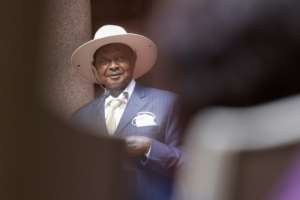
In the present circumstances, there are three ways through which the government can change in Uganda, including: (i) An election, (ii) natural death of the incumbent and (iii) a military coup.
Deep state strategists (veterans of the FRONASA Revolution, ethnically referred to as Bachwezi), headed by Gen Salim Saleh (real name Caleb Akandwanaho), are alert to all potential possibilities capable of threatening the status quo and have readied response mechanisms. For the record, this is the original group of about 800 individuals (many today represented by their multiple biological progeny) who were recruited in the 1970s to fight the Idi Amin Dada government. Several were tapped from Tutsis scattered across the east African region including eastern DR-Congo. Thus not everyone who participated in the 1980-85 Luwero Triangle war can claim rights in the revolution. Young recruits in Luwero, even those of western Uganda parentage like Col Kiza Besigye, Maj Gen Mugisha Muntu and Henry Tumukunde all who were already Kampala boys and partly educated in Buganda-based schools like Kitante SS (Besigye) and Kibuli Muslim SS (Tumukunde) from where they joined Makerere University are not part of the long mission of the original veterans, which is to restore the old Chwezi dynasty. The entire stretch of the dynasty is from Northern Tanzania to parts of South Sudan—where currently the Balaaro nomads in northern Uganda are heading to in their effort to retrace and recover ancient tracts that were lost to the Luos, from whom the present kingdoms of Bunyoro, Buganda and Toro emerged. For their survival, these kingdoms today have a reason to get concerned with the current ‘Balaaro’ developments in northern Uganda.
For their part, these kingdoms have already lost large swathes of land in what ordinary citizens perceive as massive land grabbing. When the incumbent Buganda king Ronald Mutebi alerts his citizens to wake up from slumber (temubongota), he is speaking from the context of the Chwezi threat. Citizens have often pointed to Salim Saleh as being behind the land bonanzas, unaware of the long term assignment he is conducting. They also often refer to the hijackers of service delivery funds as ‘mafias,’ a term introduced by former Vice President Gilbert Bukenya and amplified by former Museveni spokesman, Tamale Mirundi. They think the corrupt are working on their own, not knowing they are under official assignment of executing that role. Besides land bonanzas (called land recovery in the revolution vocabularies), the revolution also seeks to possess and monopolize all major economic sectors including timber, coffee, oil and gas, gold and other minerals, fisheries, banking, telecommunications (UTL), transportation (buses, private airlines) etc. A successful usurpation of all these key areas will complete the restoration process of the Chwezi dynasty to which all existing kingdoms must be loyal subordinates.
Dissent of the now (kingdoms reduced to chiefdoms ) will be subdued by either a replacement of a revolutionary ‘prince/princess’ with mixed blood or in extreme cases, totally phased out, similar to what happened to the Ankole kingdom. Several models of thriving monarchial or dominant revolutions are currently being bench-marked upon to determine a suitable approach or a hybrid to adopt. Existing global successful cases that are currently under study include the United Arab Emirates, Saudi Arabia, North Korea, Iran, China, Russia and Cuba. Particularly that of the UAE is of utmost interest how the small emirates constituted themselves into one successful polity, which despite its size holds a global economic clout today. For this, Mr Museveni, though he would need financial support for hosting the upcoming huge international conference of the Non-Aligned Movement of over 100 countries in January 2024, he is not shy to visit UAE twice in one year (Jan 2023 and Nov 2023). Political parties are meanwhile being either constructed or reconstructed to be remote controlled by installation of leaders among them that subscribe to the long term mission. A similar approach is live among religious groups. Hence the threat scenarios to be countered are expected to emerge from:
·Elections
The next general elections are about two and a few months away in Jan/Feb 2026. But preparations to that effect are already in high gear. A fully resourced office to coordinate activities has been established in Kampala called ‘Office of the National Chairman (ONC).’ It goes by that name and is not restricted to the name of the ruling party (NRM) because the title ‘Chairman’ in this context refers to ‘One Leader’ for many other semi-autonomous factions, including that of the FRONASA veterans’ political wing. They all conduct independent functions from each other. Their key objective is to ensure that H.E President Museveni retains power in the next general election of 2026. The tactics used include: (i) ensure by all means not to lose any by-election to opposition so that it insinuates the continuing popularity of the ruling party and its chairman. (ii) buy-out potential challengers and integrate them into government structures so as to further weaken aggressive opposition groups (iii) draft and promote amendments to the constitution that, it will favor the incumbent to run again in 2026 (such as amending the elections system from adult suffrage to parliamentary majority and (iv) cause or instill fear among the population to target those supporting opposition forces (through sustained mental and physical trauma resulting from torture and long unprosecuted jail detentions.) The whole idea is to totally subdue any serious political challenge and only tolerate compromised groups whose challenge is cosmetic for purposes of pretending a political pluralist landscape and warding off possible external pressure emerging from Western countries. Apparently, Gen Muhoozi Kainerugaba, elder son to Mr Museveni, is being prepared as heir-apparent in case of the inevitable happening to his father. It thus follows that, unless the Ugandan opposition can mount means to penetrate and counter all these measures, obviously with foreign support, the next election will not lead to any fundamental shifts in the political structures and government of Uganda.
·Natural death of the incumbent
Death is inevitable and can strike any one, any time. In that scenario, article 109 of the 1995 Constitution as amended, provides that the Vice President shall assume the office of the President until fresh elections are held in the next six months. If the remaining time for the deceased’s tenure was one year or less, the Vice President completes that term without going for elections until the next general elections. The mechanisms to protect the Revolution here are two ways: (i) to ensure that the VP is a tested strong cadre (ii) to ensure the VP will not voluntarily or externally be exploited by enemy forces to manipulate the systems. The incumbent VP, Jessica Alupo is a retired Major and also a tested cadre who is married to Maj Innocent Tukashaba, also a veteran of the ruling group. She was carefully selected for the position on the basis that she is not expected to be a headache in the events leading to a transition to a new government after Museveni. However, going by historical events characterizing chaotic change of governments in Uganda, the country has never had a peaceful transfer of power; even this time, the process leading to a new government cannot be expected to be peaceful. The military, under the FRONASA veterans’ leadership will wish to impose one of its own—like it has been the norm during elections. But the population will certainly rise up and likely gain back-up from disgruntled elements within the ruling NRM and other security agencies that don’t directly subscribe to FRONASA and were only loyal to Mr. Museveni on an individual basis. This will transform into a period of uncertainty characterized by scenes of anarchy.
·Military Coup
Because changes of governments in Uganda have all been orchestrated through military coups, this scenario has always been top on the table so that its possibility is constantly reviewed. As such several deterrent measures have been in place including a 24/7 counter-intelligence system against all office bearers as well as senior command personnel. In case of the inevitable, an inner-circle Rapid Response Force (RRF), mainly comprising sons and daughters belonging to FRONASA veterans was created about 10 years ago and has often been deployed to Somalia (under the guise of veterans) as a way of actively making the troops combat ready anytime. It was recalled during the 2020/21 elections to defuse the threatening mass uprisings occasioned by the arrest of opposition leader Robert Kyagulanyi (Bobi Wine). More than 100 people died in that massacre of November 18/19, 2020. Today over 4,000 troops of the RRF (Fronas) have undergone refresher training at the Singo Peace Training Center (SPTC), for deployment in various foreign missions where the regular UPDF force is deployed. The purpose is to maintain top combat-readiness to stop any internal military threat, including a highly anticipated military coup against the Revolution.
·Conclusion
From the three scenarios analyzed above, the post-Museveni government in Uganda promises to acquire a spell of anarchy. This is so because he is currently the fulcrum upon which so many power-hungry centers are turning round and his absence will certainly cause their disintegration. For how long will this pertain, is currently a subject of uncertainty and a hard one to be precise about.


 ‘Too arrogant, too sure of itself’ France confronts its legacy in Africa
 Nigeria's unwritten power-sharing rule looms over presidential race
 Several killed, dozens wounded in Jordan church shooting
 ‘I killed lots of terrorists, but it didn’t make me feel better’: The trauma hau...
 Casualties feared as multi-storey building collapses in Nairobi
 Cabinet approves bill to regulate public relations practice – Shamima Muslim
 Bawumia was right; NDC's economy is only on paper, not in people's pockets – Kwa...
 NDC should credit Bawumia for introducing gold-for-reserves policy – Kwadwo Poku
 Obuasi SHTS sex scandal: Gender Ministry deploys team to support affected studen...
 Adwoa Safo's Dome-Kwabenya comeback bid must push Elikplim Akurugu to deliver mo...


