




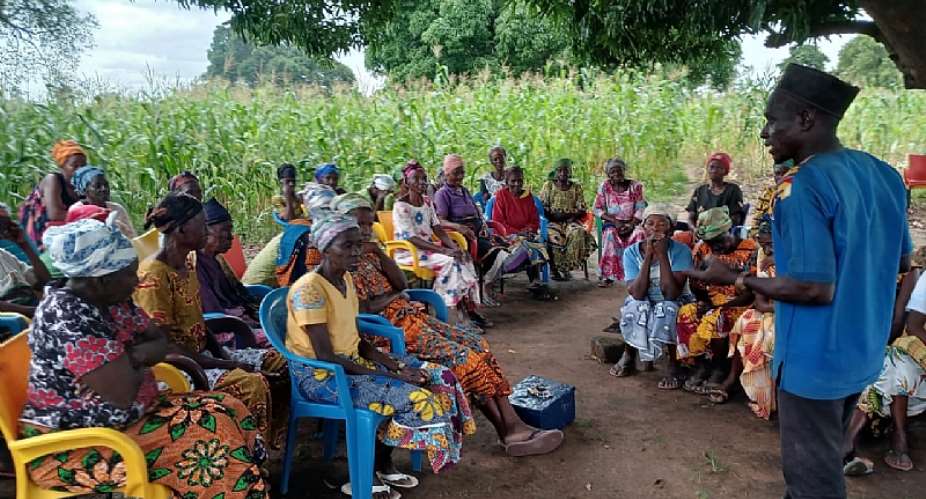
Small holder farmers in the Sawla-Tuna-Kalba District of the Savannah Region have received intensive training in groundnut and cowpea production under the Climate Smart Agroforestry System.
During the training, new members were registered into cooperatives with an indepth review of their constitutions.
The Climate Smart Agroforestry System, initiated by Centre for Rural Improvement Services (CRIS) with funding from UNDP also saw rural farmers receive empowerment training in beekeeping and apiary management under Agro Forestry Farms.
Drawn from Kunkuya and Dakompilayiri in the Sawla-Tuna-Kalba District, the farmers received a lifetime boost with many pledging to go into commercial cashew production and beekeeping.
At the end of the training, 2,400 cashew seedlings and 60 beehives were supplied to the farmers by way of aiding them to start effective production.
The Executive Director for Centre for Rural Improvement Services (CRIS), Mr. Amos Mahama encouraged the beneficiaries to take advantage of the project to improve their livelihoods, whilst making effort to protect the environment through climate smart practices.
He said the sustainance of the project will depend on how the farmers utilize the existing interventions towards self empowerment and community development, adding that, "there is more in the pipeline Small holder farmers receive training on groundnut production and VSLA concept
Small holder farmers in the Sawla-Tuna-Kalba District of the Savannah Region have received intensive training in groundnut and cowpea production under the Climate Smart Agroforestry System. During the training, new members were registered into cooperatives with an indepth review of their constitutions.
The Climate Smart Agroforestry System, initiated by Centre for Rural Improvement Services (CRIS) with funding from UNDP also saw rural farmers receive empowerment training in beekeeping and apiary management under Agro Forestry Farms.
Drawn from Kunkuya and Dakompilayiri in the Sawla-Tuna-Kalba District, the farmers received a lifetime boost with many pledging to go into commercial cashew production and beekeeping.
At the end of the training, 2,400 cashew seedlings and 60 beehives were supplied to the farmers by way of aiding them to start effective production.
The Executive Director for Centre for Rural Improvement Services (CRIS), Mr. Amos Mahama encouraged the beneficiaries to take advantage of the project to improve their livelihoods, whilst making effort to protect the environment through climate-smart practices.
He said the sustenance of the project will depend on how the farmers utilize the existing interventions towards self-empowerment and community development, adding that, "there is more in the pipeline with effective collaboration".
According to him, Cashew production and beekeeping are becoming viable economic ventures capable of redefining the destinies of communities and empowering rural farmers to be self-dependent.
Beneficiary farmers expressed gratitude to UNDP for funding the interventions, which they describe as timely and worthwhile.
They pledge to make effective and good use of the project to enhance their livelihoods whilst encouraging UNDP to expand the intervention to reach more farmers.

 France and Britain test NATO readiness with major airborne exercise in Germany
 Israel to close all West Bank land crossings on election day
 What to know as Brazilians choose between Lula and Bolsonaro in tense presidenti...
 President Mahama urges African countries to fund own peace operations, warns aga...
 Govt to borrow GHS15.38 billion from domestic market, plans DDEP bond buyback
 Finance Ministry says all 2026 ABFA allocations reserved for Accra-Kumasi expres...
 'Surprised and disappointed' — GTA CEO Efua Houadjeto responds to Abeiku Santana...
 Police arrest NDC delegates for allegedly photographing ballots at Bimbilla cons...
 Gambia’s Chief Justice pays courtesy call on Asantehene at Manhyia Palace
 NDC Constituency polls: Delegates invoke 'Antoa' deity over alleged album manipu...


