




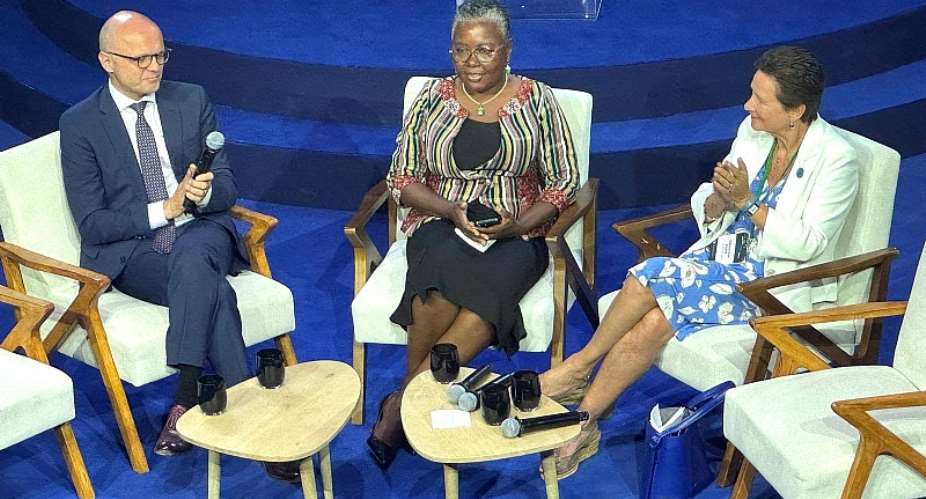
The Minister for Fisheries and Aquaculture, Madam Emelia Arthur, has called for a more equitable, inclusive, and science-driven approach to global ocean governance, urging the international community to address persistent inequities in the management and preservation of the world’s oceans.
She made the call while delivering an address at the Neptune Forum in Paris, France, on Monday, coinciding with World Oceans Day.
The Forum brought together world leaders, scientists, diplomats, policymakers, economic actors, and ocean advocates to strengthen international cooperation for sustainable ocean management.
Speaking on the theme, “International Governance in a Fragmented World: Ocean Governance and Ghana’s Perspective,” the Minister highlighted the critical role the ocean plays in Ghana’s history, economy, food security and cultural identity.
She acknowledged that technological advancements have significantly improved humanity’s understanding of the ocean. She cited real-time vessel monitoring, artificial intelligence, marine data collection, and seabed mapping as key developments that have expanded scientific knowledge.
She noted that major challenges such as declining fish stocks, threats to marine biodiversity, increasing vulnerability of coastal communities and persistent maritime insecurity remain.
The Minister said the ocean governance must go beyond resource management and must focus on equity, shared responsibility, and sustainable development.
She outlined Ghana’s Blue Economy vision, which integrates sustainable fisheries and aquaculture, marine spatial planning, strengthened monitoring and enforcement systems, and community stewardship within a unified governance framework.
She emphasised that the framework is designed to ensure that ocean resources serve the long-term interests of Ghanaian communities while upholding environmental standards consistent with international obligations.
The Minister drew attention to the disproportionate burden borne by developing countries, particularly African coastal states, in combating Illegal, Unreported and Unregulated (IUU) fishing.
She stressed that IUU fishing is not only an environmental concern but also a matter of economic justice, food security, and national sovereignty. She called on the international community to provide African nations with greater support in enforcing maritime regulations and protecting their exclusive economic zones.
Calling for stronger international partnerships, Madam Arthur advocated for increased investment in scientific capacity building, technology transfer, and access to marine data and digital infrastructure.
She argued that Africa must not only consume ocean knowledge but must also contribute to its generation and application. “Scientific sovereignty over our maritime resources is non-negotiable,” she added.
As part of her address, she proposed five guiding principles for the future of global ocean governance: Equity, Stewardship, Scientific Sovereignty, Recognition of Indigenous Wisdom, and Collective Security.
The Minister reaffirmed Ghana’s commitment to building a fairer and more effective system of ocean governance, stating that the ocean can serve as a bridge in a fragmented world when cooperation is founded on fairness, shared responsibility, and respect for the people whose livelihoods depend on the sea.
 'On what grounds are you saying Ato Forson is not spending?' — Atta Issah quizze...
 Mid-Year Budget Review: 'The Finance Minister was loudly silent on the 24-hour e...
 GES sets August 15 for dispatch of teacher promotion letters
 Mahama welcomes Gabon's President for three-day bilateral talks on trade, securi...
 Multiple deaths in Japan mall collapse after 7.1-magnitude earthquake
 Anglican Church leader visits slave trade project on Africa tour
 Archbishop of Canterbury pays courtesy call on Mahama
 Govt awaits autopsy report in South Africa death case
 Court dispute halts Apostle Kwadwo Safo’s burial set for July 30 as family seeks...
 At the appropriate time NPP will take on NDC govt for deceiving Ghanaians — COKA

