




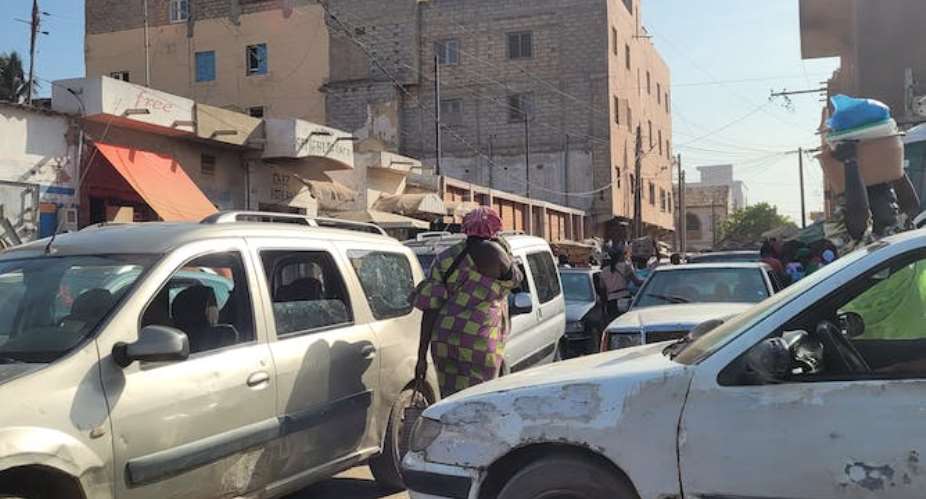
Major cities in Africa are growing at a rapid pace. In Dakar, the capital of Senegal, for example, the population has almost doubled in 20 years, reaching 4 million inhabitants today.
But in most cities, such as Dakar, planning policies are struggling to keep pace with urban growth. This is also the case with the transport system. Public transport plays a fundamental role in access to the city. However, in many cities, they are failing, especially in the outskirts. This degrades the quality of life of their residents, who live in neighborhoods where jobs and facilities of all kinds are lacking.
Satisfying basic needs – such as employment, social interaction, health care, education and food – depends on mobility. In a context where incomes are low and where public services and facilities are scarce, getting around on a daily basis is both essential and difficult.
In Dakar, the authorities are seeking to better organize the transport system to meet the growing demand for travel. Two high-capacity transport lines - the Regional Express Train (TER) and the Bus Rapid Transit (BRT) - are built or under construction. Despite this, public transport remains insufficient. Various forms of informal transport fill this gap, accounting for a significant share of motorized travel. Among them, collective taxis, commonly called “clandestine taxis” or “clandos”. But they are illegal because they operate without a license.
The clandos are generally old vehicles, with no distinctive sign on the bodywork, which carry four to six passengers. Many clandos operate in the Dakar region. There is no official figure, as the clandos are not registered. However, according to our investigations, there are clearly more than 5,000 circulating daily. People know them because they follow fixed routes, leaving “garages”, or pick-up locations, when they are full. Most of the time, garages are well located, near major roads or important buildings. The clandos also serve remote areas. They are more expensive than buses but offer a better quality of service.
The research we have carried out on daily travel in Dakar highlights the essential role played by clandos, particularly on the outskirts. Even if the buses consider them as competitors, in most situations, the clandos are complementary to them and would benefit from being better integrated into the planning and mobility strategies of the outskirts.
How to move in the outskirts of Dakar?
The 2015 household mobility survey in Dakar and the surveys that we carried out in 2021 and 2022 show that the populations of the outskirts of Dakar are poorer than the rest of the conurbation, have limited access to public transport and travel mainly by foot. When they resort to motorized modes of transport, a large part of their journeys are carried out in clandos.
The inhabitants of the Dakar region generally use clandos for two types of travel:
commuting, often long, from the outskirts to the centre. The clando is then most often used for only part of the trip, to reach the bus stop or return. It makes it possible to avoid long journeys on foot and therefore contributes to increasing the number of passengers on the buses. Most of these commuters are men.
internal displacements at the peripheries. These trips are relatively short. They represent almost two out of three trips made in clandos. The people who use them form a diverse group: housewives, school children, workers in the informal sector.
Clandos are appreciated for their speed and comfort. Our surveys also show that they have a cost for households. This explains why the use of clandos remains episodic, limited to certain types of travel, such as family visits, access to the dispensary or the return from the market.
Urban planning and clandos
Public authorities are focusing their current efforts on organizing public transport around mass transport. She considers that informal modes, such as clandos, are doomed to disappear on the pretext that they compete with mass transport, serving at best as a mode of reduction.
However, the dual role of clandos as a complementary mode, both as a feeder to public transport stops and, more importantly, for internal trips to the outskirts, largely compensates for their negative contribution to modal competition and congestion.
Recognizing them would make it possible to take better advantage of their assets and let them fully play their role in supporting mobility and daily life in the outskirts. In practice, such recognition by the authorities could result in improved operating conditions, better distribution of garages in public space, less harassment and levies by the police. It would also allow easier access to credit for drivers who own their vehicles and owner-investors in order to facilitate the renewal of the vehicle fleet.
These elements are to be considered within the framework of a more general approach to the urban integration of the outskirts and the need for public action to articulate urban planning and mobility. Taking clandos into account in the planning, development and mobility strategies of the outskirts would make it possible to frame a development of the mobility system which is currently being done “from below”. Lastly, it would contribute to strengthening employment opportunities in a very tight labor market.
The authors do not work for, consult, own shares in or receive funding from any company or organization that would benefit from this article, and have disclosed no relevant affiliations beyond their academic appointment.
By Pape Sakho, CAMES Lecturer, Cheikh Anta Diop University of Dakar And
Gaele Lesteven, Researcher, LAET, National School of Public Works And
Momar Diongue, Lecturer and Researcher, Cheikh Anta Diop University of Dakar And
Pascal Pochet, Researcher, LAET, National School of Public Works
 South Africa xenophobia: Business allegedly declines after ownership shift from ...
 Kpone Traditional Council announces death of paramount chief after 37 years of r...
 Middle East live: Iran says will target any vessel traffic in Strait of Hormuz
 Bill Gates calls Epstein meetings a ‘grave error’ while defending actions in hou...
 Infantino defends World Cup ticket prices, dismisses referee US entry dispute
 Rainstorms from Nigeria, Benin to trigger thunderstorms in Ghana — GMet warns
 Accra floods: 70 seized excavators to be deployed to NADMO for desilting — Munta...
 Kasseh Market executives stop sale of food near toilet facility
 Three arrested over theft of critical equipment at Komenda Sugar Factory
 Nearly half of Ghanaians say military rule can be justified if governments fail ...


