




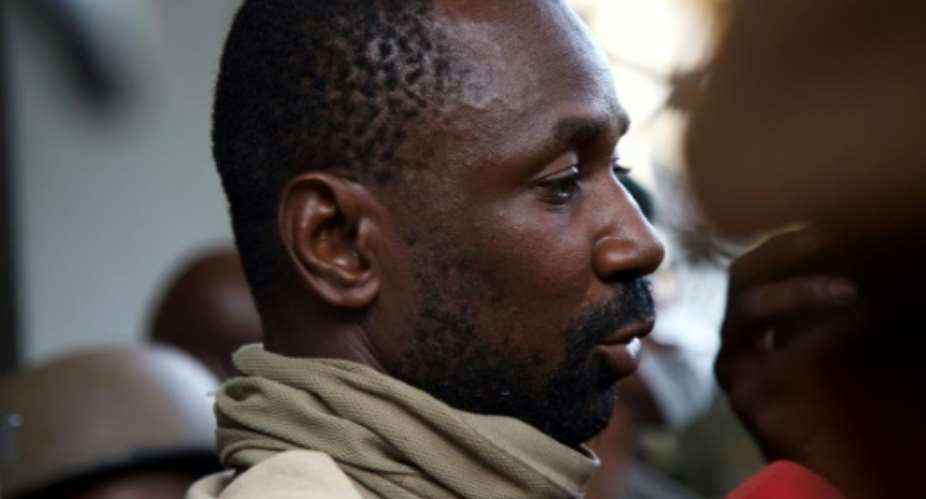
Mali's strongman summoned his cabinet on Monday for an extraordinary meeting after the West African bloc ECOWAS imposed stringent sanctions on the fragile Sahel country over delayed elections.
In a sharp escalation after months of simmering diplomatic tensions, leaders from the Economic Community of West African States (ECOWAS) on Sunday agreed to shutter borders with the Sahel state and impose a trade embargo.
They also pledged to cut financial aid to Mali and freeze its assets at the Central Bank of West African States, and recalled their ambassadors from the country.
The move followed a proposal from Mali's army-dominated government last month to stay in power for up to five years before staging elections -- in contradiction to international demands that it respect a promise to hold elections in February.
Colonel Assimi Goita, Mali's strongman who took power in a military coup in August 2020, has not yet responded publically to the political crisis.
An official in his office, who requested anonymity, said that Goita held a long meeting with his prime minister Choguel Kokalla Maiga on Monday, however.
'Illegal and illegitimate'
Earlier the same day, Mali's junta stated that the ECOWAS sanctions were "illegal and illegitimate" and accused the bloc of being "instrumentalised by extra-regional powers," in an apparent reference to France.
Relations between Mali and France, its former colonial master which has thousands of troops in the country, have deteriorated since the 2020 coup that ousted elected president Ibrahim Boubacar Keita.
Under the threat of sanctions, coup leader Goita had promised to restore civilian rule in February 2022 after holding presidential and legislative elections.
But he staged a second coup in May 2021, forcing out an interim civilian government, disrupting the reform timetable, and provoking widespread diplomatic condemnation.
ECOWAS continued to insist on elections in February, although Mali's government argued that rampant insecurity posed a problem and that peaceful elections took priority over speed.
Mali has struggled to quell a brutal jihadist insurgency that first emerged in 2012, before spreading to Burkina Faso and Niger. Swathes of its vast territory lie outside of government control.
'All necessary measures'
Mali's junta has also announced that it will recall its ambassadors in ECOWAS states and close its borders in response to the sanctions, vowing to take "all necessary measures to retaliate".
Goita's intentions remain unclear. Experts interviewed by AFP have warned that the tough language emanating from the Malian military bodes ominous for the future of its dispute with ECOWAS.
The effects of sanctions are already beginning to be felt.
Air France, for example, announced that it would no longer be serving Mali's capital Bamako over due to "regional geopolitical tensions".
The trade embargo may take longer to take effect, but Malians have voiced concern on social media about the risk of future shortages.
A landlocked nation of 19 million people, Mali is one of the poorest countries in the world.
Mali's junta has said that the new ECOWAS sanctions will "affect populations already severely affected by the security crisis and the health crisis".
It also stated said it had made arrangements to ensure normal supplies, however.
ECOWAS also imposed sanctions on Mali soon after the 2020 coup, in a move thought to have contributed to the army agreeing, at the time, to install a civilian-led government and stage elections.
Many Malians remain worried for the future. "We don't know where this will lead," said Daoulata Haidara, a Bamako resident.
However, Lassana Camara, another resident of the capital, said he opposed the sanctions, casting ECOWAS as an out-of-touch elite club.
"This club runs contrary to Africa, to the West African population," he said.

 'Some NPP members did not vote in 2024 election because I left NPP' – Alan Kyere...
 How €225 million cocaine from Ghana traced to fugitive Dutch drug kingpin based ...
 'Galamsey remains an existential threat' – Gyampo demands more action
 'I’m like Akpeteshie, I don’t need adverts to win' – Hawa Koomson storms home tu...
 'Excessive bail conditions must be reviewed' – GBA President
 Ketu South: Four-year water crisis deepens hardship in Agbozume
 Show evidence of higher operating costs to justify fare hike – NPA CEO to transp...
 Four Ghanaians arraigned over alleged €225 million cocaine shipment to France
 Agbogbloshie: Police kill suspected robber, recover AK-47, 186 rounds of ammunit...
 DVLA opens 29 new offices in 18 months; 62 offices nationwide - CEO


