




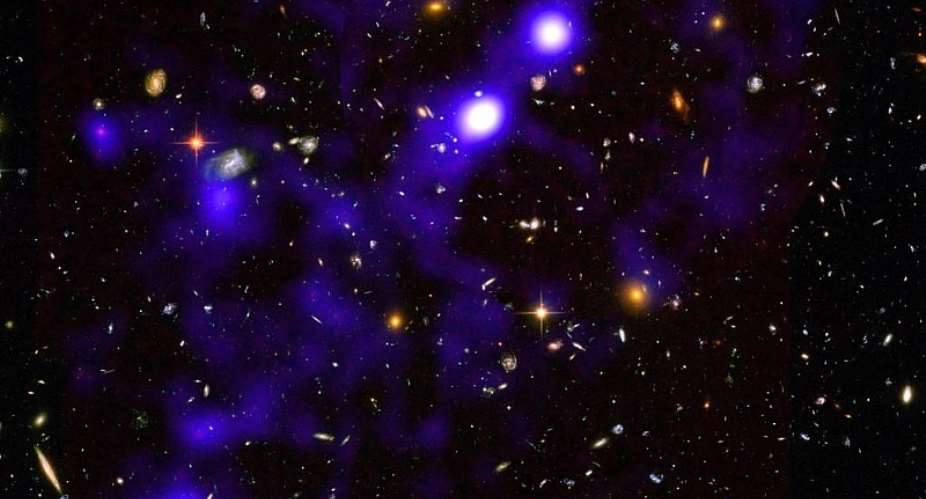
Astronomers in France have captured the first direct images of the “cosmic web” – glowing threads of dark matter laced with gas – in a discovery that also reveals the existence of billions of dwarf galaxies in the far depths of the universe.
The cosmic web is an elaborate network of interconnected hydrogen filaments that have given shape to the universe since the early years following the Big Bang.
“This is a key period because the universe was very active back then,” astrophysicist Roland Bacon, who spearheaded the research, told RFI.
“A lot of stars and galaxies were being formed … and the gas was the fuel for this formation.”
Deepest images of space
The cosmic web was mostly the stuff of cosmological simulations until it was observed by the European Southern Observatory's Very Large Telescope, which was pointed at a single region of the sky for some 140 hours, over eight months.
This focus point forms part of the Hubble Ultra-Deep Field, a section of the cosmos that was, until now, the deepest part of the universe ever observed.
Using 3D spectrograph technology, known as MUSE, scientists led by Bacon's team at the Lyon Astrophysical Research Centre were able to produce stunning images some 12 billion light years away.
So far indirect glimpses of the cosmic web have been achieved only through studying the light of quasars, massive galactic objects that emit superhot radiation.
However this latest research, published Thursday in the journal Astronomy & Astrophysics, marks the first time light emitted from the cosmic web itself has been observed.
“Even though we know it's there, we need to actually observe it to measure it,” says Bacon, adding that quasars are located in a very specific part of the cosmic web where the filaments cross paths.
Surprise galaxies
The biggest surprise to result from the research was the discovery that UV light from the filaments was coming from a previously invisible population of billions of dwarf galaxies.
These tiny galaxies – which produce a huge amount of light because they are so numerous – may be responsible for “reionising” the universe and ending the “dark age” that followed the Big Bang.
“For 500 million or a billion years, there was no light, no stars, no galaxies – and then there was the first emission of light,” Bacon explains.
“What was the source of this sort of reionisation? Black holes, micro black holes, special stars? I think it was this population of dwarf galaxies.”


 Chairman Wontumi’s lawyer says plea-bargaining talks with state ended over unfav...
 University Administrators demands 114% market premium before calling off strike
 We need your support in fight against illegal mining - Mahama appeals to chiefs
 Haruna Iddrisu orders suspension of Obuasi SHTS headmaster over alleged sexual m...
 World Cup visas: Hold TRIBE Culture Fest liable for defrauding applicants – Kofi...
 Police arrest farmer seen in viral video assaulting wife in Agona Nkwanta
 NDC appoints Julius Kwame Anthony as Deputy Communications Director
 French counter-terrorism body to investigate 14-year-old behind school shooting
 Suame MP John Darko granted bail after appearing before EOCO over GH¢27m SIC Sav...
 Ghana among stronger-performing economies in sub-Saharan Africa — IMF


