




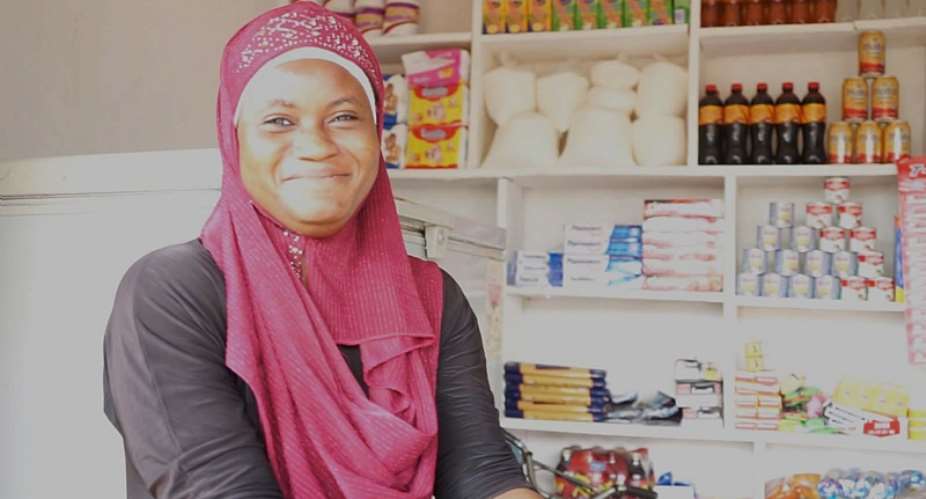
Investing in women’s economic empowerment sets a path for poverty reduction and building healthy families. Not only is the economic empowerment of women a fundamental right, but it’s also a critical foundation for reducing the vulnerability of women and children, especially girls.
This calls for not only purposeful, but also comprehensive systematic moves geared towards increasing women’s right to economic resources, uninhibited participation in the economy, and their power to make decisions that benefit themselves, families and their communities.
The Vulnerable Woman
Frustration, annoyance, exasperation, irritation. For most of us, these are feelings that arise out of unfavourable conditions or circumstances. The case of Madam Amina Yussif from Kanvili, a suburb of Sagnarigu District of the Northern region of Ghana, is not any different as she lamented her helplessness to also contribute her quota to the survival of her family due to limited economic opportunities.
Amina is 22 years, married with two kids. Her husband is a student and not financially stable. Yet, Amina is forced to completely rely on the husband for the upkeep of the household, including care of both children. She calls on her husband from buying sacket water to providing food for the family. Affording necessities and paying children school fees was a nightmare.
Due to their financial constraint, her two girls could not start school even though they were of age. Her husband had the additional responsibility of his brothers’ children who were older than his own children. And per the norms, Amina’s children could not start school if the older cousins were not in school. Her constant demands are always not met with understanding, but often result in squabbles between her husband and herself.
“Those days were horrible. There was no peace in this house. I didn’t understand why he had a problem when I asked him for money for the upkeep of the house. I was not working, and I wondered what he expected me to do to ensure the children especially had eaten. It was very painful period in our lives. All of these frustrations resulted in petty quarrels in our home”, Amina summarized.
The Empowered Woman
Amina was economically empowered and supported with start-up capital and financial literacy training through the Technology for Maternal and Child Health (T4MCH) project implemented from 2016 to 2020 by Savana Signatures with support from Global Affairs Canada.
The start-up capital enabled her to start her retailing business whiles the financial literacy training was carried out to enable her to effectively manage her finances and grow her business.
A visit to Amina recently revealed that she has been able to expand the business to a fully furnished retail shop. Sequel to this, she is now able to afford her necessities, as well as those of her children and husband.
“I have been able to really manage the start-up capital and expand the business. Ever since I started the business, I am able to afford my needs and assist my husband in providing the family needs”.
Mrs. Amina indicated that Before the project intervention, her husband was responsible for feeding and providing everything for the family, “I used to stay at home and wait for him to provide all our needs, but with the help of the project, I know that a wife should also be empowered to help in supporting the family because husbands cannot do all”.
“Women also need the right support, both the financial and soft skills to contribute their part to ensure quality of life for their families and to the economy of the country”, Amina added.
Conclusion
The case of Amina affirms that investing in women’s economic empowerment sets a path for poverty reduction and building healthy lives and families. It also indicates that, facilitating women’s right to economic resources and the power to make economic decisions would go a long way to benefit their families, communities and the country at large.
T4MCH Project
The Technology for Maternal and Child Health (T4MCH) project has since 2016 empowered women economically to improve their quality of life and to eradicate family disputes arising from financial constraints.
The project seeks to improve maternal health, family planning and economic empowerment among the vulnerable, specifically women and children in the five (5) regions; Northern, Oti, Savannah, North-East and Upper West.
Writer: Edward A. Ken-Zorre

 Govt releases GH¢9.1 billion covering six quarters of DACF to MMDAs - Ayariga
 Manhyia South MP charged over alleged GH¢9.85m loss to SIC Life
 'I didn’t know the process would be that fast' – Nana B explains missing NPP swe...
 'Who is Karbo to defy my orders?' – Buttey fumes over NPP conference clash
 'Kojo Bamba can’t stop NDC' – Gbande warns NPP against shielding anyone from arr...
 Fire destroys property building in Koforidua
 Mahama pardons 863 convicted persons, 11 from death sentence
 National Cathedral site reverts to government as Attorney-General reviews audit
 NDC confirms Dzifa Gunu’s disqualification from La Dadekotopon constituency secr...
 Nigeria's Tinubu confirms 32 dead after military plane crash


