




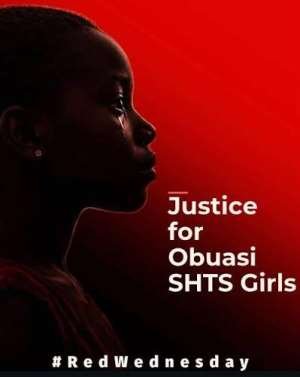
In the City of Gold, where wealth is extracted from beneath the earth, a disturbing scandal has raised uncomfortable questions about power, privilege, politics, and the protection of teenage girls. Allegations of sexual abuse involving female students at Obuasi Senior High Technical School have shocked the nation. Yet, amid the outrage, an even more troubling question emerges: are some people more concerned with defending the man at the centre of the allegations than with listening to the girls whose accounts demand serious attention?
Why are some people defending him? Is it because of his position, his political affiliations, or the influence he commands? With the National Democratic Congress (NDC) in power, questions about political connections and possible preferential treatment deserve scrutiny wherever credible evidence points to them. Political affiliation, however, should neither establish guilt nor provide immunity from investigation.
The reported question attributed to Black Rasta—whether the girls were “bad girls”—raises another disturbing issue: victim-blaming. Why should the character of the girls become the focus when the central concern is the alleged conduct of an adult entrusted with authority over students? A girl's reputation, behaviour, or background does not justify sexual abuse. The responsibility lies with the person who commits the wrongdoing.
The headmaster, Zakaria Abdulai, has denied the allegations. Nevertheless, his denial should not end the conversation or prevent a thorough investigation. Allegations of this gravity must be examined fairly, independently, and without political interference. The girls deserve to be heard, and the evidence must determine the outcome.
For decades, popular Ghanaian music has held up a mirror to the complicated relationship between age, authority, romance, and exploitation.
Kontihene's Aketesia captured themes of romantic pursuit, while Obour and Batman Samini's Konkontibaa became part of a wider cultural conversation about older men waiting for younger girls to mature. The imagery associated with the song has since attracted renewed scrutiny in discussions about age, consent, and the normalisation of inappropriate relationships between adults and minors.
Then came Mzbel's 16 Years, a song that gave voice to a young girl's resistance to unwanted advances. Its message was direct: young girls have boundaries, and older men who approach them inappropriately should expect to be reported to their mothers and guardians.
The song resonated because it reflected a reality that too many young girls know: saying no is not always enough when the person pursuing them has greater age, influence, authority, or social standing.
The Konkontibaa metaphor of the tadpole growing into a frog carries a particularly powerful message. The tadpoles must be allowed to grow into frogs and croak in their own time. They must be given the opportunity to grow, mature, and experience life without adults forcing sexual activity upon them. Childhood is not an invitation, and growing up is not consent.
A child must never be treated as a sexual opportunity waiting to mature. No adult has the right to exploit a child's vulnerability, manipulate her development, or force sexual experiences upon her. The fact that a young person is approaching adolescence does not make her available to adults.
Let the tadpoles grow. Let the frogs croak when their time comes. Above all, let children be children, free from exploitation, coercion, and the demands of adults who abuse their power.
But what happens when girls do speak up and the very institutions entrusted with protecting them fail to listen?
Obuasi is internationally recognised for its gold-mining industry. Yet behind the gates of Obuasi Senior High Technical School, allegations of sexual exploitation involving teenage girls have placed the institution under intense public scrutiny.
The scandal gained national attention through journalist Manasseh Azure Awuni's investigative documentary, Inside the Dreaded Headmaster's Bungalow. The report presented serious allegations against the school's interdicted headmaster, Zakaria Abdulai, with female students describing alleged sexual abuse and intimidation connected to his official residence.
The allegations are particularly disturbing because a headmaster occupies a position of trust. Students and their families expect school leaders to provide a safe learning environment, protect young people from harm, and ensure that complaints are treated seriously.
When allegations of abuse involve someone in such a position, the imbalance of power becomes a central concern. Students may fear retaliation, damage to their reputations, or disbelief from the very adults expected to protect them.
That is why the response of school authorities matters just as much as the allegations themselves.
Reports surrounding the scandal have raised questions about whether the housemistress Stephanie Adwoa Yeboah was aware of the molestations and whether her response was appropriate.
If officials received credible reports of sexual abuse and failed to take reasonable steps to protect the students, that failure deserves serious investigation. Any substantiated attempt to intimidate complainants, suppress reports, or obstruct an investigation would represent a grave breach of responsibility.
The issue is bigger than one individual. It concerns the entire chain of responsibility: who knew what, when they knew it, what action they took, and whether the girls were protected from further harm.
Mzbel's 16 Years imagined a girl who could report unwanted advances to her guardians. The allegations emerging from Obuasi force us to confront a more troubling possibility: what happens when a girl reports abuse but the adults around her fail to act?
A reporting system is meaningless if complaints are ignored, victims are intimidated, or officials prioritise an institution's reputation over a child's safety.
The political dimension of this controversy cannot simply be dismissed, but it must be examined responsibly.
Where the accused person is believed to have links to the governing NDC, the public is entitled to ask whether those connections have influenced the response to the allegations. However, political affiliation alone does not prove that anyone has interfered with an investigation or that a defence of the accused is politically motivated.
The proper test is evidence. Have investigators been allowed to work independently? Have complaints been handled transparently? Have the students received adequate protection? Has anyone attempted to influence witnesses or obstruct the process? These are the questions that matter.
No political party should be allowed to turn allegations of sexual abuse into a contest of loyalty. Neither the NDC nor any other party should be judged by whom it can protect, but by whether it supports accountability, safeguards minors, and respects the rule of law.
When political allegiance becomes more important than the welfare of vulnerable people, justice risks becoming a casualty of partisan loyalty.
This story is not unique to Ghana.
The Harvey Weinstein scandal exposed how a powerful entertainment executive could face years of allegations while professional influence, fear, and institutional failures helped sustain an environment in which women struggled to speak out. The crimes associated with Jeffrey Epstein similarly revealed the devastating consequences of sexual exploitation and the questions that arise when wealth and influential social connections intersect with failures of accountability.
These cases are not identical, and their facts and legal outcomes differ. Yet they raise a common question: how often do victims face disbelief, intimidation, or institutional indifference because the person they accuse holds power?
Across societies, the same dynamics can emerge. A respected public figure may receive the benefit of the doubt while a young complainant is subjected to relentless scrutiny. Friends and associates may defend the accused before the evidence is examined. Institutions may worry about reputational damage, while victims are left to carry the burden of speaking out.
The problem is not simply that some men abuse their power. It is also that systems sometimes make it difficult for victims to challenge them.
No man is entitled to a woman's or a girl's body. No position, political affiliation, wealth, reputation, or social connection should place anyone above the law.
Public outrage is important, but outrage alone cannot deliver justice.
The students deserve a credible investigation, protection from intimidation and retaliation, access to appropriate support, and a process that treats their accounts with dignity. Witnesses must be free to speak without fear, and all allegations must be assessed fairly.
The authorities must establish what happened, identify any failures in the school's response, and hold anyone found responsible accountable under the law. If institutional negligence or deliberate suppression of complaints is substantiated, those responsible must face appropriate consequences.
The headmaster's denial must be considered as part of a fair process, but it should not become a reason to dismiss the students' accounts without investigation.
Justice requires both due process for the accused and meaningful protection for those who report abuse. These principles are not enemies of one another; they are essential to a credible outcome.
For decades, Ghanaian music has explored the tensions between older men, young women, attraction, and the right to say no. Through different melodies and generations, these songs have become part of a broader cultural conversation about boundaries and the treatment of young girls.
Now, the allegations at Obuasi Senior High Technical School bring those questions into the real world, where the consequences are far more serious than anything contained in a song.
The girls of Obuasi deserve to be heard without victim-blaming, political interference, or intimidation. They deserve protection, dignity, and a fair investigation. The school community deserves answers, and the public deserves confidence that no individual is too powerful to face scrutiny.
Gold may have made Obuasi famous across the world, but no mineral wealth can compensate for a failure to protect a child.
The tadpoles must be allowed to grow. The frogs must be allowed to croak in their own time. And no one should be permitted to force a child into sexual activity before she has had the chance to grow up safely and freely.
The true measure of a society is not the influence of its powerful men, the strength of its political connections, or the wealth beneath its soil. It is whether its most vulnerable young people can speak up, be taken seriously, and receive protection when they do. Our girls are important !
In the City of Gold, the girls' voices must be worth more than any man's power. Please see the link to the documentary below:
https://youtu.be/iyPimAy4fCY?is=qriJh6bi3q4t_4hN


 NDC Oforikrom polls: Treasurer aspirant challenges Ashanti Regional Minister ove...
 NDC Oforikrom constituency election stalls over ballot paper delays
 Former NDA CEO Sumaila Abdul-Rahman, three others fined GH¢84,000 each over proc...
 Wa: Abandoned newborn baby boy rescued at Sombo
 GTA Deputy CEO Abeiku Santana drags his boss Maame Houadjet to Minister over acc...
 Stop sucking breasts during intimacy to avoid stasis of milk inside — Retired nu...
 NDC Enforces Strict Verification and Voting Rules as Constituency Elections Begi...
 Protests against cost of living expected in Italy under heavy security
 Lula, Bolsonaro clash on living costs, corruption in final Brazil election debat...
 Ebola vaccine trial begins in DR Congo


