




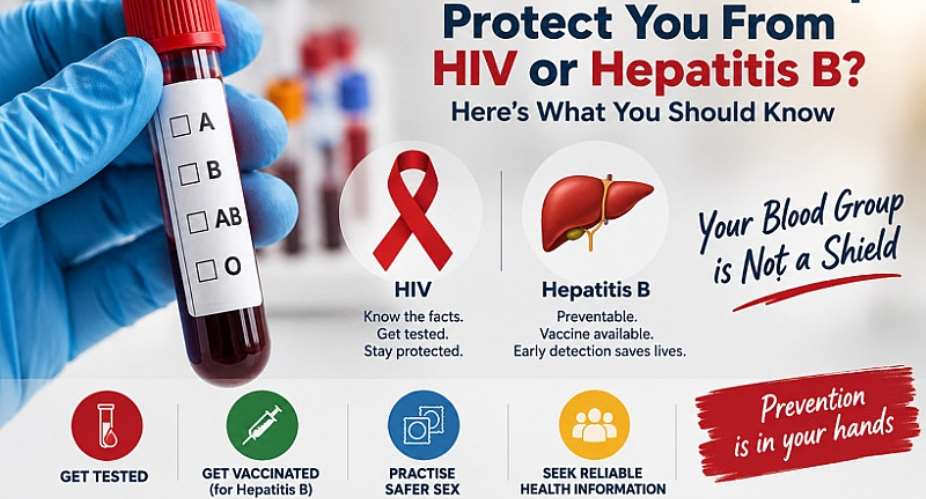
Have you ever heard someone say, “I’m blood group O, so I hardly get sick,” or wondered whether your blood group could protect you from certain diseases?
Most of us know our blood groups mainly because of blood transfusion, pregnancy or blood donation. We are usually identified as blood group A, B, AB or O and as either Rh positive or Rh negative.
But could these differences actually affect our chances of contracting infections such as HIV or Hepatitis B?
It is an interesting question, and one that scientists have investigated. But there is an important message everyone should understand: your blood group should never be considered protection against HIV or Hepatitis B.
What Does Your Blood Group Really Mean?
Our ABO blood groups are determined by certain substances, known as antigens, found on the surface of red blood cells.
People with blood group A have A antigens, those with group B have B antigens, people with AB have both, while people with blood group O have neither A nor B antigens.
Scientists have studied these biological differences to determine whether they are associated with susceptibility to various diseases and infections.
Some studies have reported associations between particular blood groups and certain diseases. However, finding an association does not mean that a particular blood group directly causes a disease or guarantees protection from it.
What About HIV and Hepatitis B?
HIV attacks the body's immune system. It can be transmitted through certain body fluids, including blood, semen, vaginal fluids and breast milk. It can also be transmitted from mother to child. HIV is not spread through ordinary contact such as hugging, shaking hands or sharing food.
Hepatitis B is caused by the Hepatitis B virus (HBV), which attacks the liver. The infection can become chronic and, over time, may lead to serious complications such as liver cirrhosis and liver cancer.
HBV can be transmitted through infected blood and other body fluids, during sex, through contaminated sharp instruments and from an infected mother to her baby.
Because these infections interact with the human body in complex ways, researchers have investigated whether characteristics such as ABO and Rh blood groups are associated with differences in infection patterns.
However, research findings have varied among different populations. Therefore, your blood group alone cannot reliably tell whether you will or will not contract HIV or Hepatitis B.
Why This Matters in Ghana
HIV remains an important public health issue in Ghana. According to Ghana's 2025 National HIV Estimates and Projections, more than 337,000 people were estimated to be living with HIV in the country.
This makes accurate public information about HIV prevention particularly important.
Hepatitis B is also a major health concern because a person can be infected without initially showing obvious symptoms. Chronic infection can eventually cause severe liver disease.
These realities make prevention, testing and reliable health information far more useful than assumptions based on one's blood group.
Don't Let Your Blood Group Give You False Confidence
Whether you are blood group O, A, B or AB, positive or negative, you should not consider yourself naturally protected from HIV or Hepatitis B.
For HIV, prevention includes knowing your status, practising safer sex, avoiding the sharing of contaminated needles and sharp objects, and using recommended preventive services such as pre-exposure prophylaxis (PrEP) when appropriate.
People living with HIV who receive effective antiretroviral treatment can live long and healthy lives. Effective treatment can also reduce the amount of HIV in the blood to an undetectable level, at which point HIV is not sexually transmitted.
For Hepatitis B, there is another powerful preventive tool: vaccination. The World Health Organization identifies Hepatitis B vaccination as an effective way of preventing the infection.
Testing is equally important. You cannot determine someone's HIV or Hepatitis B status simply by looking at them—or by knowing their blood group.
Know Your Status, Not Just Your Blood Group
There is nothing wrong with knowing whether you are A+, B+, AB-, O+ or any other blood type. That information is medically useful.
But knowing your blood group should not replace knowing your HIV or Hepatitis B status.
Scientific research into blood groups and infectious diseases helps us better understand how biological differences between individuals may relate to patterns of disease. However, for the general public, the practical message is simple:
No blood group should be treated as a shield against HIV or Hepatitis B.
Get tested when appropriate. Practise recommended preventive measures. Find out whether you have been adequately vaccinated against Hepatitis B and seek advice from a qualified healthcare professional where necessary.
Your blood group may tell us something interesting about your biology, but when it comes to HIV and Hepatitis B, prevention, vaccination where available, testing and appropriate medical care remain far more important than the letter attached to your blood type.
Research may continue to uncover interesting links between blood groups and different diseases, but one message remains clear: do not depend on your blood group to protect you. Depend on knowledge, prevention and timely healthcare.
Know your blood group but more importantly, know your status and protect your health.

 Senior nurse remanded over alleged link to ‘Ghana Jollof’ TikTok account
 ‘NDC rewriting 1992 Constitution’ – NPP rejects review approach
 $300m World Bank financing package secured to permanently end double-track by 20...
 'No piece of land is worth single human life' – Afenyo-Markin calls for peace af...
 Police declare ‘Ghana Jollof’ wanted for allegedly inciting violence
 How community watchdog group helped Police 'cobra team' arrest seven suspects fo...
 Ghana Jollof probe: “She is safe, unharmed” — Police assure GRNMA over detained ...
 36 suspects arrested over lynching of police officer at Gindabour
 Ghana Card to become e-wallet for electronic transactions soon – NIA Boss
 Constitutional amendment: Five-year presidential, parliamentary terms will weake...


