




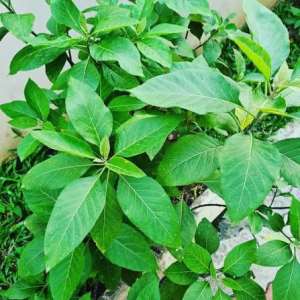
Bitter leaf is a familiar sight in Ghanaian markets and kitchens. Its sharp taste is well known, and its use in traditional remedies is passed down through generations. But for one final-year student at the University of Health and Allied Sciences (UHAS), the plant became the starting point for a detailed laboratory investigation.
Livingstone Afenyo, a final-year Biomedical Sciences student at UHAS, studied the leaves of Vernonia amygdalina, commonly called bitter leaf and known in some Ghanaian languages as "awonwono." The research was supervised by Dr. Adjoa A. Boakye of the Department of Biomedical Sciences, with co-supervision from Professor Clement O. Tettey.
The work set out to answer a straightforward question: does bitter leaf contain compounds that show measurable antioxidant and anticancer activity under laboratory conditions?
To find out, the researchers first prepared an extract from dried bitter leaf using a mixture of ethanol and water. The extraction produced a yield of 8.10 percent from the starting plant material. Laboratory screening of the extract detected several phytochemicals, such as tannins, saponins, steroids, and reducing sugars.
The extract recorded a total phenolic content of 1,210.53 micrograms per milliliters of dried extract. Phenolic compounds are widely studied because of their link to antioxidant activity.
The next step was to test whether the extract could actually neutralise free radicals.
In the DPPH assay, the extract's activity rose from 59.43 percent at the lowest concentration to 95.29 percent at the highest concentration tested. At that top concentration, the extract performed slightly better than Vitamin C, which was used as the reference antioxidant. Statistical analysis showed this difference was significant, with a p-value of 0.036.
A second test, the ABTS assay, also showed increasing activity as concentration rose, reaching 85.32 percent at the highest concentration.
The study then moved to cell-based experiments.
Using the MTT assay, the researchers examined the extract's effect on PC-3 prostate cancer cells. Cell viability dropped steadily as concentration increased, falling to 24.71 percent at the highest concentration tested.
The same extract was tested on normal Vero E6 cells. Here, the picture was different. Cell viability remained above 89 percent across all concentrations. This suggests the extract was more toxic to cancer cells than to normal cells under the conditions tested.
That finding is promising from a research perspective, but it does not mean bitter leaf has been proven to treat cancer.
The results are preliminary laboratory findings. More work is needed to identify which specific compounds are responsible for the effects observed, to understand how they act on cells, and to determine whether the findings have any practical medical application.
The research adds to a growing body of scientific interest in bitter leaf, a plant already studied for its antioxidant and antiproliferative properties in several countries. Previous work has shown that extracts of the plant can induce apoptosis, or programmed cell death, in prostate cancer cells and cause cell cycle arrest.
For Ghana, the significance may reach beyond this one plant. The country has a wide variety of plants used for food and medicine. Studies like this one help researchers work out which plants contain potentially useful compounds and which do not.
Afenyo's work also draws a clear line between traditional use and scientific proof. A plant may have been used for generations, but laboratory research is needed to establish what biological activity it truly has and whether that activity can one day translate into a safe and effective treatment.
For now, bitter leaf remains a research subject rather than a proven medicine. The study forms part of Afenyo's undergraduate thesis at UHAS and contributes to the growing interest in locally available plants as sources of bioactive compounds.
What started as an everyday Ghanaian vegetable has become a scientific question worth pursuing.
Editorial note: The findings are preliminary laboratory results and should not be interpreted as evidence that bitter leaf can prevent, treat, or cure cancer.

 Senior nurse remanded over alleged link to ‘Ghana Jollof’ TikTok account
 ‘NDC rewriting 1992 Constitution’ – NPP rejects review approach
 $300m World Bank financing package secured to permanently end double-track by 20...
 'No piece of land is worth single human life' – Afenyo-Markin calls for peace af...
 Police declare ‘Ghana Jollof’ wanted for allegedly inciting violence
 How community watchdog group helped Police 'cobra team' arrest seven suspects fo...
 Ghana Jollof probe: “She is safe, unharmed” — Police assure GRNMA over detained ...
 36 suspects arrested over lynching of police officer at Gindabour
 Ghana Card to become e-wallet for electronic transactions soon – NIA Boss
 Constitutional amendment: Five-year presidential, parliamentary terms will weake...


