




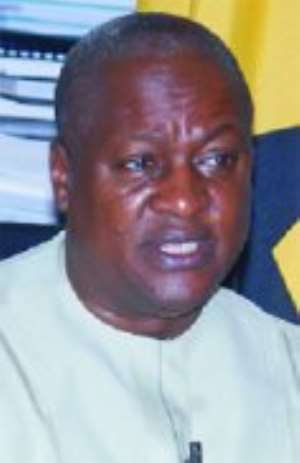
The Vice-President, Mr John Mahama, has urged journalists to abide by the ethics of the profession.
That, he said, they could do by going into issues in an open and transparent manner, by adopting an independent and impartial posture without seeking to harm anybody while protecting the public interest.
Such a stature in any person, he added, called for honesty, sacrifice, commitment and a desire to advance the public interest.
Mr Mahama’s advice was contained in a speech read on his behalf by the Minister of Information, Mr John Tia Akologu, at a seminar for journalists on professional ethics in Accra today.
The seminar, organised by the Ghana Journalists Association and the International Federation of Journalists, is aimed at ensuring that journalists abide by the ethics of the profession, thereby consolidating editorial independence and deepening the country’s democratic dispensation.
Mr Mahama noted that journalists were born and nurtured under the same political, social and economic systems like other Ghanaians, adding that the contradictions and interests groups in society with all their attractions and distractions could make an unprincipled person compromise his or her journalistic ethics.
To be a professional journalist, he added, therefore, called for attributes and values beyond the acquisition of material wealth.
“There is a school of thought on the media based on self-reliance and individual autonomy, free from governmental or societal control.
But there is also the belief that journalistic freedom without control or enforced responsibility poses the danger of some unscrupulous journalists infecting the public arena with falsehoods and opinions disguised as facts,” he said.
“Whilst this argument could be left to the indiscretions of the marketplace and the conscience of the individual journalist, I personally believe the ethics of journalism should make the journalist pursue the public interest.
I say this because ethical codes are encouraged as a self-regulatory device to provide social responsibility.
It is important for journalists or the media for that matter to maintain a balance between commercial interests and democratic enterprise as a guarantee for the protection of individual liberties in society,” he added.
Mr Akologu, for his part, said respect for the country’s laws and professional ethics as adopted by the GJA and acknowledgement of our cultural values would provide the nation a solid platform on which to build its development.
“Ethics should stretch us to think beyond our own self to consider others. In everything we write or intend to write, do we consider our family, our community, our work group, our country and our culture before a decision is made?
Or do we publish because we want to give undue prominence to an issue that has very little or no impact on our development?”
“Do we deliberately demoralise a government that has been voted into power to run a four-year programme after 18 months only in the name of free press? Or are we propagating a negative political agenda because of the personal benefits or cheap popularity to be gained?”
The President of the GJA, Mr Ransford Tetteh, said the ethic initiative being embarked upon by the GJA was good as it buttressed the theme for the 15th GJA Awards.
He said the GJA took note of the challenge hence the move to invite public discourse on ethical journalism.
He added that journalists were not afraid to place the public searchlight on themselves. Therefore, the GJA sought partnership with other civil society groups to ensure that media practice was informed by ethical standards.
The General Secretary of the IFJ, Mr Aidan White, said it was good for journalists to observe ethical journalism because it would engender public good.
In observing ethical journalism, he said, three things must be observed: telling the truth, being independent, never being the conscience of any interest and doing no harm.
Mr White said journalists must know the consequences of what they published because media was to promote peace, and build democracy and development.
“We cannot build democracy if we do not give a voice to the people. With the dawn of the Internet and global media, everybody should be heard,” he added.
He said it was not selfish for journalists to ask for adequate reward for their services but it should not be the basis for breaches of ethical journalism.
He said just as journalists demanded accountability for public office holders, journalists themselves must be accountable, respect their code of ethics and be responsible in their duties.
The President of the Federation of African Journalists (FAJ), Mr Omar Faruk Osman, urged the GJA to consider putting together a committee involving all stakeholders to campaign for ethical journalism to ensure that journalists pursue only the public good and interest.
 Nana Kwadwo Safo Akofena I installed as new leader of Kristo Asafo Mission
 Kristo Asafo Mission rejects claims of shooting Adwoa Safo, calls for independen...
 Six arrested over Kwabenya shooting incident involving Adwoa Safo
 Details emerges as Kristo Asafo Lawyer gives mission’s account of Adwoa Safo sho...
 "Ghana will lift the 2026 World Cup trophy, it will shock the world" – Prophet P...
 NADMO issues final evacuation order for occupants of dilapidated buildings in Ce...
 Two dead, two rescued alive after building collapse at Gyegyeano in Cape Coast
 Ghana vrs England: "I saw both countries sharing 3 goals with Ghana leading" — P...
 Gov’t suspends SHS graduation ceremonies over rising extravagant celebrations
 Two pilgrims arrested over alleged assault on PAOG communications team member


