




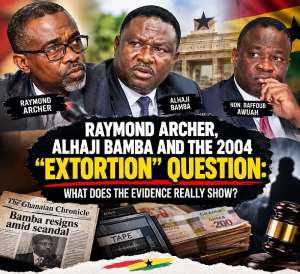
The accusation has returned almost two decades later, but this time it carries a much bigger question.
When Manhyia South MP and lawyer Nana Agyei Baffour Awuah accused EOCO Executive Director Raymond Archer of having “extorted” money during the administration of former President John Agyekum Kufuor, he did not merely make a casual political remark. He invoked a specific historical episode and specifically referred to Alhaji Moctar Bamba, a former Deputy Minister for Presidential Affairs.
That raises an important journalistic question:
What exactly happened between Raymond Archer and Alhaji Bamba in 2004 and does the historical record support Baffour Awuah's characterization of Archer as an extortionist?
The available contemporary records tell a considerably more complicated story.
And perhaps the most important question is one that Baffour Awuah himself, as a lawyer who says he has evidence, should be prepared to answer:
Where is the evidence?
WHO WAS RAYMOND ARCHER?
Before examining the allegation, it is important to understand who Raymond Archer was at the time.
Archer was an investigative journalist associated with The Ghanaian Chronicle. Contemporary profiles describe him as a graduate of the Ghana Institute of Journalism, and his investigative work had already earned international recognition. The International Federation of Journalists records that Archer won the 2002 Lorenzo Natali Prize for Africa and the overall Gold Medal for investigative reports published in The Ghanaian Chronicle.
His journalism was particularly associated with investigations into alleged corruption, abuse of office and misconduct by public officials.
One of the most consequential investigations of his career was the series concerning Alhaji Moctar Bamba.
That is important because the historical record does not present Archer simply as a businessman demanding money from Bamba.
Rather, the contemporary reporting shows Archer investigating Bamba.
WHO WAS ALHAJI MOCTAR BAMBA?
Alhaji Moctar Musah Bamba was a New Patriotic Party politician and Member of Parliament for Wenchi East. During the Kufuor administration, he served as a Deputy Minister for Presidential Affairs.
In February 2004, The Ghanaian Chronicle began publishing a series of reports concerning allegations involving Bamba.
The allegations were serious.
They included alleged misuse of the Office of the President's letterheads, alleged forged signatures of ministers in connection with loan guarantees for a private company known as Emrate/Emirates Investment Limited, alleged involvement in private business while serving in government, and other allegations concerning visas and business dealings.
The controversy eventually became serious enough for Bamba to resign.
A Ghana News Agency report carried at the time said Bamba had admitted to “indiscretion” in his business dealings, while President Kufuor accepted his resignation without prejudice to possible police investigations.
That fact is crucial.
Bamba did not simply disappear from public life because of a journalist's allegation. He resigned his government position following the publications.
BUT WHAT DOES THIS HAVE TO DO WITH RAYMOND ARCHER?
This is where the current controversy becomes fascinating.
According to contemporary Chronicle reporting, Archer alleged that Bamba had attempted to bribe him to stop or suppress the stories.
The allegation was not simply that somebody handed Archer money.
The reported allegation was that Bamba attempted to induce Archer with cash and a car to “kill” the stories.
And there was reportedly a recording.
A March 2004 report titled “Controversy over Bamba's bribery attempt tape” described a controversy surrounding a tape recording of the alleged attempted bribery of Archer by Bamba. The report said Archer was prepared to provide the recording to an appropriate investigative committee.
That changes the central question.
If Archer was allegedly being offered money to stop reporting a story, how does that become evidence that Archer himself extorted Bamba?
Those are two fundamentally different allegations.
One alleges:
> Bamba attempted to induce a journalist to suppress reporting.
The other alleges:
> The journalist demanded or obtained money from Bamba through extortion.
The historical evidence we located clearly documents the first allegation.
We have not found reliable evidence establishing the second.
DID RAYMOND ARCHER ACTUALLY TAKE THE MONEY?
This is perhaps the biggest unanswered question.
The contemporary report says Bamba allegedly attempted to bribe Archer with money and a car.
But an attempted bribe is not the same thing as a successful bribe.
Indeed, the March 2004 Chronicle report states that Archer offered to provide the tape if an appropriate committee was established to investigate the allegation.
That suggests the allegation being publicly discussed at the time was an attempted bribery, not a completed payment to Archer.
So where is the evidence that Archer accepted money?
Where is the evidence that Archer demanded money?
Where is the evidence that Archer threatened Bamba with publication unless he was paid?
Where is the receipt?
Where is the bank transaction?
Where is the witness testimony?
Where is the court judgment?
Where is the police finding?
Those questions matter enormously when a person is being accused of extortion.
WAS BAMBA ACTUALLY CAUGHT ON TAPE?
There is contemporary evidence that a tape recording concerning the alleged attempted bribery existed or was claimed to exist.
The March 5, 2004 Chronicle report specifically described controversy over the recording and quoted Archer saying that the newspaper would submit it to an investigative committee if properly requested.
However, caution is necessary.
The sources available to us establish the existence of the allegation concerning the tape, but they do not independently establish from the material reviewed here that a court authenticated the recording and convicted Bamba on the basis of it.
That distinction is essential.
A tape can exist.
A tape can be genuine.
A tape can be disputed.
And a tape can also establish an attempted conversation without necessarily proving every allegation surrounding that conversation.
Therefore, responsible journalism requires us to distinguish reported evidence from judicially established fact.
DID BAMBA SUCCESSFULLY BRIBE ARCHER?
The historical material reviewed does not establish that he did.
Quite the opposite: the contemporary account frames the episode as an attempted bribery allegation.
Archer's own reported position was that Bamba attempted to offer him money and a car in connection with stopping the publications.
There is no reliable evidence in the sources reviewed showing that Archer accepted such payment.
That is an important distinction when evaluating Baffour Awuah's present accusation.
SO WHERE DOES THE “EXTORTION” CLAIM COME FROM?
This is where the current controversy deserves serious scrutiny.
On September 23, 2026, following an attempted arrest of Baffour Awuah at the Accra High Court in connection with an EOCO investigation, the MP went on air and accused Archer of having extorted money during the Kufuor era to suppress stories. He specifically referred to Bamba's presence at the Office of the President at the time and said he had evidence supporting his allegation.
The allegation was therefore made publicly and in unmistakably strong language.
But there is an enormous difference between saying:
“I remember an extortion case involving Raymond Archer.”
and proving:
“Raymond Archer extorted Alhaji Bamba.”
The second statement requires evidence.
WAS RAYMOND ARCHER EVER CONVICTED OF EXTORTING BAMBA?
From the historical material available to us, we found no evidence of a criminal conviction of Raymond Archer for extorting Alhaji Moctar Bamba.
That does not prove that every allegation made against Archer was false.
It means something narrower and more important:
We could not identify a court judgment establishing that Archer was convicted of extorting Bamba.
And that distinction must not be lost.
Bamba himself later maintained that the allegations against him remained allegations and questioned why he had not been prosecuted if he had committed an offence.
Interestingly, the subsequent history of the Bamba affair also became controversial.
In October 2004, Attorney-General and Minister of Justice Papa Owusu-Ankomah reportedly said government did not intend to prosecute Bamba and that he had committed no criminal offence.
Shortly afterwards, however, The Chronicle reported that the Attorney-General acknowledged that he had not actually seen a police investigative report and that his earlier comments about Bamba being cleared were not based on such a report.
Therefore, even the ultimate legal resolution of Bamba's own case was controversial.
WHAT DID BAMBA HIMSELF SAY?
Bamba did not simply accept the allegations.
In later interviews, he said the media reports were intended to damage his political career and claimed that the allegations had not been proven. He also attributed his political difficulties to internal party opponents.
At the same time, the historical record shows that he had resigned from government following the controversy.
That produces a complicated historical picture:
Resignation does not automatically equal criminal guilt.
But equally:
Failure to prosecute does not automatically prove that every allegation was fabricated.
Those two principles should guide any serious examination of the affair.
THE QUESTION BAFFOUR AWUAH MUST ANSWER
Baffour Awuah is a lawyer.
That makes his allegation particularly significant.
Lawyers understand the difference between an allegation, evidence, proof and a conviction.
So if he says he has evidence that Raymond Archer extorted Bamba, the obvious questions are:
1. What exactly is the evidence?
Is it a court document?
A police report?
A witness statement?
A recording?
A bank transaction?
A letter?
An affidavit?
Or personal knowledge?
2. Who was allegedly extorted?
Was it Alhaji Moctar Bamba personally?
His company?
A government official?
Or someone acting on his behalf?
3. How much money was allegedly demanded?
4. When was the money allegedly demanded?
5. Where did the alleged extortion occur?
6. Who witnessed it?
7. Was the matter reported to the police?
8. Was Archer ever investigated?
9. Was Archer ever arrested?
10. Was Archer ever charged?
11. Was Archer ever prosecuted?
12. Was Archer ever convicted?
And perhaps the most important question:
If none of those things happened, on what precise evidence does the allegation of extortion rest?
THE EVEN MORE INTERESTING QUESTION: WHO WAS TRYING TO “KILL” THE STORY?
The historical record contains another intriguing piece of evidence.
A later 2004 report concerned then-presidential spokesperson Kwabena Agyepong and claims that he had contacted Archer regarding the publications about Bamba.
The report said Agyepong denied the conversation, but Archer reportedly identified the number from which the call came, after which Agyepong confirmed that it was his office number.
That does not, by itself, prove every allegation made about the call.
But it raises an important historical question:
If Archer was the person supposedly trying to extort people in order to suppress stories, why were there contemporaneous allegations that people connected to the Presidency were attempting to persuade him to stop publishing the stories?
That question deserves an answer.
WHAT REALLY HAPPENED TO ALHAJI BAMBA?
The documented sequence is more nuanced than the modern political argument suggests.
Bamba was a government minister and MP.
Investigative reports were published concerning alleged misconduct and abuse of office.
He resigned his ministerial position.
The government indicated that police investigations could continue.
There were subsequent disputes about whether he had committed a criminal offence and whether police investigations had exonerated him.
Bamba continued to deny wrongdoing.
He subsequently lost his party's parliamentary primary.
And the allegations surrounding the affair remained part of Ghana's political and journalistic history.
What is not established by the evidence reviewed here is that Raymond Archer was convicted of extorting Bamba.
THE BIG QUESTION: DID BAFFOUR AWUAH MISREPRESENT HISTORY?
This is where caution is necessary.
The evidence reviewed does not allow us to responsibly conclude that Baffour Awuah was deliberately lying.
That would require evidence of his knowledge, intent and the factual basis upon which he made the statement.
But there is a legitimate question about whether his characterization accurately describes the historical record.
The contemporary documentation we found describes Archer as the journalist investigating Bamba and Bamba as the person accused of attempting to bribe Archer.
We did not find corresponding contemporary evidence establishing that Archer extorted Bamba.
That is a significant evidentiary gap.
And if Baffour Awuah says he possesses evidence that fills that gap, the public has a legitimate interest in seeing it.
WHAT IF THE ACCUSATION WERE MADE AGAINST BAFFOUR AWUAH HIMSELF?
Here is perhaps the hardest question.
Imagine that another person appeared on radio tomorrow and said:
> “Nana Agyei Baffour Awuah extorted money from somebody in 2004.”
Would the public be expected simply to believe it?
Would he not demand the evidence?
Would he not ask:
Who did I extort?
How much did I take?
When did I take it?
Where is the evidence?
Who witnessed it?
Where is the police report?
Where is the court judgment?
Where is the conviction?
And if no such evidence existed, would he not be entitled to challenge the accusation?
That same standard should apply to allegations against Raymond Archer.
THIS IS NOT REALLY ABOUT ARCHER OR BAFFOUR AWUAH
There is a bigger principle here.
Ghana's democracy depends not merely on politicians making allegations and journalists publishing them.
It depends on evidence.
A politician may make an allegation.
A journalist may investigate it.
A government may deny it.
A lawyer may challenge it.
A court may determine it.
But none of those stages should be confused with another.
An allegation is not a conviction.
A resignation is not necessarily a conviction.
A tape is not automatically proof of every allegation surrounding it.
And the absence of prosecution is not automatically proof that an allegation was fabricated.
That is why the Bamba affair remains historically fascinating.
THE QUESTIONS GHANA SHOULD BE ASKING TODAY
Nearly 23 years later, the public deserves to ask:
Where is the evidence that Raymond Archer extorted Alhaji Bamba?
Was Archer ever formally accused of extortion in a police complaint?
Was he ever investigated for extortion?
Was he ever charged?
Was he ever prosecuted?
Was he ever convicted?
Did Archer receive any money from Bamba?
Did he receive the alleged car?
If not, why is the allegation described as extortion rather than an attempted bribery episode?
What exactly does Baffour Awuah's evidence contain?
Does he possess the original police file?
Does he have a court record?
Does he have a witness who personally saw Archer demand money?
Does he have documentary proof that was unavailable to investigators at the time?
And perhaps the most important question of all:
If the evidence exists, why not put it before the Ghanaian public and allow the record to speak for itself?
Because if a lawyer makes a serious allegation about another person's integrity, the burden of public credibility becomes even greater.
THE HISTORICAL RECORD DESERVES MORE THAN A POLITICAL EXCHANGE
The Bamba scandal was one of the notable controversies of the Kufuor era.
Raymond Archer was one of the journalists who investigated it.
Bamba resigned.
There were allegations of attempted bribery involving Archer.
There was reportedly a tape connected to that allegation.
There were government investigations and later disagreements over whether Bamba had committed a criminal offence.
But in the material reviewed for this article, there is no identified conviction of Raymond Archer for extorting Alhaji Bamba.
Therefore, the most responsible conclusion is not to declare Baffour Awuah a liar or to declare Archer innocent of every conceivable allegation but to demand something much more fundamental:
Evidence.
If Baffour Awuah has evidence that the historical record has missed, Ghana deserves to see it.
If he does not, then perhaps the real lesson from the Bamba affair is that accusations made on radio can survive for decades but only evidence can establish what actually happened.
And that is the question that should now follow Raymond Archer's name:
Was he an extortionist or was he the journalist who refused to be bribed into killing a story?
By:
Patrick Belebang Yagsori
0240292413
[email protected]
 'If God will judge people we call holy, what about us?' — Evangelist asks after ...
 Nigerian evangelist shares list of top Nigerian pastors he saw in hell weeping f...
 How suspected phone thief swallowed five SIM cards during arrest on Kasoa-Bawjia...
 Two arrested over alleged possession and trafficking of suspected narcotics at K...
 Agric Minister urges Finance Minister to reverse Ghana's withdrawal from food re...
 S&P holds Ghana at B-/B as fiscal risks persist
 Mahama exposes 'humiliating' requirements in trashed US Health Compact
 NSA releases PIN codes for private candidates, defaulters and foreign-trained gr...
 Toyota Hiace crashes Toyota Voxy from behind at Tsibu-Bethel Junction
 'It has been the old story of promises upon promises; we won’t return until sala...


