




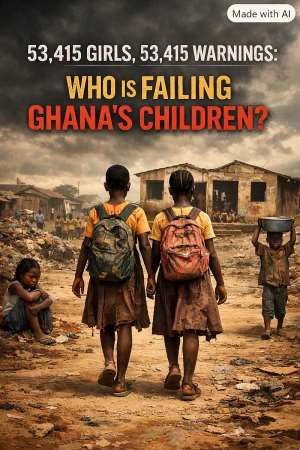
When a 10-year-old becomes a mother, the question cannot simply be: “What did the girl do?” We must ask who was supposed to protect her, who had access to her, who exploited her vulnerability and why the adults around her did not see it coming.
Ghana has a problem that can no longer be hidden behind statistics.
Between January and July 2026, 53,415 adolescent pregnancies were recorded at health facilities across the country, according to data from the Ghana Health Service. Of these, 1,501 involved girls aged between 10 and 14 years. The figures were disclosed at a National Multisectoral Dialogue on reducing teenage pregnancy in Accra on September 14, 2026.
That means thousands of girls many of whom should be thinking about examinations, friendships, university dreams, careers and the future are instead confronting pregnancy, childbirth and the responsibilities of motherhood.
And there is a number hidden inside the number that should disturb every Ghanaian adult:
1,501 girls were between 10 and 14.
A 10-year-old is not simply a "teenage mother."
She is a child.
So perhaps the national conversation needs to change.
Instead of asking only “Why are girls getting pregnant?”, perhaps Ghana must ask:
Who is getting these girls pregnant?
Where are these men finding them?
How are these relationships beginning?
What are adults offering these girls that they are not receiving at home?
Who is monitoring the adults who have access to vulnerable children?
And perhaps the hardest question:
When a child becomes pregnant, why does society immediately interrogate the child before interrogating the adult who had sexual access to her?
THE GIRLS BEHIND THE NUMBERS
The 53,415 figure represents pregnancies recorded at health facilities during the first seven months of 2026. It should not be interpreted as a list of 53,415 identical stories.
Some pregnancies may arise from relationships between adolescents.
Others may involve older partners.
Some may involve poverty, transactional relationships, inadequate access to contraception, misinformation or social pressures.
And some children may be victims of sexual abuse or exploitation.
That distinction matters enormously.
We cannot responsibly identify particular men or accuse particular communities without case-level evidence. The national statistics do not provide a list of the fathers, their ages, or the circumstances surrounding every pregnancy.
But Ghana can and should demand better information about those circumstances.
Because if thousands of girls are becoming pregnant, knowing only the age of the mother is not enough.
We need to know the age of the father.
We need to know whether he was a schoolmate, boyfriend, adult worker, relative, neighbour, teacher, religious leader or someone else.
We need to know whether money, gifts, accommodation, food, transportation, school expenses or employment promises were involved.
We need to know how many cases involved sexual violence.
And we need to know how many were reported to the police.
Without those answers, Ghana is counting pregnancies without fully understanding the machinery producing them.
WHY IS THIS HAPPENING?
There is no single cause.
Research and national programmes point to an intersection of poverty, gender inequality, limited access to sexual and reproductive-health information and services, child marriage, social norms, educational disadvantage and vulnerability to sexual and gender-based violence. UNICEF has repeatedly identified early pregnancy, violence, inadequate opportunities and unequal access to information and services as major challenges confronting adolescent girls in Ghana.
A 2026 study using Ghanaian data found teenage pregnancy among girls aged 15–19 to be 15.2%, with education, age, region and exposure to family-planning information among factors associated with pregnancy. The study also found substantially lower odds among girls with secondary or higher education.
That raises another uncomfortable question:
Are we protecting girls enough or are we simply waiting until they become pregnant before we start caring about them?
POVERTY CAN TURN AFFECTION INTO SURVIVAL
For some girls, the relationship with an older man may not initially look like exploitation.
It may begin with a phone.
A small amount of money.
Food.
Transport fare.
Clothes.
School fees.
Hairdressing.
A promise of a job.
A promise of marriage.
Or simply the attention of an adult who makes a neglected child feel important.
Research published in 2026 on child marriage in Ghana found that women's experiences of entering relationships before marriage were connected to intersecting structural pressures including poverty, limited reproductive-health services, unintended pregnancy, gendered power relations and lack of livelihood opportunities. The researchers also identified relationships involving material support that resembled survival or transactional sex.
This should force parents and communities to ask:
What happens when a girl does not have enough at home but discovers that somebody outside the home is willing to provide it?
And another:
Who is teaching her to distinguish genuine care from manipulation?
THE PHONE MAY NOT BE THE PROBLEM BUT THE ADULT BEHIND IT CAN BE
Today's adolescent does not grow up in the same environment as previous generations.
A child can meet somebody online without the knowledge of her parents.
A stranger can establish an emotional relationship with a girl through social media.
A man can gradually gain her trust before requesting a meeting.
And a vulnerable child may not understand that attention, gifts and romantic promises can be tools of manipulation.
CHRAJ has itself called for stronger implementation of laws and policies to make Ghana's digital environment safer for children, citing concerns about online child sexual exploitation and abuse.
So another question deserves national attention:
How many Ghanaian parents know who their daughters are communicating with online?
Not how many Facebook friends they have.
Not how many TikTok followers they have.
But who is privately messaging them?
WHAT ABOUT THE MEN?
This is one part of the conversation Ghana sometimes avoids.
When a 14-year-old becomes pregnant, people often ask:
“Why did she allow it?”
But where is the equally powerful question?
“Who had sex with a 14-year-old child?”
Ghanaian law provides important protections. Under Ghana's legal framework, sexual intercourse with a child under 16 constitutes defilement, regardless of whether the child supposedly agreed. The law provides severe penalties for offenders.
The minimum legal age of marriage is 18.
The law therefore does not recognise a 13-, 14- or 15-year-old as someone who can simply be treated as an adult because she says she has a boyfriend.
This is precisely why pregnancy among very young girls should trigger more than family embarrassment.
It should trigger child-protection questions.
BUT HOW DO THESE MEN LURE THE GIRLS?
There is no single method.
It can involve grooming.
Emotional manipulation.
Gifts.
Money.
Promises of marriage.
Promises of employment.
Transportation.
Accommodation.
Food.
Mobile phones.
Alcohol or drugs in some circumstances.
Threats.
Blackmail.
Or simply exploiting a child who desperately wants affection and attention.
But we must be careful not to turn these possibilities into accusations against unidentified individuals.
The proper question for law enforcement and child-protection authorities is:
How many of the 53,415 cases have been investigated to determine whether coercion, exploitation, grooming, abuse or unlawful sexual activity was involved?
Ghana needs that answer.
DO THESE GIRLS ACTUALLY WANT TO BECOME MOTHERS?
Some adolescent girls may genuinely say they wanted a relationship or even wanted a baby.
But that statement should not automatically end the inquiry.
A child's apparent willingness does not erase the responsibility of adults to protect children from exploitation.
UNICEF notes that adolescence from 10 to 19 is a period of developing capacities and aspirations but also significant vulnerability. Girls can face heightened risks of sexual and gender-based violence, exploitation, early pregnancy and child marriage.
The better question is therefore not simply:
“Did she agree?”
It is:
“Was she old enough to legally consent?”
“Was she pressured?”
“Was she manipulated?”
“Was there a significant power imbalance?”
“Was money or material support exchanged?”
“Was there violence or coercion?”
“Was the relationship with another adolescent or an adult?”
Those questions can reveal a very different story behind the word “pregnancy.”
CAN PARENTS BE BLAMED?
Sometimes parents fail.
But blaming parents collectively would be as simplistic as blaming girls collectively.
Some parents work long hours.
Some struggle financially.
Some are single parents.
Some do not know how to discuss sexuality with their children.
Some believe talking about sex encourages sexual activity.
Some assume their children are safe because they are at school.
Some discover what has happened only after the pregnancy.
And some children deliberately hide relationships from their parents.
Yet parental responsibility cannot be ignored.
Where are the conversations about sex, consent, relationships, online safety and exploitation?
Where are fathers?
Where are mothers?
Where are guardians?
Who knows where their daughters go after school?
Who knows who buys them gifts?
Who knows who pays their phone bills?
Who knows who they call late at night?
Who knows where they spend weekends?
Parents cannot monitor every second of a child's life.
But silence is not supervision.
AND WHAT ABOUT TEACHERS?
Teachers cannot be blamed for pregnancies they did not cause.
But schools have an important protective role.
Teachers may notice changes in attendance, behaviour, academic performance, relationships or emotional wellbeing before parents do.
Schools therefore need effective safeguarding mechanisms through which children can safely disclose abuse or exploitation.
Ghana's Education Service has a re-entry framework designed to enable pregnant schoolgirls to return to education after childbirth. Evidence from northern Ghana shows that such support can work, but research has also identified barriers including inadequate awareness, limited school-based support, childcare difficulties and financial hardship.
The lesson is important:
Preventing pregnancy is essential but abandoning a girl after pregnancy is not prevention.
WHAT ARE CHIEFS AND COMMUNITY LEADERS DOING?
Traditional authorities, religious leaders, assembly members, youth leaders and community organisations possess enormous influence.
They can identify harmful practices.
They can challenge child marriage.
They can encourage parents to keep girls in school.
They can help establish community child-protection structures.
They can support reporting rather than informal settlements.
And they can make it socially unacceptable for adults to exploit children.
Ghana's national operational plan for ending child marriage assigns roles across government, police/DOVVSU, CHRAJ, education, health, social welfare, traditional leaders, NGOs and other stakeholders. It specifically includes strengthening law-enforcement capacity to investigate and prosecute child marriage and sexual and gender-based violence cases.
But the question is:
How much of this exists on paper and how much exists in the village, town, school and household where the child actually lives?
WHAT IS THE MINISTRY OF GENDER DOING?
The Ministry of Gender, Children and Social Protection is not starting from zero.
Government has a national policy architecture addressing gender equality, child protection, social protection and harmful practices.
In March 2026, the Ministry launched Ghana's Revised National Gender Policy 2025–2034, intended to provide direction for gender equality and inclusive development.
The Ministry also publishes the National Operational, Monitoring and Evaluation Plan on Child Marriage 2025–2026, involving agencies including DOVVSU, CHRAJ, the Ghana Health Service, Ghana Education Service, traditional leaders and civil-society organisations.
These frameworks matter.
But policies do not protect children by themselves.
People implement policies.
Money implements programmes.
Social workers reach families.
Police investigate allegations.
Schools protect pupils.
Parents supervise children.
Chiefs challenge harmful practices.
And communities report abuse.
The real test is therefore implementation.
WHAT ABOUT CHRAJ AND HUMAN RIGHTS PROTECTION?
CHRAJ has a constitutional and human-rights role in protecting rights and promoting accountability.
It has worked with communities and partners on sexual and gender-based violence and survivor-centred services. In a 2025 engagement in Ada, CHRAJ highlighted barriers survivors face in reporting cases and accessing support and stressed the responsibility to ensure protection, care and justice without discrimination.
CHRAJ has also been involved in national child-protection processes and consultations concerning legislation and policies affecting children.
But again:
How many vulnerable children know where to report?
How many families know what to do?
How many communities have functioning child-protection structures?
How quickly does a report move from a community complaint to investigation and protection?
Those are the questions that determine whether a legal right exists only in a document or in a child's real life.
THE MOST DANGEROUS RESPONSE: “SHE HAS GROWN UP”
Perhaps one of Ghana's most dangerous social attitudes is treating a girl as an adult simply because she has reached puberty.
A child can look physically mature and still be emotionally, economically and socially vulnerable.
Pregnancy does not magically transform a child into an adult.
Motherhood does not erase childhood.
And having a boyfriend does not eliminate the responsibility of adults to protect children.
UNICEF identifies child marriage, early pregnancy, sexual violence and exploitation as interconnected threats to adolescent girls' rights and development.
THE GIRL SHOULD NOT BECOME THE FAMILY'S SHAME
Research on adolescent pregnancy in Ghana has found that parents may react with disappointment and anger, while some may normalise pregnancy. Lack of sexual and reproductive-health education and child marriage have also emerged as important factors.
Imagine being a frightened teenage girl.
You discover that you are pregnant.
Instead of hearing:
“Are you safe?”
You hear:
“What have you done to us?”
Instead of:
“Who did this to you?”
You hear:
“You have disgraced the family.”
Instead of:
“How do we protect your future?”
You hear:
“What will the community say?”
That is how another tragedy begins.
The pregnancy may be the first crisis.
The shame can become the second.
BUT SHOULD GIRLS HAVE NO RESPONSIBILITY?
Girls should absolutely be educated about consequences, relationships, contraception, consent and personal safety.
They should be encouraged to make informed decisions.
But responsibility must be proportionate to age, knowledge, circumstances and power.
A 19-year-old's situation cannot automatically be treated the same way as that of a 10-year-old.
And a 14-year-old cannot reasonably carry the same responsibility as the adult who exploited her.
If Ghana makes the girl carry 100 percent of the blame while the adult man disappears into the community, we have not solved the problem we have simply found someone easier to blame.
THE QUESTION GHANA MUST ASK ABOUT THE 1,501
Of the 1,501 pregnancies involving girls aged 10–14, how many were referred to child-protection authorities?
How many were investigated?
How many resulted in prosecutions?
How many fathers were identified?
How old were those fathers?
How many girls reported coercion?
How many involved family members or trusted adults?
How many involved school-related environments?
How many girls returned to school?
How many received psychological support?
How many were forced into marriage?
How many are now raising babies while still children themselves?
And perhaps the question that should make every authority uncomfortable:
If we know that 1,501 children aged 10–14 became pregnant in only seven months, do we know who made them pregnant?
53,415 IS NOT JUST A NUMBER
At roughly 53,415 pregnancies in seven months, the country is recording thousands of cases every month.
GHS has indicated that the 2026 figures are approaching the annual national burden of more than 100,000 adolescent pregnancies reported in national estimates.
But behind every statistic is a person.
A girl who had a name before she became a statistic.
A girl who may have wanted to become a nurse.
A teacher.
An engineer.
A lawyer.
A businesswoman.
A journalist.
A farmer.
A doctor.
A politician.
Or simply a happy adult woman living a life she chose.
Now some of them will enter motherhood before they have finished becoming adults themselves.
SO WHO IS RESPONSIBLE?
There is no honest single answer.
Parents have responsibilities.
Schools have responsibilities.
Government has responsibilities.
Traditional and religious leaders have responsibilities.
Health services have responsibilities.
Police and justice institutions have responsibilities.
Communities have responsibilities.
Men and boys have responsibilities.
And adolescent girls need accurate information, support and opportunities to make safe decisions.
But responsibility must not become an excuse to blame victims.
The central question should be:
How do we build a society in which a 10-year-old child is protected before she becomes pregnant, rather than supported only after she becomes pregnant?
GHANA CANNOT EDUCATE ITS WAY OUT OF THIS WITHOUT PROTECTING ITS GIRLS
Sexual-health education matters.
Keeping girls in school matters.
Accessible adolescent-friendly health services matter.
Economic empowerment matters.
Parenting education matters.
Online safety matters.
Child-protection committees matter.
Law enforcement matters.
Accountability matters.
And perhaps most importantly, men must become part of the prevention conversation.
For years, teenage pregnancy has often been framed primarily as a girl's problem.
But pregnancy requires two people.
So if Ghana wants to reduce teenage pregnancy, it cannot spend all its energy teaching girls how to avoid boys while spending comparatively less energy teaching boys and men about consent, responsibility, exploitation and the consequences of sexual relationships with children.
THE QUESTIONS GHANA SHOULD NO LONGER RUN FROM
Where are the men responsible for these pregnancies?
Why are some adults able to pursue children without fear of consequences?
Are some families too economically desperate to recognise exploitation when it arrives disguised as generosity?
Why do some girls feel safer telling strangers online than telling their own parents?
Are parents monitoring their children or merely feeding and schooling them?
Do chiefs know which adults are pursuing girls in their communities?
Do religious leaders discuss sexual exploitation as aggressively as they discuss morality?
Do schools have safe systems for children to report abuse?
Are child-protection officers adequately resourced?
Are laws being enforced consistently?
How many perpetrators are prosecuted?
How many girls disappear from school after pregnancy?
How many return?
How many receive counselling?
How many are pushed into early marriage?
And the question Ghana must confront most painfully:
If a 10-year-old can become pregnant under the watch of parents, teachers, chiefs, social workers, health officials and government institutions, who exactly was watching over her?
THE FUTURE OF GHANA IS SITTING IN THESE GIRLS
Ghana does not need another conference where officials read speeches, take photographs and return to their offices.
The country needs measurable accountability.
Every district should know its adolescent-pregnancy numbers.
Every community with persistently high cases should have a prevention plan.
Every girl should know where to report abuse.
Every parent should have access to practical guidance.
Every school should have safeguarding mechanisms.
Every child who becomes pregnant should receive support to continue her education.
Every allegation of sexual abuse involving a child should receive appropriate investigation.
And every institution entrusted with protecting children should be able to answer a simple question:
What did you do?
Because 53,415 pregnancies in seven months is not merely a health statistic.
It is an education crisis.
A child-protection crisis.
A poverty and inequality crisis.
A family crisis.
A gender crisis.
A justice issue.
And above all, a warning.
The question is no longer whether Ghana knows there is a problem.
We know.
The question is whether, before another generation of girls loses part of its childhood, Ghana will finally decide that protecting the girl child is not somebody else's responsibility.
It belongs to all of us.
And the clock is already running.
Data note: The latest GHS figure available as of September 2026 is 53,415, rather than 53,414. The data cover pregnancies recorded at health facilities between January and July 2026; they should not automatically be interpreted as the total number of pregnancies occurring nationally, because pregnancies not reaching or recorded by health facilities may not appear in the routine system.
By:
Patrick Belebang Yagsori
+233240292413
[email protected]

 Senior nurse remanded over alleged link to ‘Ghana Jollof’ TikTok account
 ‘NDC rewriting 1992 Constitution’ – NPP rejects review approach
 $300m World Bank financing package secured to permanently end double-track by 20...
 'No piece of land is worth single human life' – Afenyo-Markin calls for peace af...
 Police declare ‘Ghana Jollof’ wanted for allegedly inciting violence
 How community watchdog group helped Police 'cobra team' arrest seven suspects fo...
 Ghana Jollof probe: “She is safe, unharmed” — Police assure GRNMA over detained ...
 36 suspects arrested over lynching of police officer at Gindabour
 Ghana Card to become e-wallet for electronic transactions soon – NIA Boss
 Constitutional amendment: Five-year presidential, parliamentary terms will weake...


