




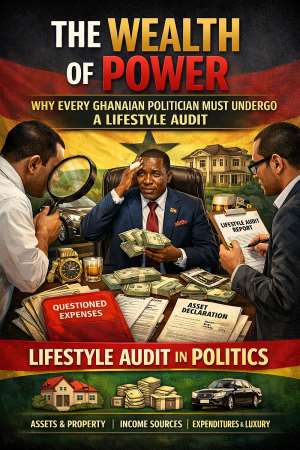
"If politics is public service, why are so many politicians becoming wealthy while the people become poorer?"
There is a question many Ghanaians whisper in their homes, debate in taxis, and argue about on social media but are often afraid to ask publicly:
How does a politician who struggled financially before entering public office become a millionaire within four or eight years of serving the people?
Another uncomfortable question is this:
Why do some politicians leave office richer than the institutions they promised to develop?
Ghana's fight against corruption has largely focused on investigations after money has gone missing. Yet, perhaps we have been asking the wrong questions all along. Instead of asking where the money went after it disappears, shouldn't we ask where the wealth came from before it becomes impossible to trace?
This is where lifestyle audits become not only necessary but indispensable.
What Is a Lifestyle Audit?
A lifestyle audit is an independent assessment that compares a politician's legitimate income and declared assets with the lifestyle they live. It examines:
Income and salary.
Properties and landed assets.
Vehicles and luxury items.
Investments and business interests.
Domestic and international travel expenditure.
Bank accounts and financial transactions.
Family-owned properties and businesses.
Gifts and donations received while in office.
Simply put, it asks one fundamental question:
Can this person's wealth be reasonably explained by their legitimate income?
If the answer is no, then citizens deserve answers.
Why Should Politicians Undergo Lifestyle Audits?
Politics should never be the shortest route to becoming wealthy.
Public office was designed to serve citizens, not to enrich individuals. Unfortunately, many Africans have witnessed politicians whose financial circumstances dramatically improve immediately after assuming office.
Lifestyle audits can help answer critical questions such as:
How did a politician acquire ten houses on a government salary?
Who financed their luxurious vehicles?
Why does a public servant suddenly own businesses worth millions?
Why are politicians' children studying abroad in expensive institutions that far exceed their declared earnings?
How does someone who entered politics with virtually nothing become one of the wealthiest individuals in their constituency?
These are not questions of jealousy. They are questions of accountability.
The Questions Nobody Wants to Ask
Let us ask the difficult questions.
Why are politicians among the richest people in many developing countries?
Why is it easier to become wealthy through politics than through entrepreneurship in Ghana?
Why do politicians rarely become poorer after leaving office?
Why do some politicians build mansions while the roads leading to their own communities remain death traps?
Why do politicians campaign in modest vehicles but return after winning elections in luxury convoys?
Why are public projects frequently abandoned while private wealth among political elites continues to grow?
If public service is truly about sacrifice, where is the sacrifice?
Perhaps the most disturbing question of all is this:
Are some politicians contesting elections because they want to serve Ghana or because they have discovered politics is the most profitable business in the country?
Can Lifestyle Audits Help Ghana Develop?
The answer is yes if properly implemented.
Lifestyle audits can significantly improve:
1. Public Accountability
Politicians will think twice before misappropriating public funds if they know their assets are continuously monitored.
2. Better Use of Public Funds
Money meant for:
Roads
Schools
Hospitals
Youth employment
Water projects
Infrastructure development
would be more likely to reach their intended beneficiaries.
3. Increased Investor Confidence
Foreign and local investors are more willing to invest in countries where corruption is actively fought and public institutions are transparent.
4. Improved Public Trust
Many citizens no longer trust politicians because of unexplained wealth accumulation.
Lifestyle audits would demonstrate that public office holders are accountable to the people.
Will Lifestyle Audits Stop Corruption Completely?
No.
Corruption is highly adaptive.
However, lifestyle audits can significantly reduce:
Bribery
Procurement fraud
Embezzlement
Kickbacks
Abuse of office
Money laundering
Conflict of interest
Corruption survives in secrecy. Lifestyle audits expose secrecy.
It is difficult to steal public funds when investigators can legally ask:
"How did you acquire this wealth?"
Countries that have aggressively pursued asset declaration and lifestyle audits have strengthened public accountability and reduced opportunities for illicit enrichment among public officials.
Should Lifestyle Audits Be Public?
Absolutely.
Public office is funded by taxpayers.
If citizens pay politicians' salaries, they have every right to know:
What assets politicians declared before assuming office.
What they acquired while in office.
What they own after leaving office.
Transparency strengthens democracy.
Asset declarations should not remain hidden documents gathering dust in government offices.
Ghanaians deserve access to information that helps them determine whether their leaders are serving the nation or serving themselves.
How Can Lifestyle Audits Be Conducted?
Lifestyle audits can include:
Before Assuming Office
Politicians should declare:
Bank accounts.
Properties.
Vehicles.
Businesses.
Investments.
Liabilities and debts.
During Office
Independent institutions should monitor:
Major acquisitions.
Procurement relationships.
Financial disclosures.
Tax compliance.
Business interests.
After Leaving Office
There should be:
Exit asset declarations.
Financial investigations where necessary.
Independent verification of wealth accumulation.
Regular audits every two years could make corruption far more difficult to conceal.
Can Technology Help?
Yes.
Ghana can establish a digital asset declaration and public accountability portal that allows citizens to view:
Declared assets.
Changes in wealth over time.
Public contracts awarded.
Political office holders' financial disclosures.
Imagine being able to compare:
A politician's declared salary versus his or her accumulated wealth after four years in office.
Technology can become one of the greatest weapons against corruption.
What Are Ghanaians Saying?
Many ordinary Ghanaians are frustrated.
Across radio discussions, social commentary, and public debates, citizens frequently question:
Why politicians seem immune from economic hardship.
Why public services remain inadequate despite significant government spending.
Why corruption scandals continue to emerge.
Why political office appears financially rewarding.
The growing public demand is simple:
"If you want to serve the people, prove that you are serving not stealing."
Citizens are increasingly calling for stronger anti-corruption measures, greater transparency, and meaningful consequences for illicit enrichment.
What Are Politicians Saying?
Some politicians support stronger accountability mechanisms and advocate stricter anti-corruption measures.
Others argue that:
Lifestyle audits can become politically motivated.
They may violate privacy rights.
Asset declarations are already required under existing laws.
Anti-corruption institutions should simply be strengthened.
These concerns deserve consideration. Lifestyle audits must be conducted professionally, independently, and without political witch-hunting.
The objective should never be political persecution.
The objective is public accountability.
What Is Government Doing?
Successive governments have introduced:
Asset declaration requirements.
Anti-corruption agencies.
Procurement regulations.
Financial auditing mechanisms.
Public financial management reforms.
However, public confidence remains low because implementation has often been inconsistent.
Many corruption allegations take years to investigate or remain unresolved.
Without effective enforcement, even the best anti-corruption laws become mere paperwork.
Imagine a New Ghana
Imagine if every minister, Member of Parliament, municipal chief executive, chief executive officer of a public institution, and presidential appointee underwent mandatory lifestyle audits.
Imagine if every Ghanaian could know:
What they owned before office.
What they acquired during office.
What they owned after leaving office.
Imagine if corruption became more difficult than honesty.
Imagine if politicians entered office knowing that unexplained wealth would automatically trigger investigations.
Would fewer people contest elections for money?
Would public projects finally be completed?
Would hospitals receive proper funding?
Would our schools improve?
Would our youth have jobs?
Would Ghana finally begin to develop at the pace we all desire?
Final Thoughts
Ghana does not lack resources. Ghana does not lack brilliant minds. Ghana does not lack opportunities.
What Ghana often lacks is accountability.
The greatest tragedy of corruption is not the money stolen. It is the dreams stolen from millions of citizens who continue to struggle because public resources are diverted into private pockets.
Lifestyle audits are not about embarrassing politicians. They are about protecting democracy, preserving public trust, and ensuring that leadership remains a sacred responsibility rather than a lucrative business.
If a politician's wealth is honestly earned, then a lifestyle audit becomes a badge of honour.
But if public office has become a pathway to unexplained riches, then every Ghanaian deserves to know.
The question is no longer whether Ghana needs lifestyle audits for politicians.
The real question is:
If politicians have nothing to hide, why should they fear transparency?
By:
Patrick Belebang Yagsori
+233240292413
[email protected]
 ‘Father-for-all please pardon Chairman Wontumi to increase your glory' - Former ...
 [Full Text] Minority Caucus in Parliament react to High Court conviction of Wont...
 Tiktoker ‘bawumia ba’ re-arrested over alleged offensive conduct
 Minority criticises court for piercing Akonta Mining's corporate veil and holdin...
 Wontumi's conviction was based on assumptions with no evidence — NPP alleges
 Galamsey prosecutions should not end with Wontumi's sentence — Prof Agyemang-Dua...
 Attorney General was very efficient in Wontumi's Samreboi case — Martin Kpebu
 Ghana has lost a statesman among traditional rulers — Mahama mourns Yaa Naa
 Mahama Rallies ECOWAS: “Differences Must Not Divide West Africa”
 “I’ll Put My Life on the Line!” — Appiah‑Kubi Questions Basis of Wontumi’s Galam...

