




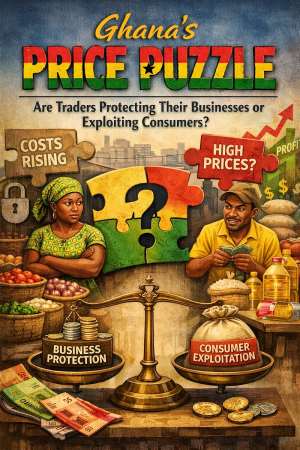
Walk into any market in Ghana today and ask a simple question: Why do prices go up overnight when the dollar rises by a few pesewas, but refuse to come down when the cedi appreciates?
The answer you will often hear is familiar. Fuel prices have gone up. The dollar has gone up. Transport fares have increased. Import duties are high. The economy is unstable.
But when fuel prices fall, when inflation slows, or when the cedi gains significant value against major currencies, consumers are told something entirely different: "Give it time."
This raises an uncomfortable but necessary question: Are Ghanaian traders genuinely responding to economic realities, or have many become experts at finding reasons to increase prices while avoiding reasons to reduce them?
The Speed of Price Increases Is Suspicious
One of the most frustrating experiences for Ghanaian consumers is how quickly prices rise whenever negative economic news emerges.
A rumour of a weakening cedi can trigger price increases before many traders have even replenished their stock. Fuel prices increase today and transport fares are adjusted almost immediately. Import costs rise and prices are revised overnight.
Yet, when the same factors improve, consumers are asked to wait weeks or even months.
Why is bad news implemented immediately while good news must mature before consumers benefit?
If traders can react within hours when costs increase, then economic fairness demands similar urgency when costs decline.
What Traders Are Saying
Trader associations and importers have defended themselves by arguing that pricing is more complicated than simply looking at today's exchange rate.
According to them:
- Existing stock was purchased when the dollar was higher.
- Transport and utility costs remain expensive.
- Businesses are servicing loans with high interest rates.
- Currency appreciation must be stable before prices can be adjusted.
- Reducing prices too quickly could result in losses if economic conditions reverse.
These arguments are not entirely unreasonable. Businesses are expected to make profits and protect themselves from market volatility.
However, many consumers argue that traders conveniently remember these explanations only when reductions are demanded. When prices are increasing, such caution mysteriously disappears.
Are The Complaints Real?
Some are.
Ghana imports a significant proportion of its consumer goods. Exchange rate movements genuinely affect import costs. Fuel prices influence transportation expenses, and inflation affects operational costs.
No serious economic discussion should ignore these realities.
But economic realities do not explain everything.
If the dollar rises from GH¢10 to GH¢12, many traders immediately increase prices based on future replacement costs. Yet when the dollar falls from GH¢12 to GH¢9 or GH¢10, those same future replacement cost arguments suddenly become irrelevant.
The inconsistency is difficult to justify.
The issue is not whether traders should increase prices when costs increase. The real issue is whether they are equally committed to reducing prices when costs decline.
What Economists Are Saying
Economists have described Ghana's pricing behaviour as a classic case of "price stickiness."
Price stickiness refers to situations where prices move upwards quickly but resist moving downward despite favourable economic changes.
This phenomenon exists globally, but Ghana's informal market structure makes it particularly problematic.
Unlike highly regulated economies where competition and consumer protection laws pressure businesses to reduce prices, Ghana's markets are largely informal and decentralised. There is often no mechanism compelling businesses to pass economic gains on to consumers.
In simple terms, once prices go up, they become comfortable.
What Are Ghanaians Saying?
Public frustration has become increasingly visible.
Many consumers complain that traders use the dollar as a convenient excuse for virtually everything. Others argue that fuel prices are blamed even for products that have little relationship with transportation costs.
There is also growing criticism that traders selectively apply economic principles.
Consumers are asking:
- Why are prices adjusted before new stock arrives?
- Why are reductions delayed indefinitely?
- Why is every increase justified but every reduction debated?
- Why do consumers carry all the economic risks while businesses retain all the benefits?
These are legitimate questions that deserve honest answers.
Is It Greed?
Some consumer advocates have gone further by describing the situation as profiteering or greed-driven pricing.
That accusation may be uncomfortable, but it cannot simply be dismissed.
If businesses continuously maximise profits during economic downturns but refuse to share economic gains during periods of recovery, then consumers will inevitably perceive such behaviour as exploitative.
Profit is not the problem. Unfair pricing behaviour is.
Businesses exist to make money. However, businesses also operate within societies that expect fairness, transparency and responsibility.
The Bigger Problem: Weak Consumer Protection
Perhaps the biggest issue is not the traders themselves but the system.
Ghana lacks strong consumer protection mechanisms and effective price transparency across many sectors.
Consumers often have little information regarding:
- Actual import costs.
- Reasonable profit margins.
- Supply chain costs.
- Market competition.
This information gap allows narratives to flourish without accountability.
When traders claim that prices cannot be reduced, consumers have limited means of verifying those claims.
So, Are Ghanaian Traders Honest?
The honest answer is that some are and some are not.
Many traders are legitimately affected by economic conditions and operate under difficult business environments.
However, there is growing evidence that a significant number of businesses take advantage of economic uncertainty to maintain higher prices even when market conditions improve.
The behaviour is neither universal honesty nor universal dishonesty. It is a mixture of legitimate business concerns, market inefficiencies, weak regulation and, in some cases, opportunistic pricing.
Final Thoughts
Ghana cannot build a resilient economy if consumers suffer during bad times and are excluded during good times.
Economic improvements should benefit everyone not only governments and businesses.
If traders expect consumers to understand why prices must increase during difficult periods, then traders must also demonstrate the same honesty and urgency when circumstances improve.
The Ghanaian consumer deserves more than excuses. They deserve consistency.
Perhaps the most important question is not whether prices should go up or down.
The real question is this:
If economic pain is shared collectively, why is economic relief so selective?The article can also be adapted into a LinkedIn or newspaper-style opinion piece if needed.
By:
Patrick Belebang Yagsori
+233240292413
[email protected]

 'I would have loved to have experienced Asiedu Nketiah remain NDC National Chair...
 NDC not a principled political party over Supreme Court nominations — Afenyo-Mar...
 Miracles Aboagye’s arrest: EOCO is ‘unprofessional, are liars’ - Nana B
 Black Stars can win AFCON, World Cup if team and coach is maintained – Mahama
 GNAT, NAGRAT and PRETAG threaten strike over unresolved conditions of service
 GHS55m probe: Miracles is not a threat; NPP using national communicator ambition...
 Two Ghanaians petition ICC to probe Xenophobic attacks, killings in South Africa
 Mahama nominates Tony Forson, two Appeal Court Justices to Supreme Court
 Creating new tribunal system to compete with existing courts will create chaos i...
 Tribunal system another new bureaucracy; digilize existing courts — Afenyo-Marki...

